Dear reader,
Edit: My children loved the class and printable worksheet and requested more classes like this. Follow for the next classes coming up in the same fun but in-depth manner.
I have been pitching the idea everywhere that poetry is an excellent tool for language learning as reading materials. And now I will prove by creating the most creative Spanish lesson ever.
The full lesson, including a printable worksheet and test for children is available if you need additional help with this material:
Here’s why poetry is amazing for language learning:
Culture
Deep learning through complexity of poetry
Fun content that is memorable
Rhyming and rhythm helps with memorization
Spanish: 1st level. Lesson 1
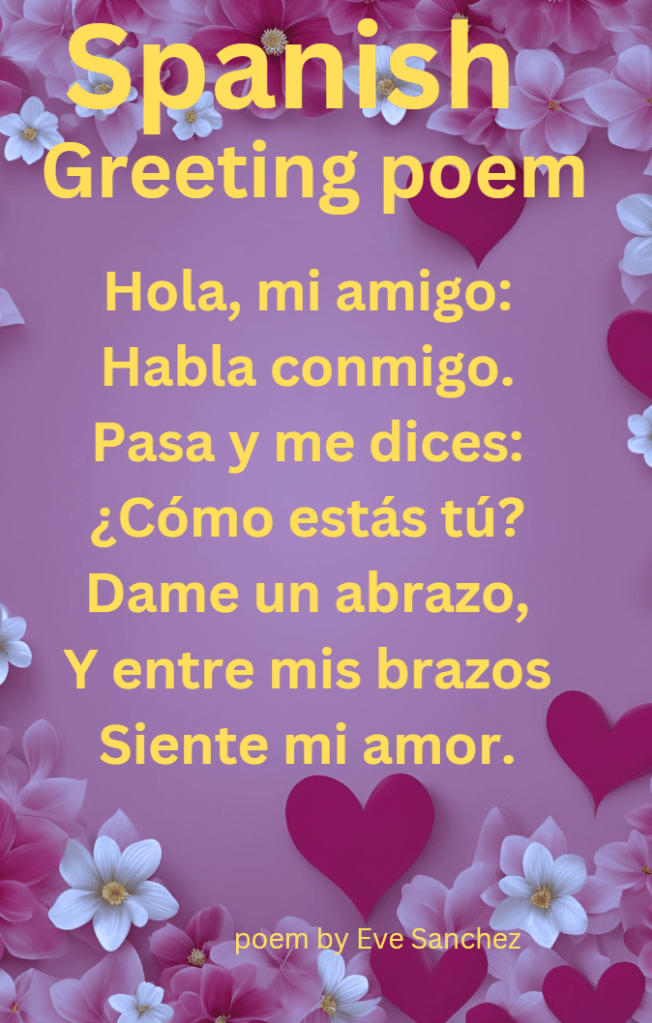
This poem is appropriate for a level 1 learning. It uses simple language and common phrases, making it accessible for beginners. This is a little more intense than the usual level 1 dialog, but it is also much more memorable, and I bet you can engage with this content more than with the usual language class dialog.
The main points for teaching are:
- Basic Vocabulary: The words and expressions are straightforward and familiar, suitable for early learners.
- Simple Sentence Structure: The poem’s structure is uncomplicated, which helps learners grasp basic sentence formation and concepts.
- Easy to memorize: I do not attempt to memorize vocabulary anymore. That is the “boring” learning style that many of us reject. I like to engage with the reading content. However, poetry is naturally easier to memorize than prose or conversations. You will find yourself remembering without trying, especially if you do it with fun in mind and without judging your learning speed.
Lesson Plan. Feel free to use this for personal use/ homeschooling
(For more learning, I’m collecting all this into an ebook, return, and you will see additional lesson posts totally free)
If you’re a teacher and wish to use this material, let me know.
Welcome to my unique language lesson, where we explore the beauty of poetry as a tool for learning. Poetry is more than just a form of artistic expression; it’s a gateway to deep emotional understanding and linguistic mastery. By delving into poetry, you’ll not only enhance your language skills but also gain insight into the cultural and emotional nuances of Spanish.
Why poetry? It offers a fun and engaging way to learn, transforming the study of vocabulary and grammar into a creative and immersive experience. Poetry often includes complex structures and rich imagery, which challenges learners to think critically and understand the language on a deeper level. Many native speakers might not fully grasp the subtleties of poetry, but by engaging with it, you’ll achieve a profound and sophisticated understanding of the language.
In this class, we’ll use carefully selected poems to guide our learning journey. You’ll explore themes, emotions, and linguistic intricacies that will elevate your understanding of the language. Let’s embark on this poetic adventure together and discover the power of language through the art of verse.
Poem translation
Hello my friend,
Talk to me,
Come in, and tell me,
How are you?
Give me a hug
And between my arms
Feel my love.
The entire package available through this link:
https://payhip.com/b/NLMdU: Spanish lesson 1. Rima y Ritmo: Poetry with a native poet (1)Vocabulary
Here’s a vocabulary list for the poem, including translations and brief explanations:
Vocabulary List:
1. Hola
– Translation: Hello
– Explanation: A common greeting used to say “hello” or “hi.”
2. mi
– Translation: my
– Explanation: A possessive adjective meaning “my.”
3. amigo
– Translation: friend (masculine)
– Explanation: A noun meaning “friend,” used for males or in a gender-neutral context.
4. Habla
– Translation: (You) speak/talk
– Explanation: The third person singular form of the verb “hablar” (to speak) in the present tense.
5. conmigo
– Translation: with me
– Explanation: A preposition combined with the pronoun “mí,” meaning “with me.”
6. Pasa
– Translation: (You) come in/enter
– Explanation: The third person singular form of the verb “pasar” (to pass/enter) in the present tense, used here as a command or suggestion.
7. y
– Translation: and
– Explanation: A conjunction meaning “and.”
8. me
– Translation: me
– Explanation: An object pronoun meaning “me.”
9. dices
– Translation: (You) say/tell
– Explanation: The second person singular form of the verb “decir” (to say/tell) in the present tense.
10. cómo
– Translation: how
– Explanation: An interrogative adverb meaning “how.”
11. estás
– Translation: (You) are
– Explanation: The second person singular form of the verb “estar” (to be) in the present tense. The person (tú) is omitted.
12. tú
– Translation: you
– Explanation: The second person singular pronoun meaning “you.”
13. Dame
– Translation: (You) give me
– Explanation: The imperative form of the verb “dar” (to give), used as a command or request.
14. un
– Translation: a/one
– Explanation: An indefinite article meaning “a” or “one.”
15. abrazo
– Translation: hug
– Explanation: A noun meaning “hug.”
16. entre
– Translation: between
– Explanation: A preposition meaning “between.”
17. mis
– Translation: my (plural)
– Explanation: The plural form of the possessive adjective “my.”
18. brazos
– Translation: arms
– Explanation: A noun meaning “arms.” Plural of brazo.
19. Siente
– Translation: (You) feel
– Explanation: The third person singular form of the verb “sentir” (to feel) in the present tense, used here as a command or suggestion.
20. amor
– Translation: love
– Explanation: A noun meaning “love.”
Phrase Exploration
“Hola mi amigo,”
- Translation: Hello my friend,
- Explanation: A common greeting. “Hola” means “hello” and “mi amigo” means “my friend.” This phrase establishes a friendly and informal tone.
“Habla conmigo,”
- Translation: Talk to me,
- Explanation: “Habla” is the command form (imperative) of “hablar” (to speak/talk), and “conmigo” means “with me.” It’s an invitation to engage in conversation.
“Pasa, y me dices,”
- Translation: Come in, and tell me,
- Explanation: “Pasa” is an imperative form of “pasar” (to pass/come in). “Me dices” is the present tense of “decir” (to say/tell) with “me” (to me), asking the listener to share information. Pasa is commonly used in Spanish to indicate entering a building (amongst other meanings)
“¿Cómo estás tú?”
- Translation: How are you?
- Explanation: “¿Cómo” means “how,” “estás” is the second person singular form of “estar” (to be), and “tú” is the subject pronoun “you.” This is a common way to inquire about someone’s well-being.
“Dame un abrazo”
- Translation: Give me a hug,
- Explanation: “Dame” is the imperative form of “dar” (to give), meaning “give me.” “Un abrazo” means “a hug.” This is a request for a hug.
“Y entre mis brazos”
- Translation: And between my arms,
- Explanation: “Y” means “and,” “entre” means “between” or “in,” “mis” means “my,” and “brazos” means “arms.” This phrase indicates where the hug takes place.
“Siente mi amor.”
- Translation: Feel my love.
- Explanation: “Siente” is the imperative form of “sentir” (to feel), and “mi amor” means “my love.” It’s an invitation to experience the speaker’s affection.
If you need additional help, purchase the complete ebook through this link:
https://payhip.com/b/NLMdU: Spanish lesson 1. Rima y Ritmo: Poetry with a native poet (1)Poetry Rhyming Memory Game
Here are two sentences to help students remember the connection between “brazos” and “abrazo”:
Brazo = arm (singular)
Brazos = arms (plural)
Abrazo = hug (singular)
Abrazos = hugs (plural)
1. “When you give someone an abrazo (hug), you wrap them up with your brazos (arms).”
2. “In an abrazo, your brazos come together to give a warm hug.
Link these two rhyming words in both action and meaning to drive into your subconscious the understanding that abrazo is related to brazo.
These sentences emphasize the action of hugging and the role of arms, reinforcing the connection between the words through their rhyming relationship.
Objective: Connect the rhyming words “brazos” and “abrazo” to enhance memorization and understanding.
Instructions:
1. Rhyming Pairs Exercise:
– Write the words “brazos” and “abrazo” on separate index cards.
– Have students create a visual or mnemonic connection between the two words. For example, they might draw a picture of two arms (brazos) giving a hug (abrazo).
2. Rhyming Match-Up:
– Create a set of cards with different rhyming pairs. Include “brazos” and “abrazo” among them.
– Shuffle the cards and ask students to match rhyming words. This reinforces the connection between the rhyming words through repetition.
3. Sentence Creation:
– Ask students to create sentences or short stories using “brazos” and “abrazo” to reinforce their meanings. For instance: “When I give you an abrazo, my brazos are wrapped around you.”
4. Memory Challenge:
– Divide the class into small groups. Have each group come up with a short, creative rhyme or jingle that includes both “brazos” and “abrazo.” Share the creations with the class.
5. Visual Mnemonic:
– Show a picture or video of a hug and explain that “abrazo” is the action (hug) and “brazos” are the arms performing the action. This visual link helps reinforce the words’ meanings and their rhyming relationship.
This game helps students connect the rhyming words through visual, verbal, and creative means, making it easier to remember and understand their meanings.
“Me dices” vs. “dime”
I used me dices in the poem for flow, but I could have used dime. These phrases are very similar and can be used interchangeably. See the grammar details below.
“Me dices” and “dime” are both forms of requesting or asking for information in Spanish, but they are used in different contexts:
1. “Me dices”:
– Meaning: “You tell me” or “You are telling me.”
– Usage: This phrase is the present tense form of the verb “decir” (to say/tell) used with the pronoun “me” (to me). It is often used in statements or questions where you are referring to the action of telling as an ongoing or habitual action.
– Example: “¿Qué me dices?” (What are you telling me?) This is the Spanish culture you gain while studying with poetry.
2. “Dime”:
– Meaning: “Tell me.”
– Usage: This is the imperative form of the verb “decir” (to say/tell), used to give a direct command or request. It’s a more immediate way of asking someone to provide information.
– Example: “Dime la verdad.” (Tell me the truth.)
In summary:
– “Me dices” is used to describe or refer to the act of telling in a more descriptive or habitual sense.
– “Dime” is used for direct commands or requests, asking someone to provide information immediately.
Language Practice Activities:
1. Understanding the Poem:
– Vocabulary Exploration: Identify and discuss new words or phrases.
– Emotional Impact: What emotions does the poem evoke? How does it make you feel?
2. Language Practice:
– Translation Exercise: Translate the poem line by line, focusing on capturing the nuances of the language.
– Discussion: How do different phrases in Spanish and English affect the meaning of the poem?
3. Creative Writing:
– Compose Your Own Poem: Using the themes from today’s poem, write a short poem in either Spanish or English. Use the rhyming words from the poem. Share with the class.
4. Discussion:
– Cultural Reflection: How does this poem reflect cultural expressions of friendship and love?
By engaging with poetry, we’re not just learning a language; we’re connecting with its cultural and emotional essence. Enjoy the journey, and let’s uncover the beauty of both languages together!
If you enjoyed this, please let me know.
I am creating this for a fellow poet who is learning Spanish, and I’m going to take full advantage of the situation and teach Spanish while testing my theory.
My intention also to teach my children, but I can’t make them. It has to be fun and on their time.
For much more, including printable worksheets and a test, purchase the entire lesson through this link:
https://payhip.com/b/NLMdU: Spanish lesson 1. Rima y Ritmo: Poetry with a native poet (1)With love,
Eve
Discover more from Creative Kids
Subscribe to get the latest posts sent to your email.


Rima Y Ritmo. Learn Spanish With Poetry Fun & Memorable Spanish Language Lesson 1 – Etsy
LikeLike