
Dear readers,
Below I share several images intended to be used as backgrounds for poetry. hare your creation with me on X @evelovestar






FUN AND LEARNING INTERSECT
Dear readers,
Below I share several images intended to be used as backgrounds for poetry. hare your creation with me on X @evelovestar
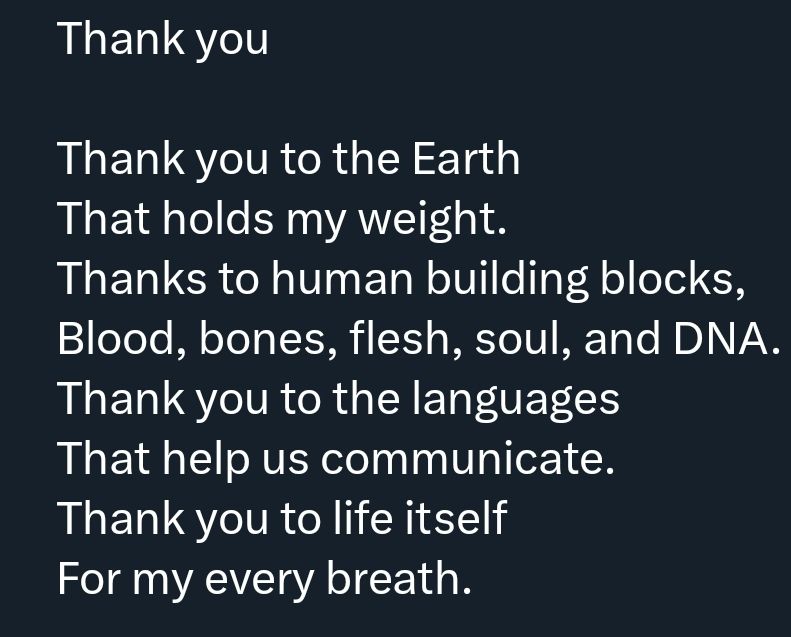
This Thanksgiving poem, along with other poems and a video, are coming very soon.
Christmas Challenge coming next consisting of one poem a day. I already wrote with my daughters more than 20, and we are also designing free e-cards to share.
Many of the Christmas poems are already scheduled.
I am using these poems for homeschooling purposes, and we will talk about Lilli and Lizzie’s poetry and songwriting efforts soon.
Until the next Thanksgiving post,
Eve
Did you know that rhyming aids memorization? I came up with this fun way to study multiplication with my daughters. It was so fun and effective that they asked for more.
Multiplication Memorization.
Two Times Table

2×0=0
𝒁𝒆𝒓𝒐 𝒂𝒍𝒘𝒂𝒚𝒔 𝒘𝒊𝒏𝒔, 𝒍𝒊𝒌𝒆 𝒂 𝒉𝒆𝒓𝒐.
2×1=2
𝑻𝒘𝒐 𝒂𝒍𝒘𝒂𝒚𝒔 𝒆𝒂𝒕𝒔 𝒂𝒍𝒍 𝒕𝒉𝒆 𝒇𝒐𝒐𝒅.
2×2=4
𝑭𝒐𝒖𝒓 𝒔𝒊𝒏𝒈𝒔 𝒍𝒐𝒕𝒔 𝒐𝒇 𝒈𝒐𝒐𝒅 𝒄𝒉𝒐𝒓𝒅𝒔.
2×3=6
𝑺𝒊𝒙 𝒂𝒍𝒘𝒂𝒚𝒔 𝒍𝒐𝒗𝒆𝒔 𝒂 𝒒𝒖𝒊𝒄𝒌 𝒇𝒊𝒙.
2×4=8
𝑬𝒊𝒈𝒉𝒕 𝒍𝒊𝒌𝒆𝒔 𝒕𝒐 𝒔𝒌𝒂𝒕𝒆.
2×5=10
𝑻𝒆𝒏 𝒍𝒐𝒗𝒆𝒔 𝒉𝒊𝒔 𝒇𝒂𝒗𝒐𝒓𝒊𝒕𝒆 𝒑𝒆𝒏.
2×6=12
𝑻𝒘𝒆𝒍𝒗𝒆 𝒍𝒊𝒌𝒆𝒔 𝒕𝒐 𝒄𝒐𝒔𝒑𝒍𝒂𝒚 𝒂𝒔 𝒂𝒏 𝒆𝒍𝒇.
2×7=14
𝑭𝒐𝒖𝒓𝒕𝒆𝒆𝒏 𝒃𝒖𝒊𝒍𝒕 𝒂 𝒕𝒊𝒎𝒆 𝒎𝒂𝒄𝒉𝒊𝒏𝒆.
2×8=16
𝑺𝒊𝒙𝒕𝒆𝒆𝒏 𝒊𝒔 𝒎𝒆𝒂𝒏 𝒄𝒖𝒛 𝒉𝒆'𝒔 𝒏𝒆𝒗𝒆𝒓 𝒃𝒆𝒆𝒏 𝒔𝒆𝒆𝒏.
2×9=18
𝑬𝒊𝒈𝒉𝒕𝒆𝒆𝒏 𝒕𝒉𝒊𝒏𝒌𝒔 𝒔𝒉𝒆'𝒔 𝒂 𝒒𝒖𝒆𝒆𝒏.
2×10=20
𝑻𝒘𝒆𝒏𝒕𝒚 𝒘𝒂𝒏𝒕𝒔 𝒇𝒐𝒐𝒅 𝒃𝒖𝒕 𝒔𝒉𝒆 𝒂𝒍𝒓𝒆𝒂𝒅𝒚 𝒉𝒂𝒔 𝒑𝒍𝒆𝒏𝒕𝒚.

Eve Sanchez
Lilli & Lizzie H.
Created in collaboration with Lilli and Lizzie.
They created most of the lines, practiced rhyming, and practiced multiplication in a stress free manner.
If you need help teaching multiplication, follow us for more stress free learning.
Eve
Dear reader,
This is a cool song I wrote many years ago.
I have a very old video singing it. I will not show you because it was too awful.
But, I created the lyrics for the song in a better way today.
I am looking for singers or musicians to sing this or any of my other songs. Just ask and I will allow you to.
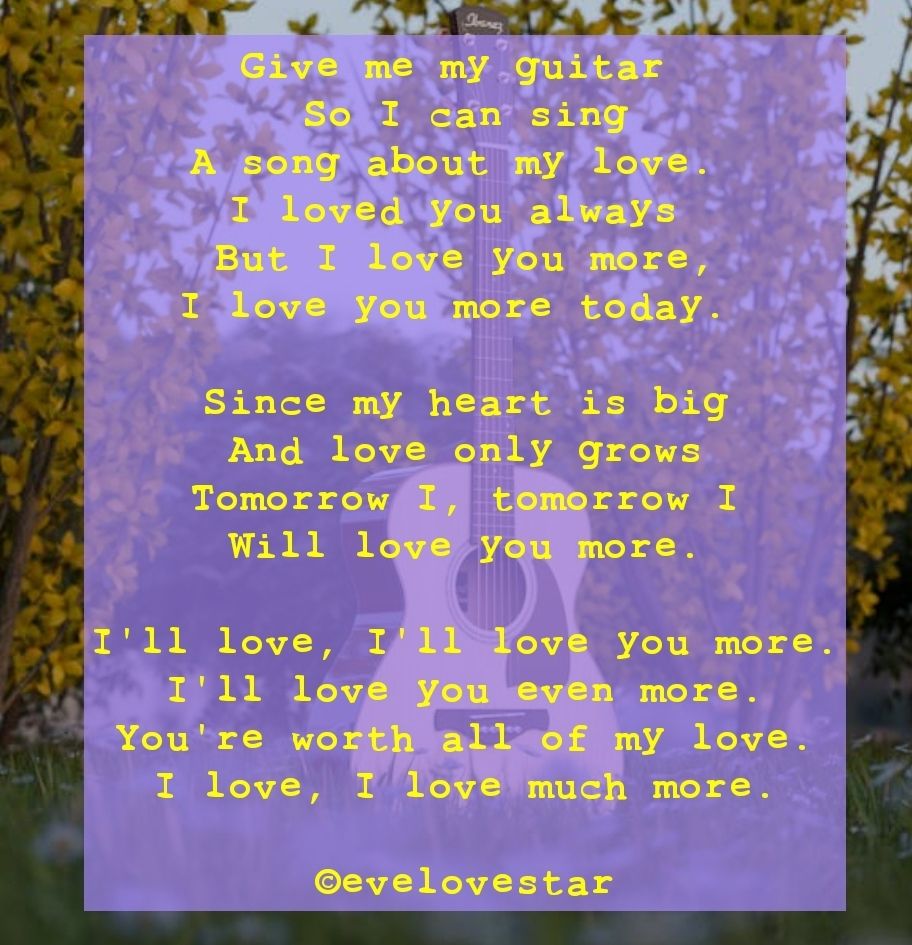
Lilli is creating a Pandacorn (my newest song) animation right now which is simply adorable.
With love,
Eve
Dear reader,
English is my second language. learned it as an adult. Since I love to learn properly, grammar has been my best friend.
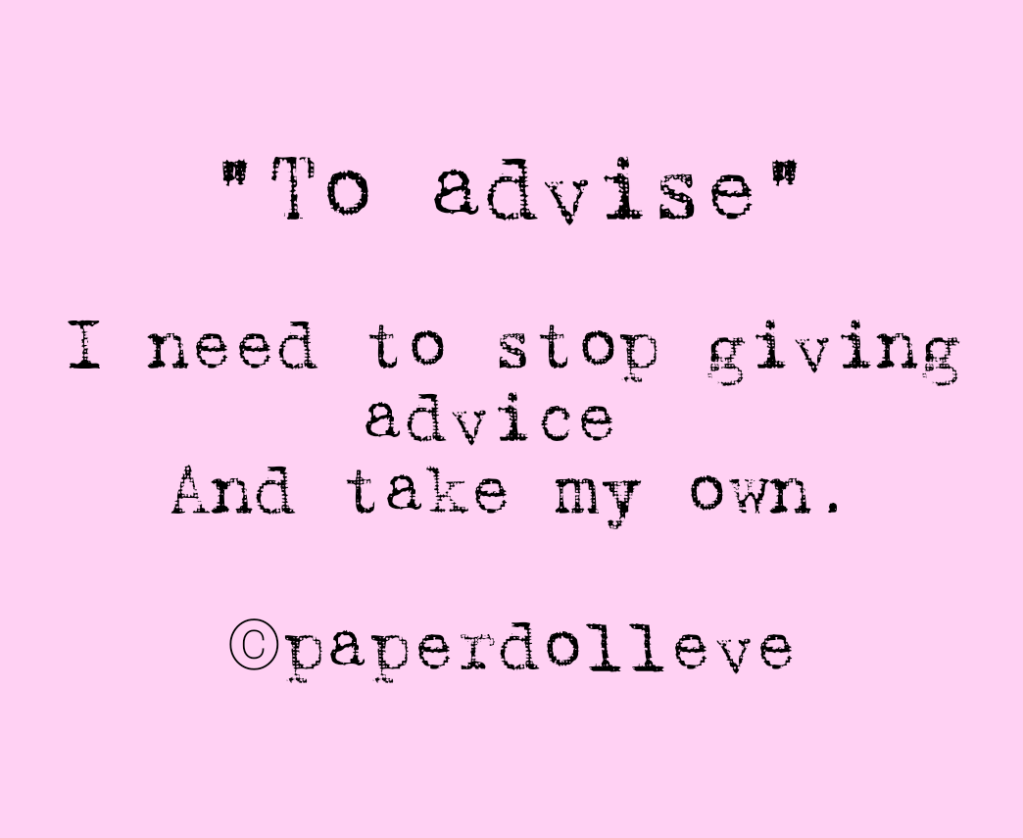
With this short poem, I was trying to make the distinction between advice and advise after I realized I had used the improper spelling of the word. Actually, I thought it was only one word long ago.
When you write, you learn. My advise if you are trying to make a distinction between the two words is to use them in writing. I know now, before, while I was confused and knew I could make a mistake, I would search the difference and find help from a blog post like this one or an article.
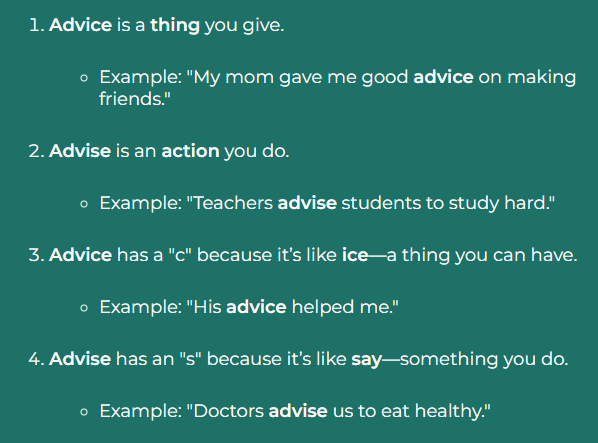
The difference between advise and advice is simple:
Tip: Use “advice” when you’re talking about the suggestion itself, and use “advise” when you’re talking about giving or offering that suggestion.
To advice is a verb or a word that refers to action. The action is advising. The word is spelled with an s whenever you say TO ADVISE or ADVISING because these refer to the verb or the action of advising another.
A noun is a thing, wether a physical thing like a table or a non physical thing such as advice
When someone is giving a suggestion or recommendation, the action is called advising. So, “advising” is the act of offering advice.
Advice is the thing: the words or suggestions and to advise is the action of saying the advice.
For example:
Just remember: the action of giving advice = advising!
Here are a few simple sentences for children to help them remember the difference between advise and advice:
These can make it fun and easier for children to remember the difference!
Was this helpful?
Feel free to use my poem in your lesson or class or as a reminder.
Please tell me if you would like to see more like this,
With love,
Eve
Dear reader,
Lizzie does not want to learn cursive. I listen.
But she came to me and requested help.with her letter g, lowercase.
She collaborated with me to create this G poem and practiced until we loved her letter g.
The graceful groom
In Ancient Greece
Was in gloom all week:
Ghastly days, lost grace,
His good wife, a ghost,
In the green garden.
Heart goes grey,
Galaxies away,
Gracious goddess:
Gown, crown, greatness.
Green grape dance to the god,
Bring my wife back.
The god’s generous reply,
A glistening sun ray,
And a goose to greet.
In two years time,
Sacrifice a goat,
And your girl will grow
From the goose,
Take care and groom her
Be warned: if you neglect her,
Your guilt a curse will be
To grueling loneliness.
The groom agrees, he will not neglect the Goose. Two years pass slowly, the groom Has been taking good care of the goose, the Groom brings the goat to the altar, and Prays, Grape god returns, Two years have Passed, Your wish shall be granted, goose Into wife, I command. The groom reunited, He is happy again with his wife. This story Ends with a happy ending.
Lizzie practiced her letter g handwriting by writing the poem on a paper and her creative writing by creating this poem with me as well as writing the ending all by herself.
©evelovestar
Dear Reader,
The free Spanish lesson plan is on this blog through this link:
Purchase the ebook through this link:
https://payhip.com/b/NLMdU: Learn Spanish: Rima y Ritmo: Greeting Poem Printables and test for children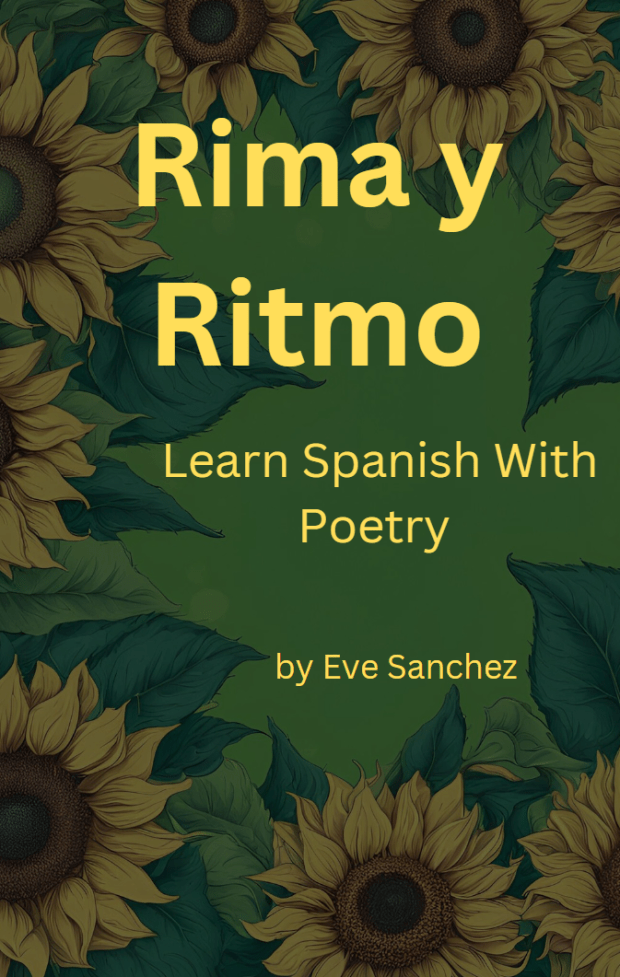
Rima y Ritmo is my cool Spanish class where I use poetry to teach my kids my native language. I already taught this lesson to my children, and they loved it. I am currently designing lesson 2: the poem is about a butterfly.
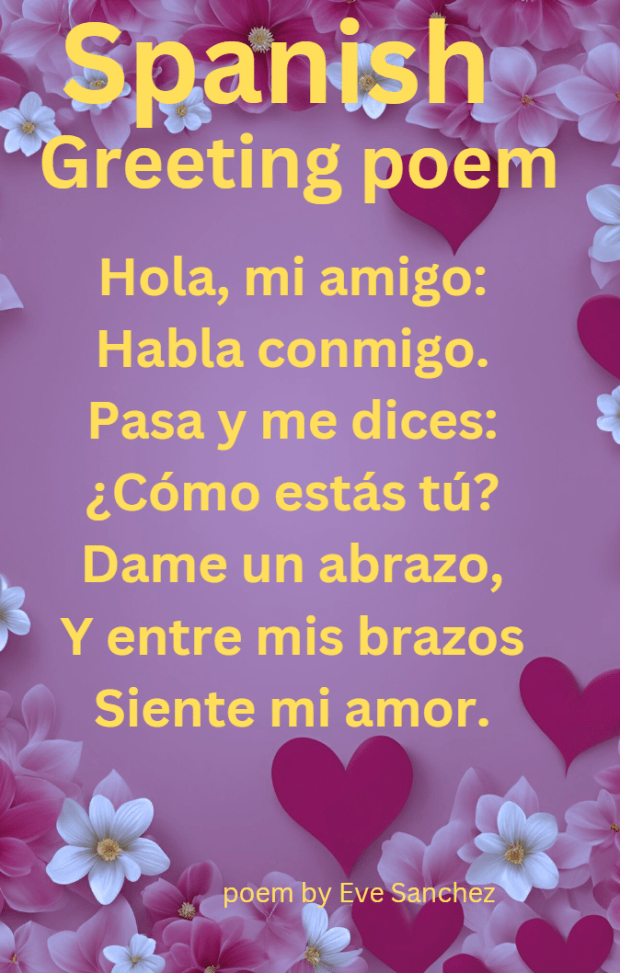
Below are the printable worksheets from my Rima y Ritmo class 1 ebook.
Print the printables, including the poem and read the lesson plan I linked above and using the poem and translation, work through these exercises. My children found them non easy.
Let me know if you need the answers.
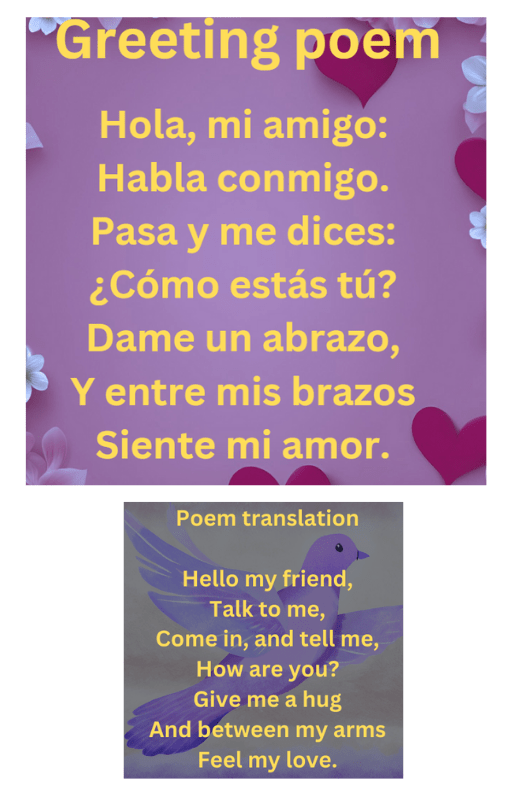
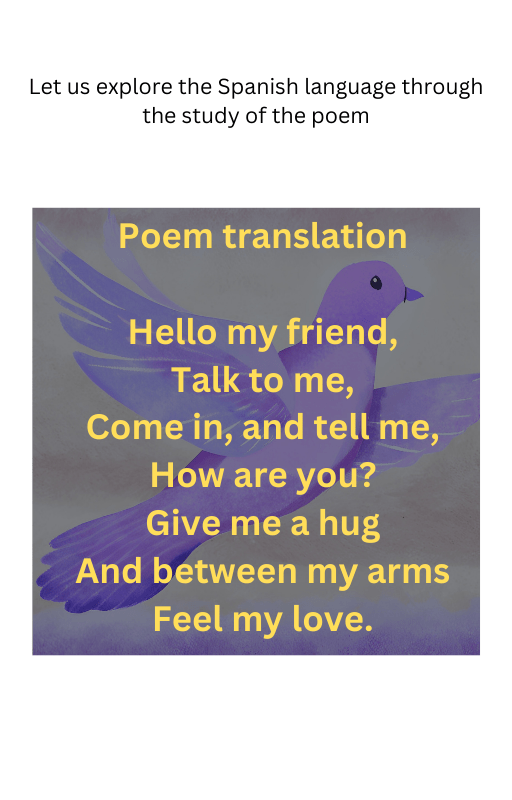
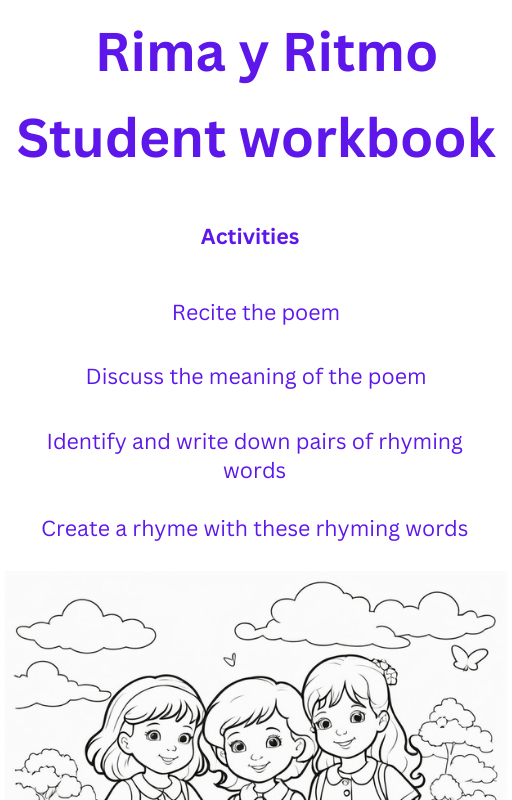

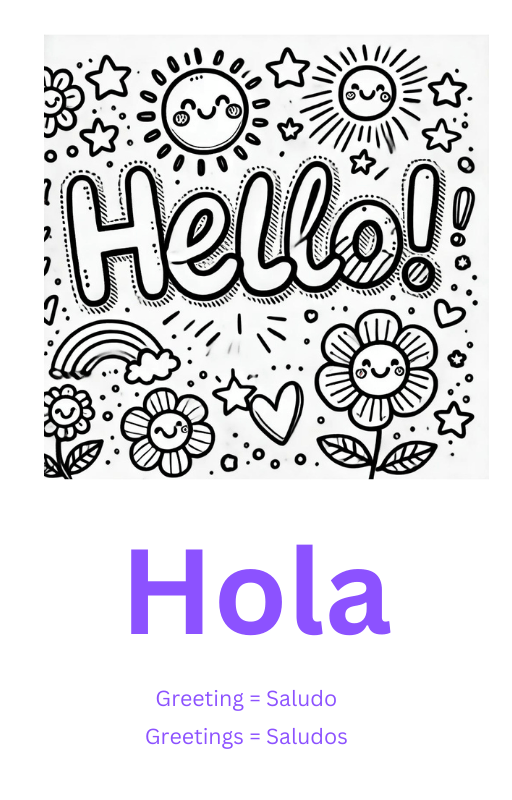
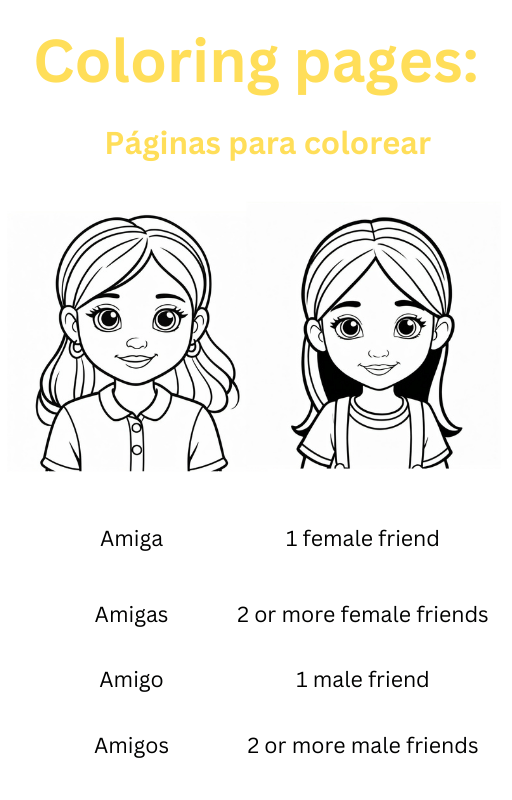
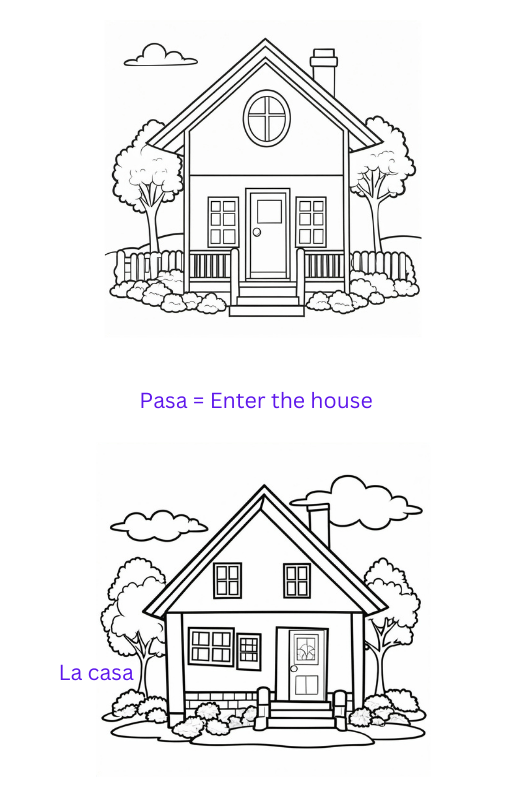

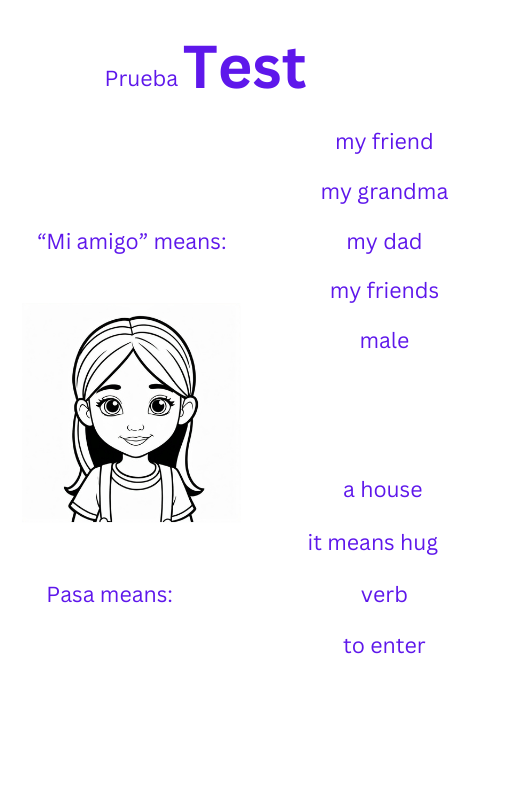
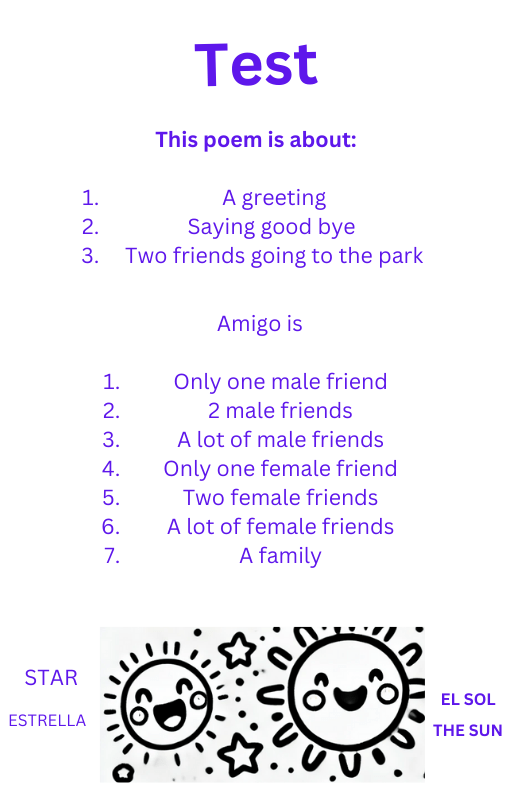
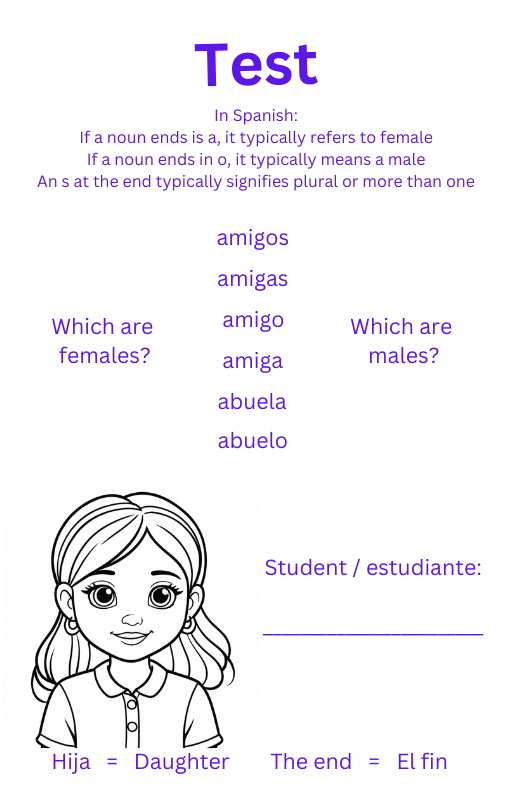
Let me know if this helped and if you want to see more like this.
Would you benefit from video lessons?
With love,
Eve
Dear reader,
(Spanish learning/ teaching? Scrool to the end for my fun lesson)
It is true that I love language study and learning and I love Duolingo, even though I am not happy they do not have a level two once you finish you language course. I finished my Latin course and got bored, picked up 2 more languages…
This is my Duolingo report this week:
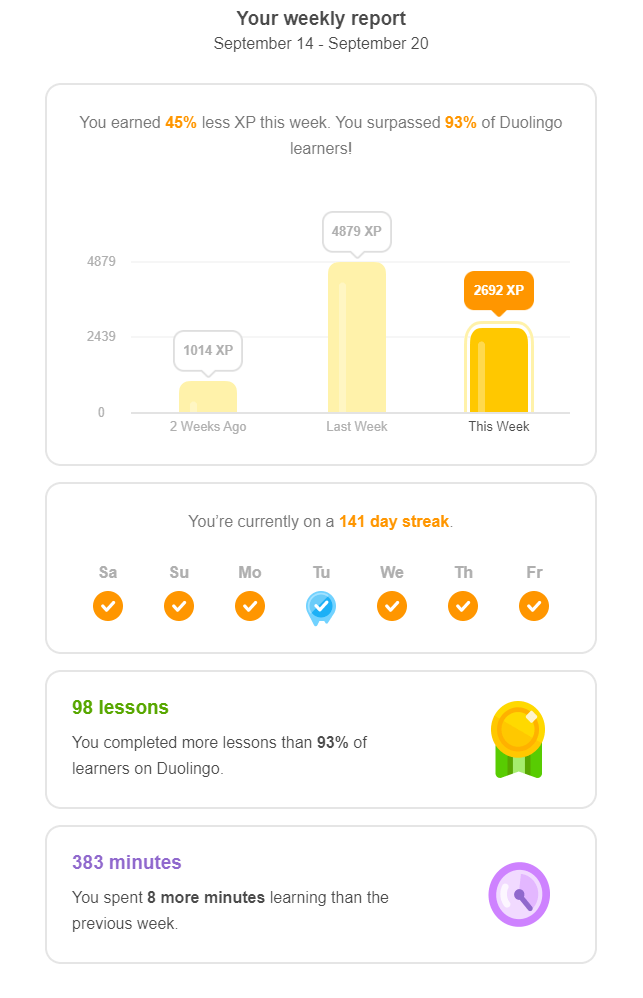
I guess I have a need to prove I am a real person. Why?
With the modern trend of everything we find being AI, I do have a need to prove that I am a real person who really studies language and teaches her children.
Just today we did Halloween arts and crafts…
Anyway, let us connect on Duolingo if you use it, find me as Eve Sanchez.
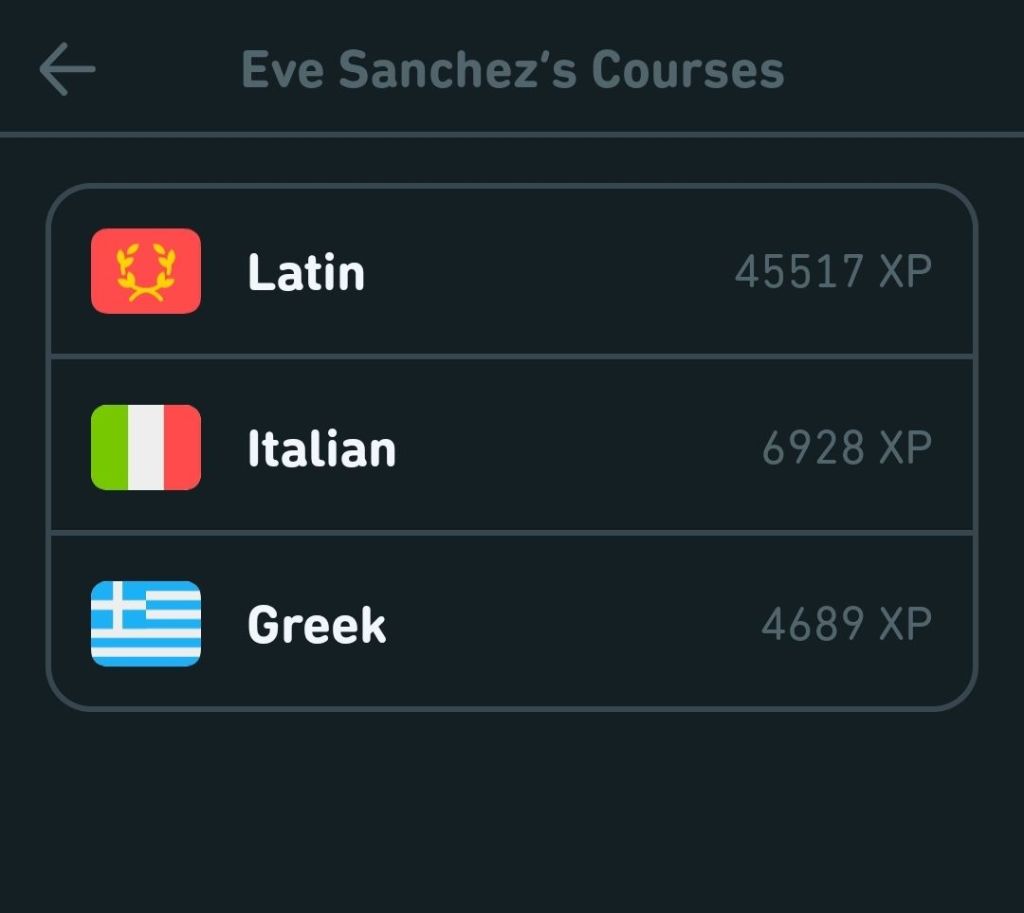
I do not need to learn a language, but I attempted to get my kids interested in Spanish, my first language, and they do not want to be told what to learn, they have their own opinions and ideas, which is really cute…
I joined Duolingo to inspire my kids to learn languages because they imitate anything I do: no pressure.
It worked because they started learning languages too. They are not organized and quit their own Duolingo, yet, Lilli does my Latin lessons at times, Vivi is learning the Greek alphabet with me, they have a Dinolingo Spanish course, Lilli took a Latin class, Lilli and I have Latin jokes, Alex does the Greek lessons with me and repeats the Greek words, Lilli and Vivi took Spanish classes: it worked, but my inspiration effort is ongoing.
Part of my effort is to have them observe my own learning, as well as to experience my learning methods which are varied and colorful, on top of that to expose them to different languages: music in Spanish and Italian; Italian, Latin, Greek words, phrases, and entire videos or podcasts being broadcasted in our house; and more.
And you,
Are you learning or teaching a language? Which? Do you have tips?
Do you listen to music in your target language?
Check out my cool Spanish with poetry clas:
Purchase the class through this link which includes a children’s printable workbook, a test, and more:
But first, take the free lesson on this blog:
With love,
Eve
Dear reader,
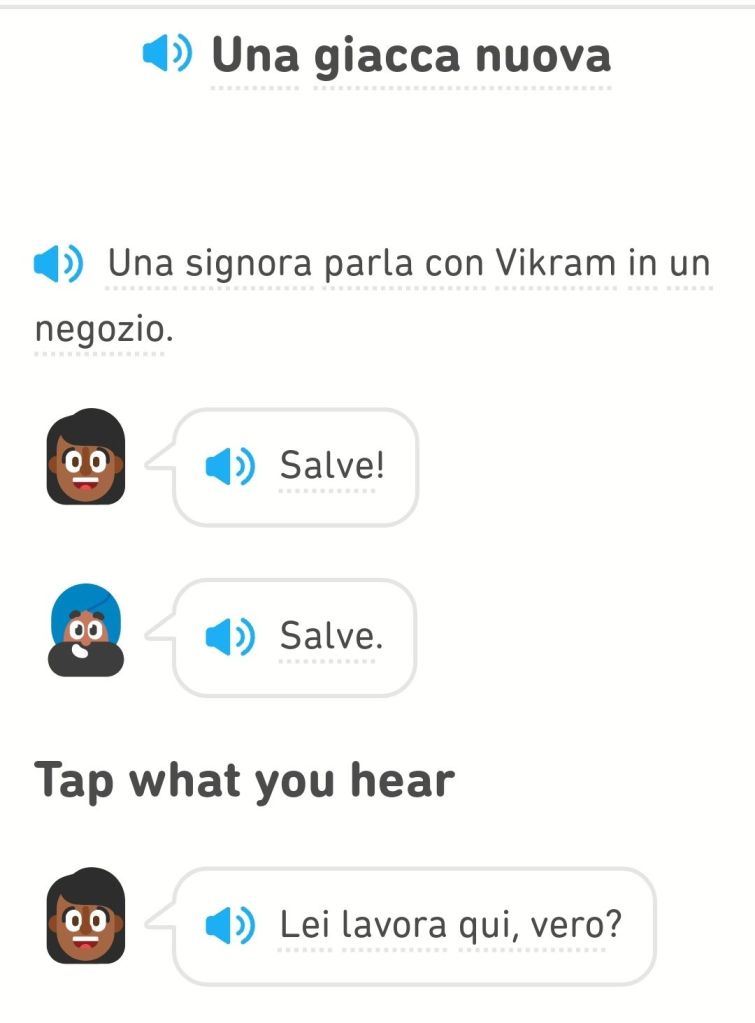
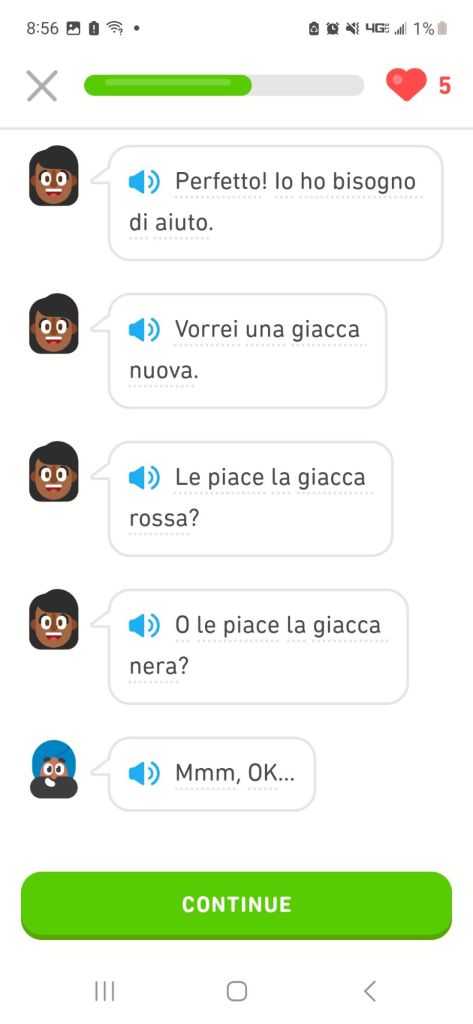
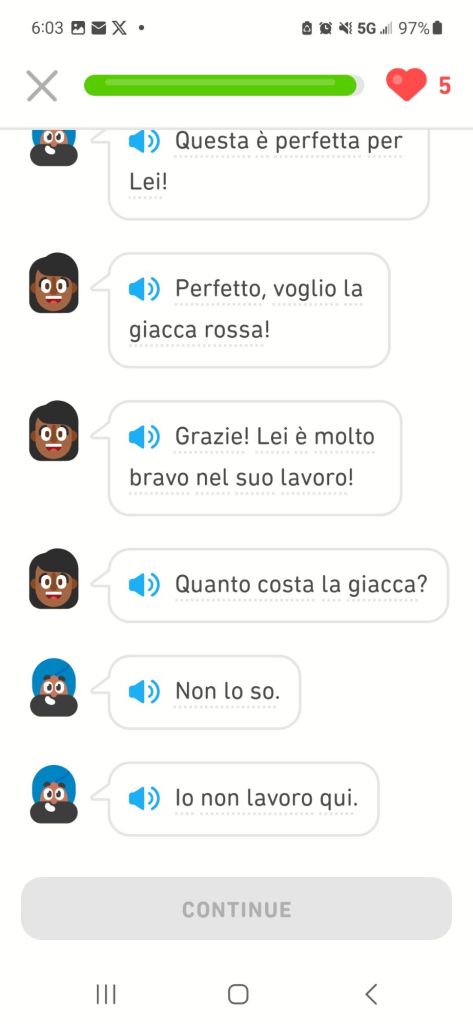
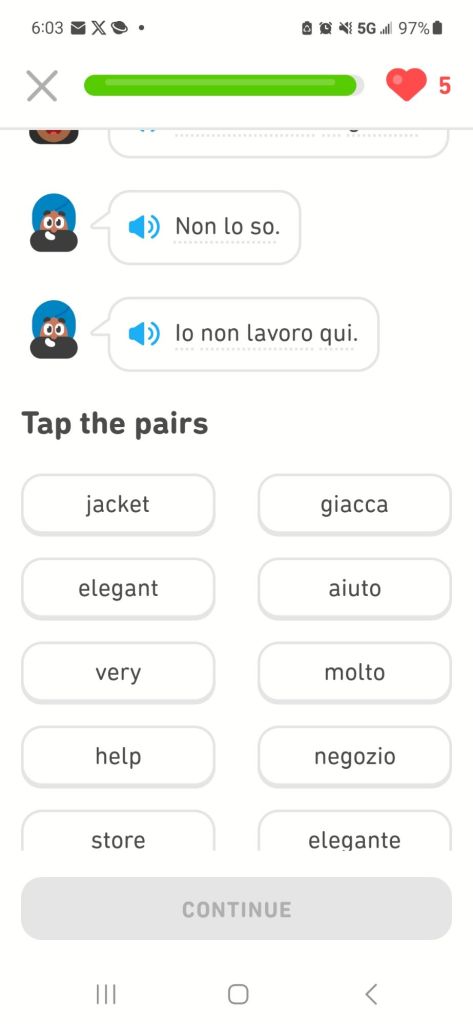
I stopped learning Italian on Duolingo because the Duolingo Italian course is not fun. Italian is a gorgeous language and Duolingo does not do it justice.
After I almost lost my streak because of the Italian course, I started a new language, Greek and started learning Italian by listening to Italian music and interacting with the language in a fun and relaxed way. I do not have to learn this language anyway.
Using Music for Language Learning
What is a fun way to learn a new language if traditional methods don’t quite resonate with you? If you’ve ever felt frustrated with a language learning app or textbook, it might be time to consider an alternative approach: music.
Music can transform the language learning process into a game of wonderment and exploration, making it not only enjoyable but also highly effective. Here’s how you can harness the power of music to learn a new language, drawing on my own experience with Italian music.
1. Anchoring into Favorite Tunes
One of the most engaging ways to learn a new language is by immersing yourself in music you already love. For instance, I enjoyed the Spanish songs of Laura Pausini and Eros Ramazzotti. By listening to these artists’ Italian versions of the songs I know and love, I learned. This familiar territory provides a comforting anchor, helping you recognize and remember phrases and words more easily.
I fell in love with a new Italian song, started singing it in karaoke, then found translations to Spanish and English. I learned expressions and words as well as recognized words that are the same as in Spanish, my first language. Now I used the vocabulary I learned on my karaoke song in a different song.
2. Pattern Recognition
Music is an excellent tool for pattern recognition. Pay attention to recurring phrases, themes, and lyrical structures.
For example, in Italian music, I noticed themes such as “Il mare” (the sea), “Parole” (words), and “il cuore” (the heart). I learned all three words because of music and since they’re themes in Italian music, they’re in so many songs. Noticing these patterns helps you internalize the language structure and vocabulary. The rhythm and melody also make it easier to remember new words and phrases.
3. Exploring New Sounds
Spotify and other streaming services offer a wide range of Italian music that can introduce you to the rhythm and intonation of the language. Fast-paced European-style songs with poetic lyrics can be especially engaging. These songs often blend beautiful singing with intricate language, providing a rich auditory experience that helps you get used to the language’s sounds and patterns.
Learning a language through music is akin to being a baby in an Italian-speaking environment. Just as a child absorbs language by hearing it spoken around them, you absorb Italian by listening to its music. Embrace the process of trying to understand without judging yourself. It’s natural not to grasp every word or sentence at first. Over time, you’ll start recognizing familiar words and phrases, which will naturally expand your vocabulary and understanding.
1. Enhanced Listening Skills
Listening to music helps improve your listening skills and pronunciation. You become more attuned to the nuances of the language, such as intonation and stress, which are crucial for effective communication.
2. Emotional Connection
Music often evokes emotions, making the language learning process more personal and memorable. The emotional connection to a song can make new vocabulary stick better. Similar to my pitch for poetry for language learning.
3. Cultural Insight
Music is a reflection of culture. By listening to Italian songs, you gain insights into Italian culture, traditions, and values, enriching your overall learning experience.
I still do not speak or understand Italian but I am learning and it is fun. I do not have to learn it anyway but I take any opportunity I get to learn.
Incorporating music into my language learning routine was a powerful and enjoyable method to familiarize myself with my new language. By anchoring myself in familiar tunes, recognizing patterns, and exploring new sounds, I transformed language learning into an engaging game.
My goal is to become comfortable with the language’s sounds and rhythms. As I continue to listen and immerse myself, I found that I understood some words and the knowledge of the language grew naturally, much like a child absorbing their mother tongue.
Embrace the melody of learning, and let the music guide you to fluency.
I listen to this playlist all the time.
My favorite song is my karaoke song
I recognize a word such as it happened with “parole” (words) in music after listening to it many times in several contexts, looking up the meaning and remembering it.
And you, what language are you learning or teaching and what tools are you using?
Thank you for your time,
Eve
The Pythia, mysterious figures of ancient lore. Not myth, though.
Did you know
There were several Pythias.
The Pythias are said to have been poetesses
The Pythia spoke in cryptic messages translated by priests
She would have been a teenager, unmarried young woman, or woman past childbearing age.
Alexander the Great and many kings visited the Pythia
The Pythia influenced state, kings, and citizens with her prophecies
Pythia’s Whisper
In Delphi’s sacred shadow, she speaks,
Veiled in mist of ancient dreams,
A breath of earth and smoke she seeks,
Where truth in whispered echoes streams.
Her voice, a tremor through the veil,
Glimmers of the gods, their will,
In trance she rides the hidden gale,
To prophesy with fervent thrill.
The chasm breathes its mystic air,
A sigh of fate, a quiver deep,
She dances in the temple’s lair,
Where ancient secrets softly seep.
In every riddle, cosmic dance,
A glimpse of truth, both fierce and sweet,
The Pythia, in fleeting trance,
Unfolds the world’s concealed heartbeat.
Short version
In Delphi’s shadow, veiled in mist,
She breathes the gods’ ethereal kiss,
In trance, her voice through secrets weaves,
Prophecies in whispered leaves.
This information is from my mind, from too much reading.
The book Alexandros (this was the Spanish name, but this is my favorite book, I’ll buy this book) of his visit to Pythia.
A philologist I follow (who is not safe for home education) speaks of her poetry.
Many ancient historians wrote of the Pythia.
If you liked this, let me know,
With love,
Eve

You must be logged in to post a comment.