Empowering Parents: The Case for Homeschooling

Dear reader,

Let’s discuss the benefits of home education focusing on specific research that is promising.

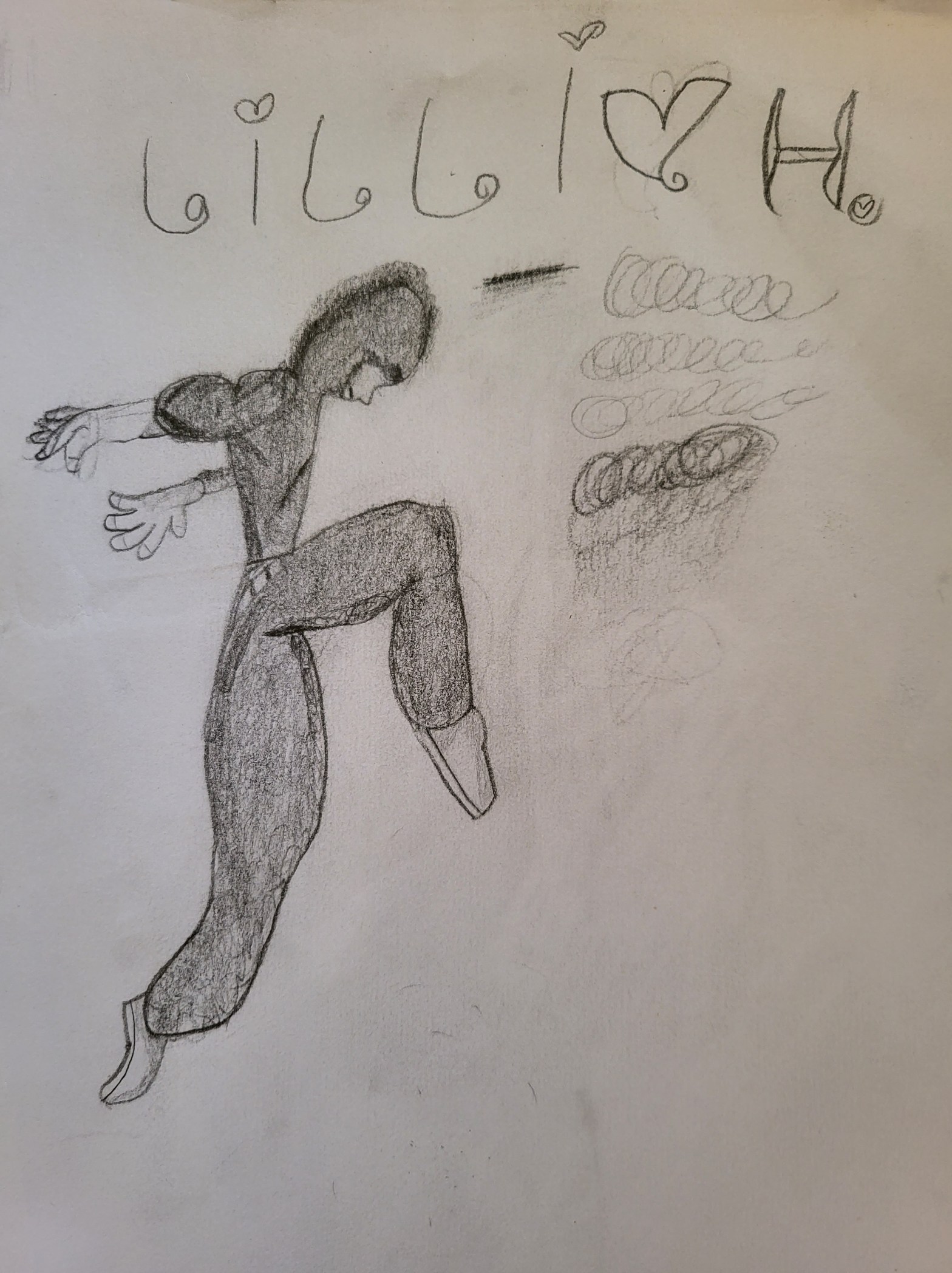
My daughter Lilli is very proud of this art she learned to create on Outschool, our tutoring service of choice

In recent years, the landscape of education has evolved dramatically, with an increasing number of families opting for homeschooling as an alternative to traditional schooling. This shift is driven by various factors, including the desire for greater parental involvement in a child’s education and the flexibility to tailor learning experiences to individual needs. As debates continue on the effectiveness of homeschooling, several studies highlight compelling reasons why empowering parents with more control over their children’s education can be beneficial.

**1. Personalized Learning**

One of the primary advantages of homeschooling is the ability to customize the educational experience to suit the unique learning style and pace of each child. Research by Dr. Brian Ray, founder of the National Home Education Research Institute (NHERI), suggests that personalized instruction leads to better academic outcomes and higher levels of student engagement. Parents can adapt curriculum materials, teaching methods, and schedules to match their child’s strengths, interests, and developmental stage, fostering a more effective learning environment.

**2. Stronger Family Bonds**

Homeschooling often strengthens familial relationships by providing more opportunities for meaningful interaction and shared learning experiences. A study published in the Journal of Research in Childhood Education found that homeschooling families reported closer parent-child relationships and increased communication compared to families with children in traditional schools. The collaborative nature of homeschooling encourages parents to actively participate in their child’s intellectual and emotional growth, creating a supportive and nurturing environment.

**3. Enhanced Academic Performance**

Contrary to misconceptions, research indicates that homeschooled students perform well academically and excel in standardized tests. According to a longitudinal study by Dr. Lawrence Rudner, homeschool students consistently scored above the national average on standardized achievement tests across all subjects and grade levels. This academic success is attributed to individualized attention, focused instruction, and the ability to explore subjects in greater depth based on the child’s interests and abilities.

**4. Flexible Learning Opportunities**

Homeschooling offers flexibility in terms of curriculum, scheduling, and learning environments. Parents can incorporate real-world experiences, field trips, and hands-on activities into daily lessons, enhancing practical skills and critical thinking abilities. This flexibility also accommodates diverse family lifestyles, such as travel, religious observances, or accommodating special needs, ensuring that education remains accessible and relevant to each child’s circumstances.

**5. Socialization and Community Engagement**

Concerns about socialization are often raised regarding homeschooling, but studies show that homeschooled children actively participate in community activities, sports, and social groups. Research published in the Peabody Journal of Education found that homeschool students develop strong interpersonal skills, exhibit higher levels of self-esteem, and engage positively with peers and adults in various settings. Additionally, digital platforms and homeschool co-ops provide opportunities for collaborative learning and social interaction, fostering a well-rounded educational experience.

**Conclusion**

As the landscape of education continues to evolve, homeschooling emerges as a viable option for families seeking greater autonomy and control over their children’s educational journey. Empowered by research and supported by educational resources, parents can effectively tailor learning experiences that promote academic excellence, foster strong family bonds, and nurture holistic development. While homeschooling requires commitment, dedication, and ongoing support, its potential to empower parents and enrich children’s lives remains a compelling argument in favor of parental control over education.

Do you have any interest in home education?

Eve
Homeschool Plan: Learning Latin to inspire my children to learn Spanish/ languages

Dear reader,

First of all, this is absolutely not 100 percent of my homeschooling log. Additionally, my babies have awesome tutors, and I supplement their learning.

Spanish is my first language. But I speak mostly English now. Dad speaks only English.

Our children were not interested in learning Spanish, so I didn’t force them.

Now, they’re more open since spending time with my mom and making friends who only speak Spanish that they could not understand.

My plan to practice amazing calligraphy to inspire my babies to do better (more legible and beautiful) handwriting worked, and I have pictures of their new improved handwriting to prove it. The progress happened within a week of my practice.

I decided to use the same exact tactic to inspire my kids to learn a language. Hopefully, they’ll learn Spanish, but I’m flexible and will let them choose their own language to learn.

I started learning Latin one month ago to show my studying and learning to my kids. My second daughter already practiced with me, though she thought it was boring.

I have had an interest in learning a third language for a long, long, long while, and my favorite sounding new language is Portuguese. Portuguese shares the root of Spanish, and that makes it easier for me to understand. I’m constantly trying to read Portuguese texts. (Note to self: follow Portuguese poets on Twitter)

I actually want to learn Hindi, though, because I love India, and this is a bit crazy but I want to retire in India, and I feel I have a deep connection to India and its culture. Hindi is extremely hard to learn: it has an entirely different script, so our Latin/ Greek influence will not help me there.

I did a tiny bit of Hindi and Sanskrit study just for the awareness. If I retire in India, I’ll need to know some Hindi, I’ll consider the study in the future, and I think it would be a lifelong study of that language. Their script is lovely, and my interest, of course, is to read their divine ancient texts before translation: it would be an insane amount of learning as I learned the original Sanskrit has an even older script! Learning two totally new scripts would be such a burden.

Either way. I downloaded the Duolingo app and went searching to start learning Hindi, but it wasn’t on the app, and I didn’t want to learn any of the languages available (because I’m interested in ancient texts)

But Latin was an option! I never had an interest in learning Latin. I know Spanish was developed from Latin and assumed it might be easier because of my fluent Spanish. However, I don’t like the Romans. And I don’t really care to read the Roman texts.

Latin was used to translate hieroglyphs, which I adore, and I understand there are uses. It might be the most used ancient language (that’s a total assumption). Anyway, I chose it because I’m doing this just for fun.

As soon as I chose Latin, I was happy it wasn’t Hindi! I might have abandoned Hindi studies by today because I like easy and fast progress and finding what I’m naturally good at.

I’m naturally good at learning Latin and by today, I know some vocabulary, history of the language, simple sentences, some grammar, I understand the Latin root of some English words, and got a bit comfortable in the learning process. I’m progressing fast, and I loved it. I’m really excited about it. I started learning yesterday!

My second daughter practiced a bit with me when she saw me! It was a huge success! I showed her and her older sister the Duolingo app and suggested they download it as it’s fun and perfect for children! My oldest daughter asked what vocabulary I’d learned, too.

I intend to watch Spanish videos with them and practice Spanish on Duolingo to impress them and pull them towards language learning.

Language learning is super fun, and I’m already looking for Latin poetry!

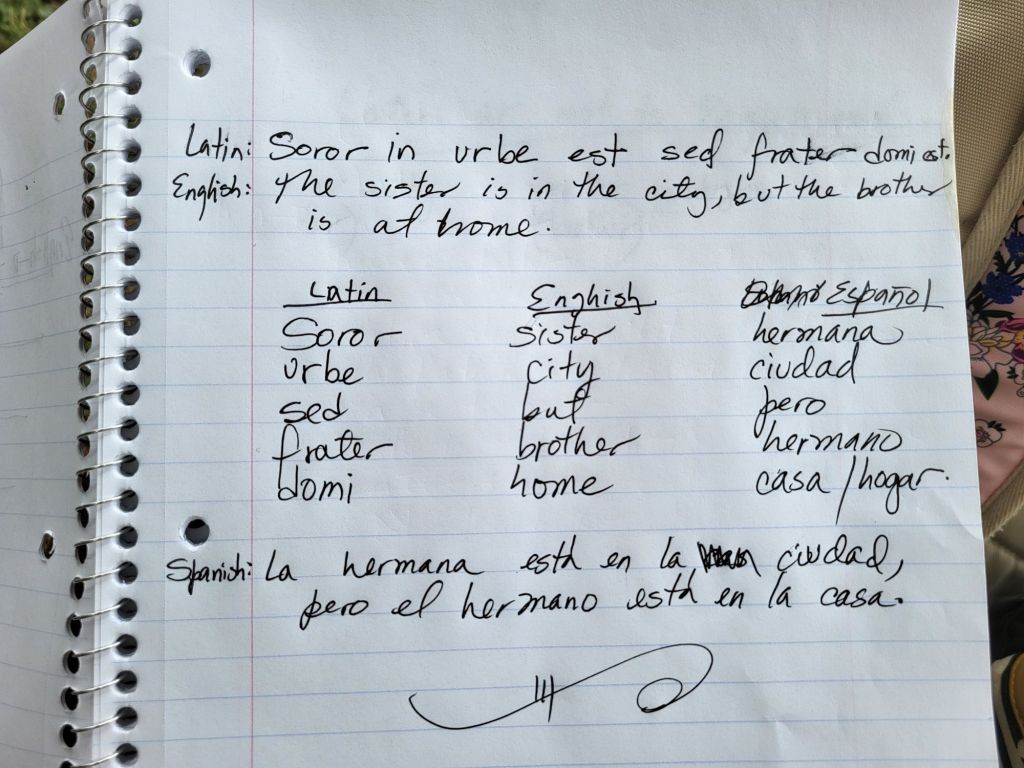
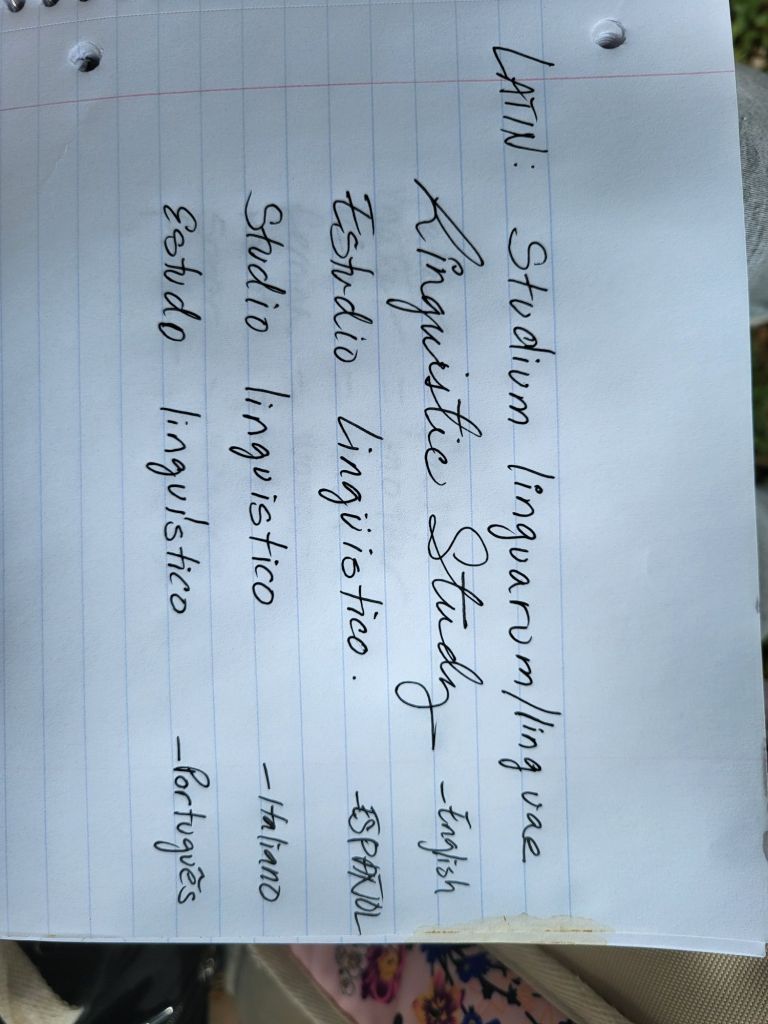
Linguistic study in Latin, English, Spanish, Portuguese, and Italian. Not about to study French any time soon.
Latin to English/ Spanish sentence translation and vocabulary
Simple Latin sentences translated to Spanish and English
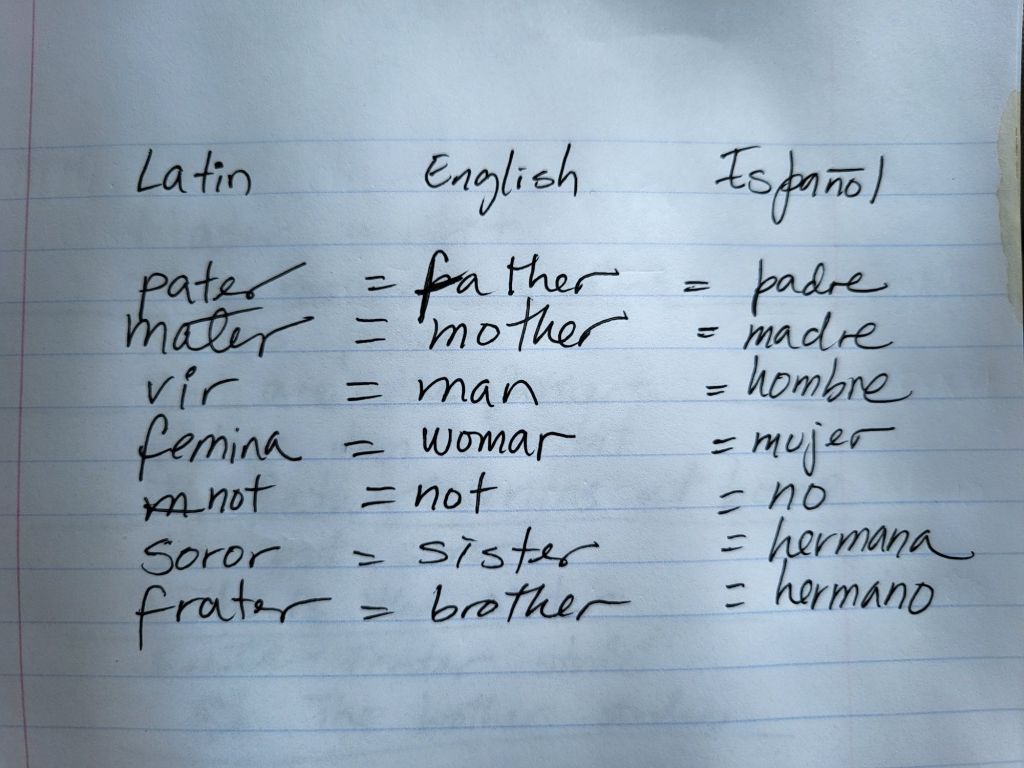
Latin – English – Spanish vocabulary

Eve

Homeschool Log

Dear reader,

Since I have 5 children being educated at home (2 are toddlers) and I need constant motivation, on Monday and sometimes Tuesdays, I listen to homeschooling or home education podcasts, YouTube videos, or Ted talk of educators. This helps me get in the mood for learning.

We start the week off easy for the children. Right now, my 3 oldest have classes with tutors on Wednesday, Thursday, and Friday.

How her home schooling changed her life.

Oh, and the one thing I do not agree with this creator is where she didn’t criticize school. Not that she’s wrong. Her experience is her experience!

But, I do openly criticize school.

Always learning,

Eve

Home education. Our story and inspiring my children to be lifelong learners.

Dear reader,

Ever since my first child, now 11, was a baby, I have been interested in homeschooling. By now, I have 3 daughters being educated at home. Today, I don’t want to call it homeschooling anymore because what we do is not school. It is definitely education but not school.

Home as the first school

It is a fact that the most important school is the home, whether or not we were homeschooled. I was a hungry learner who was extremely involved in exceeding expectations and big achievements, but this is something my father taught me, and he was a teacher but not my teacher. He also inspired my love for poetry and literature, and today, I’m a poet and writer. 

Similarly, when children are not doing well in school, it might be that they’re not doing good at home. Home is the first school, and parent figures our first teachers.

My introduction to homeschooling

Continue reading “Home education. Our story and inspiring my children to be lifelong learners.”