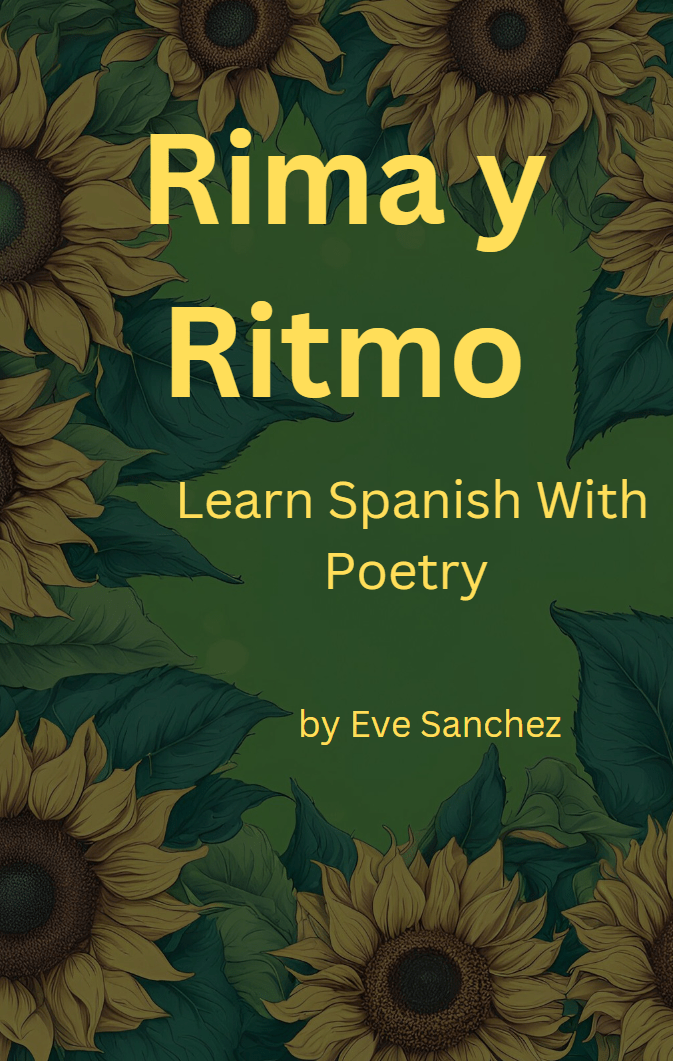
Spanish lesson 1. Rima y Ritmo: Poetry with a native poet (1)

Dear reader,

Edit: My children loved the class and printable worksheet and requested more classes like this. Follow for the next classes coming up in the same fun but in-depth manner.

I have been pitching the idea everywhere that poetry is an excellent tool for language learning as reading materials. And now I will prove by creating the most creative Spanish lesson ever.

The full lesson, including a printable worksheet and test for children is available if you need additional help with this material:

Here’s why poetry is amazing for language learning:

Culture

Deep learning through complexity of poetry

Fun content that is memorable

Rhyming and rhythm helps with memorization

Spanish: 1st level. Lesson 1
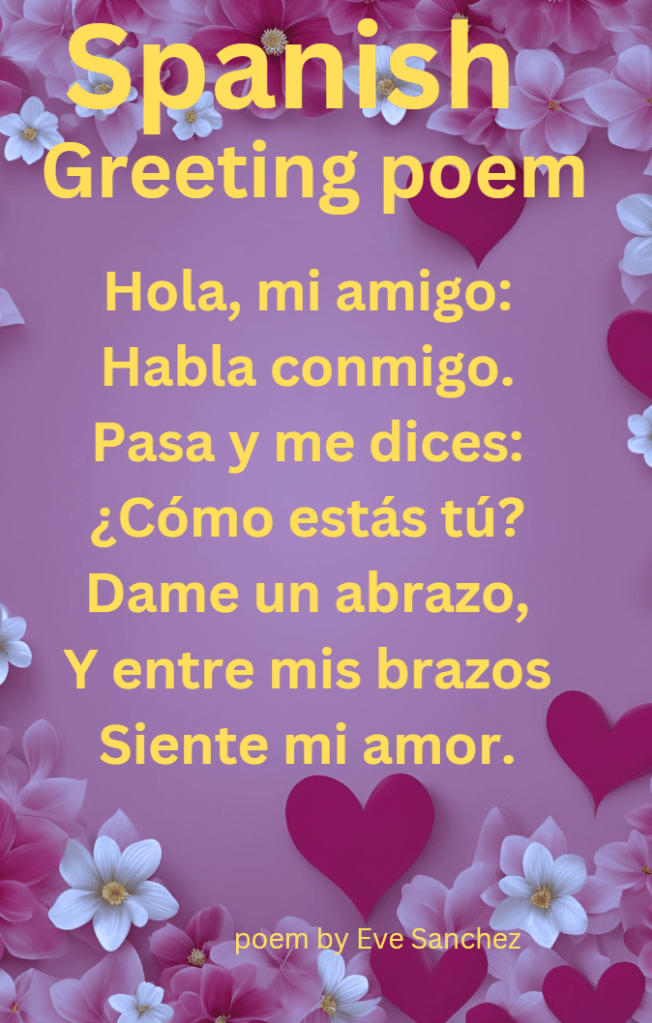
Hola mi amigo (Hello my friend) poem by Eve. Read further, and I’ll explain every word and phrase.

This poem is appropriate for a level 1 learning. It uses simple language and common phrases, making it accessible for beginners. This is a little more intense than the usual level 1 dialog, but it is also much more memorable, and I bet you can engage with this content more than with the usual language class dialog.

The main points for teaching are:

  • Basic Vocabulary: The words and expressions are straightforward and familiar, suitable for early learners.
  • Simple Sentence Structure: The poem’s structure is uncomplicated, which helps learners grasp basic sentence formation and concepts.
  • Easy to memorize: I do not attempt to memorize vocabulary anymore. That is the “boring” learning style that many of us reject. I like to engage with the reading content. However, poetry is naturally easier to memorize than prose or conversations. You will find yourself remembering without trying, especially if you do it with fun in mind and without judging your learning speed.

Lesson Plan. Feel free to use this for personal use/ homeschooling

(For more learning, I’m collecting all this into an ebook, return, and you will see additional lesson posts totally free)

If you’re a teacher and wish to use this material, let me know.

Welcome to my unique language lesson, where we explore the beauty of poetry as a tool for learning. Poetry is more than just a form of artistic expression; it’s a gateway to deep emotional understanding and linguistic mastery. By delving into poetry, you’ll not only enhance your language skills but also gain insight into the cultural and emotional nuances of Spanish.

Why poetry? It offers a fun and engaging way to learn, transforming the study of vocabulary and grammar into a creative and immersive experience. Poetry often includes complex structures and rich imagery, which challenges learners to think critically and understand the language on a deeper level. Many native speakers might not fully grasp the subtleties of poetry, but by engaging with it, you’ll achieve a profound and sophisticated understanding of the language.

In this class, we’ll use carefully selected poems to guide our learning journey. You’ll explore themes, emotions, and linguistic intricacies that will elevate your understanding of the language. Let’s embark on this poetic adventure together and discover the power of language through the art of verse.

Poem translation

Hello my friend,
Talk to me,
Come in, and tell me,
How are you?
Give me a hug
And between my arms
Feel my love.
Continue reading “Spanish lesson 1. Rima y Ritmo: Poetry with a native poet (1)”

Socrates: Ancient Greek Philosopher. The Wisest Man Ever Born?

Dear reader,

Let us talk about Socrates, the ancient Athenian philosopher.

First, I’ll include an essay for adults, and coming soon, I’m going to share a free lesson plan for home education parents, just in case you’re looking for educational materials. If you’re a homeschooling parent, and this was helpful, let me know, I’ll be sure to create more like this.

The soon to come lesson plan will be completely free, as my gift to parents. I will continue to develop this lesson plan for use with my kids. I’ll then go about creating materials for my future lesson plan, one that will be complete. This will take a lot of time, but I’ll share a lot of sources for your studies if you’re interested in introducing your children to Ancient Philosophy. Stay tuned.

The free Lesson will include

  • A lesson plan to introduce kids to Ancient Philosophy and Socrates
  • The lesson will be tailored for children 8 -12 ( my oldest learners)
  • Several simple poems for reading and  comprehension materials

Socrates. Valor and Fearlessness

Socrates said in his famous trial (the result of which was the Athenians killing him) that the god Apollo had prophesied that there was no wiser man than him.

Socrates went on to inspire wisdom in a level that has not been matched. His student Plato would go on to be the father of philosophy, and Plato’s student, Aristotle (Alexander the Great’s famous teacher), was the father of universities, per this course I listed below.

Source:

Listen to Famous Greeks by J. Rufus Fears, The Great Courses on Audible.

https://www.audible.com/pd/B00D8G01VG?source_code=ASSOR150021921000R

Socrates

  • Ancient Athenian
  • Known for questioning everyone
  • “No honest man can survive in your democracy. It is so corrupt!” Were hos words to his Athenian oppressors proving his valor and fearlessness
  • Murdered by the Athenians for inpiety

Socrates: The Paragon of Virtue and Philosophy


Socrates, one of the most influential figures in Western philosophy, lived in ancient Athens during the 5th century BCE. His contributions to philosophy, characterized by his commitment to virtue and his fearless stance against the political establishment, have left a lasting legacy.

Legacy and Ideas

Socrates is renowned for his contributions to ethics and epistemology. Unlike his predecessors, who often engaged in speculative and metaphysical inquiry, Socrates focused on practical ethics and the nature of human virtue. His philosophy was grounded in the belief that understanding the nature of virtue was essential for leading a good life. This approach is most famously encapsulated in his assertion that “the unexamined life is not worth living.”

Central to Socratic thought is the Socratic Method, a form of dialectical questioning that aims to stimulate critical thinking and expose contradictions. Through this method, Socrates sought to challenge assumptions and encourage deeper understanding. This approach involves asking a series of questions to help individuals arrive at their own conclusions, rather than providing them with answers. The goal is to foster clarity of thought and promote self-awareness.

Socrates also introduced the concept of “Socratic irony,” where he professed ignorance to draw out the knowledge of others. This tactic allowed him to reveal the ignorance of those who claimed to possess knowledge, thus promoting a deeper exploration of truth.

Valor and Fearlessness

Socrates’ valor and fearlessness are perhaps most evident in his interactions with Athenian politicians and his eventual trial. Socrates lived during a time of significant political turmoil in Athens. His commitment to questioning the status quo and challenging the moral and intellectual complacency of the time often put him at odds with powerful figures.

One of Socrates’ most notable acts of courage was his refusal to abandon his principles, even in the face of severe consequences. During the Peloponnesian War, Athens was under the influence of a series of politically charged events and shifts in power. Socrates remained steadfast in his commitment to questioning the moral and ethical conduct of the politicians and leaders, despite growing hostility.

Socrates’ fearlessness culminated in his trial and subsequent execution. In 399 BCE, Socrates was charged with impiety and corrupting the youth of Athens. He was sentenced to death by drinking poison hemlock. Despite the gravity of his situation, Socrates faced his fate with remarkable composure, continuing to question and discuss philosophical issues up until his final moments. His willingness to accept death rather than compromise his beliefs is seen as a testament to his commitment to truth and virtue.

Conclusion

Socrates’ legacy endures through his profound impact on philosophy and his embodiment of intellectual courage. His method of questioning, dedication to virtue, and resistance to political pressure have inspired countless individuals to seek truth and live a life of moral integrity. Socrates’ life and teachings continue to be a beacon for those who value wisdom, ethical rigor, and the courage to stand up for one’s beliefs. His unwavering pursuit of truth in the face of adversity exemplifies the highest ideals of philosophical inquiry and personal virtue.

If this was inspiring or helpful, let me know, I would love to do more like this.

Stay tuned for an upcoming free lesson plan to introduce children to Socrates and Athenian philosophy,

Eve

Can I learn a new language in 6 months? My experience from studying my 3rd language

Dear reader,

Today, I read a wonderful article on the Duolingo app, but I couldn’t share a link with you. So, I will tell you what it said.

Let’s connect on Duolingo: find me as Eve Sanchez or Eve Lovestar, and I’ll follow you back.

The article, written by a senior learning scientist and language learning expert, Dr. Cindy Blanco explains why we can’t become fluent in a new language in 6 months.

Why we can’t learn a language in 6 months by Dr. Cindy Blanco

In the Duolingo article, the learning scientist says the first thing is that fluent means different things to different people. Obviously, what’s fluent to the people who claim they learned a language in 3 months (I have seen ads) is different from me.

When I was learning English, my second language, I told people who I could understand in perfect English that I only spoke a little bit of English. I had an American boyfriend and was communicating with him only in English (he taught me), but I was extremely careful not to claim I knew more than I actually knew!

Maybe after a year of living with my boyfriend, now my partner and father of my children, I said I spoke English. It took me years total to feel fluent. Some people can make such a claim a lot faster than I did. This is because fluent means different things to different people.

Then Cindy explained how much there is to learn, such as grammar, vocabulary, pronunciation, and more. There’s no way to learn so much well in 6 months. There’s not even enough time for enough repetition.

“Repetitio est mater studiorum”

“Repetition is the mother of learning.”

This is a popular Roman saying in Latin attributed to someone named Varro. I read he was an educator.

Back to the article, Cindy Blanco then explained that what people refer to by saying “fluent” is confident and conversational.

Just like me, having an English conversation to explain in perfect English sentences:

“I don’t speak English ”

                 “But you’re speaking English”

“But I only speak a little ”

                  “Can you understand me?”

“Yes, but I have to think and translate in my mind”

Ok, that last sentence is not something I said 17 years ago. I understand this now.

Language skills we can learn in 6 months

Cindy Blanco, Duolingo’s learning scientist, says: “Yes, we can become comfortable and conversational in a new language within 6 months”

Why some learn languages so fast

I want to be one of these magical unicorns and now, learning a 3rd language (of course, I’m studying 3 languages at once, 2 of them I’m doing good in), it’s much easier and faster.

Per Cindy, people who learn a language very fast have these things in common:

  • Previous language learning experience. Like me, learning a third language feels great, so much easier than learning a second language. We already know how to learn a second language and feel super confident in our ability to learn a third one.
  • They are committed. There’s no excuses. I will learn this language no matter what! The language better watch it because I’m coming to acquire it! I dropped even blogging and poetry writing (my favorite things to do) to learn Latin full time. I also got off social media, but it was easy to do, and i was the happiest I’ve been in recent years studying Latin.
  • They start practicing the new language right away, on day one. Shameless practice is what I call this. I’m not at all fluent in Latin, but I wrote a poem in Latin! I talk to my daughter in Latin. I teach Latin words to my partner. I’m making the Latin connection into English and Spanish. Oh, I’m also attempting to sing in Italian. A month ago, I only knew 3 words in Ialian…
  • They excel at making mistakes. I understand this because mistakes are so embarrassing. English, my second language, such an embarrassing experience to me… but I have been making videos of my Latin learning experience in Duolingo and showing off my progress on YouTube. I mess up for all to see, then laugh at it. On a poem I wrote in my first week of Latin, a poem in which I spoke of Latin learning and said 2 words in Latin. I said Vos (you in plural) was tu (you but in the singular). The shame was not present. Instead, I’ll never forget these 2 words. Mistakes are teachers, too.
  • They immerse themselves.  Immersion is a word you hear a lot if learning about language learning. This is how I’m getting immersed in Italian: I started listening to Italian music, followed Italian artists on Twitter, and I am listening to an Italian podcast. This is the third week, maybe, but I plan on learning exclusively by interacting with the language, and I’m doing really well. Getting immersed to Latin was harder but for a while I’ve been reading in Latin, studying Roman history, reading Latin poetry, investigating how much Latin is Greek, listening to podcasts in Latin, watching videos in Latin. There’s not a lot of options since it’s an ancient language, but this makes learning it fun. I’m also reading about mythology because it’s fun.
  • Finally, people who learn a language fast put in the time. They’re not lazy about it. They do not dread studying the new language. They love it! It’s mind play with art which is language.

My conclusion

Once you enjoy your language learning, you learn incredibly fast.

Immersion can also be obsession of a positive kind. I can’t stop thinking of Latin!

Next step: think in Latin

What language are you studying?

I study Spanish, English, Latin, Ancient Greek, and Italian.

Thanks for visiting,

Eve

Exploring poetry as a tool for language learning. Part 2

Dear reader,

I currently use poetry as a tool for my language study, and I feel it’s the most fascinating way to study a new language. Let me tell you about my strategy.

My language study

I took to Duolingo for language learning and quickly realized that I needed more input. I chose Latin and quickly started watching YouTube videos about it, and (this is strange, but I felt it was a sign from the universe) I realized what I’d be doing with my Latin learning on my second day of learning it.

I immediately recognized that poets were huge in Ancient Rome, and of course, I should have already known that, as a poet…

The message I received from the universe was that I was going to read and translate the ancient Roman poetry (I did already translate one).

Then, I decided to learn the Ancient Greek alphabet and found gorgeous Greek romantic poetry, which I’m already working on just for fun. It is extremely complex, which makes everything else seem easy.

Then, I started following poets on Twitter and followed an Italian guy. I interacted with the guy, and he shared an Italian poem with me, so I have a soft goal of learning Italian. I am taking an Italian course and doing well as a total newbie.

So, me, a poet… learning languages with poetry is simply natural.

However, I believe it’s the most fun way to practice, which is why I want to tell you all about it.

Tips to use poetry for language study from a poet

  1. Start with Simple Poems: Begin with shorter poems or poems with straightforward language. This helps in understanding basic poetic structures and building confidence.
  2. If you don’t already read poetry: start with poetry in your language. Then, move on to bilingual poetry.
  3. Focus on Themes of Interest: Choose poems that resonate with your personal interests or topics you are passionate about. This makes the learning process more enjoyable and meaningful.
  4. Read Aloud and Listen: Poetry is meant to be heard. Read poems aloud to practice pronunciation, intonation, and rhythm. Listening to recordings of native speakers reciting poems helps in understanding cultural nuances and natural cadence.
  5. Analyze and Discuss: Break down poems line by line to grasp their meaning, themes, and literary devices. Discuss interpretations with language partners or teachers to gain different perspectives.
  6. Write Your Own Poems: Use the language you’re learning to compose your own poems. This reinforces vocabulary, grammar, and creativity while allowing for personal expression. Writing your own poetry has the potential to lift your spirits, help you grow, and increase your self steem! 🙏
  7. Explore Different Poetic Forms: Experiment with various forms like haikus, sonnets, or free verse. Each form challenges different aspects of language skills and encourages exploration of cultural differences in poetic expression.
  8. Use Poetry Collections and Anthologies: Explore collections of poems from different cultures and time periods. This broadens exposure to diverse linguistic styles and historical contexts. Note: When you’re advanced, read the very old poetry.
  9. Integrate Technology: Utilize language learning apps, online forums, and social media to share and discuss poetry with native speakers and other learners worldwide.
  10. Attend Poetry Readings and Events: Immerse yourself in the local poetry scene or attend virtual poetry readings. This provides exposure to authentic language use and cultural insights.
  11. Be Patient and Persistent: Learning through poetry requires patience and persistence. Embrace challenges as opportunities for growth and celebrate progress along the way.

By incorporating these tips into your language learning journey, you can effectively harness the power of poetry to enhance your linguistic proficiency and deepen your appreciation for the beauty of language and literature.

Learning Spanish?

Consider my Spanish class:

https://payhip.com/b/NLMdU

Thank you for reading,

Eve

Shall I compare thee to a summer day? Solstice poetry by Shakespeare with modernization of the poem

Dear Lovestar, Happy Solstice! I didn’t write a summer poem yet, so I decided to let Shakespeare do the speaking today. Read and enjoy one of the most popular and beloved poems ever by the most famous English poet.

Shakespeare sonnet 18

Shall I compare thee to a summer’s day?Thou art more lovely and more […]

Shall I compare thee to a summer day? Solstice poetry by Shakespeare

Home education. Our story and inspiring my children to be lifelong learners.

Dear reader,

Ever since my first child, now 11, was a baby, I have been interested in homeschooling. By now, I have 3 daughters being educated at home. Today, I don’t want to call it homeschooling anymore because what we do is not school. It is definitely education but not school.

Home as the first school

It is a fact that the most important school is the home, whether or not we were homeschooled. I was a hungry learner who was extremely involved in exceeding expectations and big achievements, but this is something my father taught me, and he was a teacher but not my teacher. He also inspired my love for poetry and literature, and today, I’m a poet and writer. 

Similarly, when children are not doing well in school, it might be that they’re not doing good at home. Home is the first school, and parent figures our first teachers.

My introduction to homeschooling

Continue reading “Home education. Our story and inspiring my children to be lifelong learners.”

Time to heal. Maternity 5 days in bed prep

I have seriously learned to love the idea of being prepped. Something I didn’t know anything about previous to the health emergency that shall not be named.

My current prep is for baby time as the time comes so very near to deliver

I’m preparing for the baby, for labor, for maternity. On this post I’d like to focus specifically on my 5 days in bed healing time postpartum. I mentioned I’m giving birth at home with a midwife (best decision ever) and for once I’m listening to my health professional. I’ve never been one to listen really. My mom will be proud when she visits and sees me actually resting postpartum. I’m excited to spend 5 days in bed!

My plan for 5 days in bed postpartum

  • Obviously I’ll be bonding with the new baby, updating family members, and taking adorable pictures and videos with the baby and my children
  • When I’m not working on that number one: Finish ongoing crochet projects
  • Work on new embroidery projects. I have a large collection of embroidery floss that I have not used at all and I haven’t embroidered anything in years so I’m excited to work on some simple projects that will make a big difference
  • Reading, reading used to be my favorite thing to do as a teenager and this time has passed, I’ve stopped completely for some reason now I don’t want to spend my time reading. But I have picked up some library books that I would like to read, and I plan on picking up more books, and reading with my children
  • Blogging and podcasting
  • I would like to make some videos too

Healing is so important and I want to work with my body and give it the love and the time it needs. Certainly though, I don’t want to just be in bed sleeping which is why I want to work on projects when baby is calm.

My midwife ordered 5 days in bed and 5 days around the bed.

Eve

Plarn coasters

Hello friend,

I shared with you a post about the making of my plan coasters. Below, I linked the post in case you want to know what plarn is (recycled plastic bag yarn) and how to make it.

https://lovelightandlife.art.blog/2022/02/08/crocheting-coasters-out-of-plastic-bags/

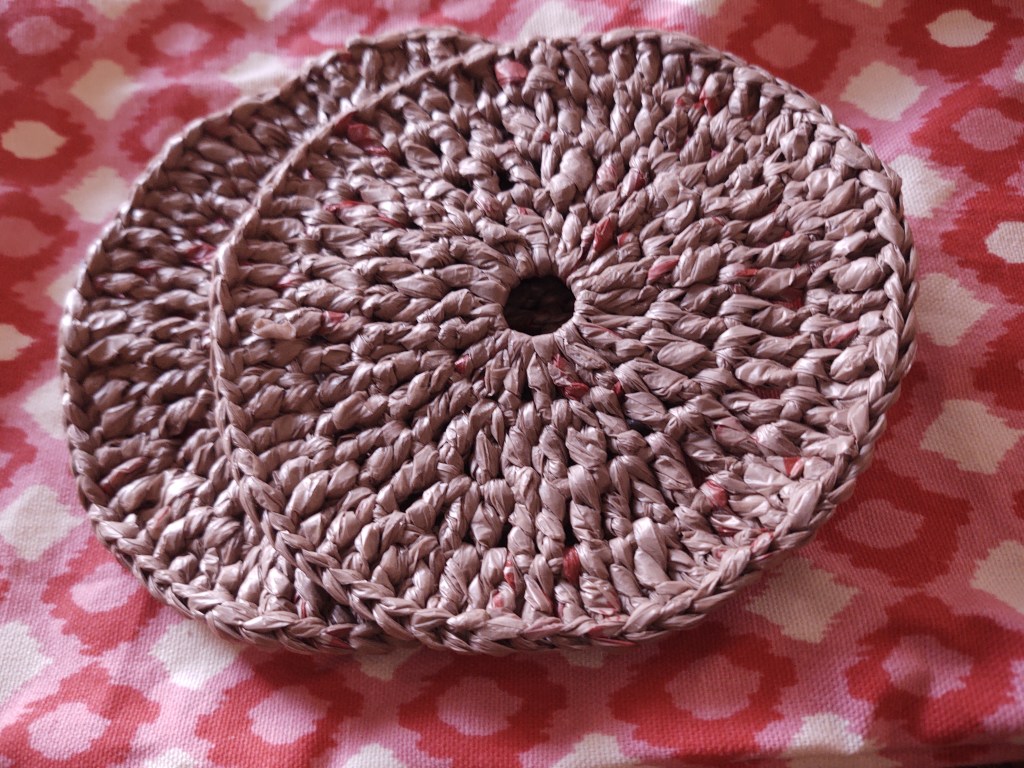
Here are the pictures of the two I’ve made so far, I love them and my entire family uses them. I like that I get to leave them on the table unlike my fabric ones, which I have to keep in a drawer, put them out on special occasions and wash after most uses.

Crochet plarn coasters

The background of the picture is of the fabric napkins I made. I’ll show you pictures of them eventually.

Note: if you’re crocheting these, count your rounds very well so as to make a perfect circle. I messed up and added an extra stitch, and it created a ruffle effect, rather than a perfect circle, I use the ruffled one for dish washing.

Next, I’ll show you my plarn baskets. I made 2 nesting baskets to house our rock collections. I will make another basket of the same kind, then I found a cute heart basket and I want to make a plarn one. Again, not for storage but for display of our rock collections.

Other projects I’m working on (I usually have a few going on at once and I embark on super easy and short projects like coasters and baskets that take an evening or a day to make:

  • Pillows, I have been recycling old pillows into new fancy throw pillows, I have one I’m about to finish, everyone loves them. (Finished 1)
  • Girly blanket: this is long term project. It’s for my youngest daughter. I plan on finishing it when I am healing from having my baby. (Added new color)
  • Plarn bag: this is a super long term project. It’ll take a lot of bags and I’m using super tiny stitches.

Thanks for reading and if you’re so inspired let me know what are you working on?

Eve