History of Poetry (1). The Origins – Exploring Oral Tradition and Mythology

Dear reader,

Are you a poetry lover or an educator who uses poetry?

I am studying the history of poetry. Thank you for embarking on this journey with me.
“The Ancient Stream” the beginning of the poetry collaboration on Twitter/ X.

In my home education journey, I am still working to get my children more involved with poetry. My oldest agreed to take a class about poetry. She also studied Shakespeare.

Previously, when we tried online school, I helped my two oldest kids write poems for classes. My oldest kid won second place in a poetry competition. They have created their own poems after watching me write many poems of my own.

Previous to attempting to teach my kids the history of poetry, I have to learn more about it myself.

As I researched this topic to create something solid, I learned so much that I didn’t know about the power of poetry, and I’m excited to share.

Eventually, I’ll collect all this information together into an ebook – presentation for my kids to study when they’re ready.

This material is advanced, not for kids. This could be useful to teenagers, young adults, poets, writers, and teachers/ homeschool parents.

Why I study poetry

I see poetry as the king of language.

I study poetry more than for its beauty. I can’t even express why. All I can say is that poetry is in my DNA. I feel certain word combinations deeply. Poetry that resonates with me has the potential to be more than inspirational. It can be life changing.

Studying poetry and its rich history and tradition offers numerous gifts, including:

1. **Cultural Insight**: Poetry provides a window into the values, beliefs, and societal norms of different cultures throughout history.

2. **Language Mastery**: Analyzing poetry enhances language skills, including vocabulary, syntax, and figurative language comprehension.

3. **Emotional Expression**: Poetry explores complex human emotions and experiences in ways that prose often cannot, fostering empathy and emotional intelligence.

4. **Historical Context**: Poems reflect historical events, movements, and perspectives, offering unique insights into the past.

5. **Aesthetic Appreciation**: Studying poetry develops an appreciation for the beauty of language, imagery, rhythm, and sound.

6. **Critical Thinking**: Analyzing poetry sharpens critical thinking skills by requiring interpretation, evaluation of themes, and exploration of multiple meanings.

7. **Creativity and Imagination**: Writing and studying poetry encourage creative expression and imaginative thinking.

8. **Personal Growth**: Engaging with poetry promotes self-reflection, mindfulness, and personal growth through introspection and exploration of universal themes.

9. **Literary Tradition**: Understanding the history of poetry connects us to a rich literary tradition spanning millennia, influencing modern literature and culture.

10. **Cross-Cultural Connections**: Poetry transcends borders and languages, facilitating cross-cultural understanding and appreciation.

11. **Psychological Insight**: Poetic expression often delves into the depths of human psychology, offering insights into the human condition and psyche.

12. **Spiritual and Philosophical Exploration**: Many poems explore existential questions, spiritual beliefs, and philosophical inquiries, inviting contemplation and dialogue.

Studying poetry thus enriches our understanding of language, culture, history, and ourselves, making it a valuable pursuit across educational, personal, and professional realms.


**Introduction: Unraveling the Mysteries of Poetry**

Poetry, as an art form, transcends time and culture, serving as a medium of expression, storytelling, and cultural preservation. Delving into its origins leads us into the realms of ancient oral traditions and mythology.

**Section 1: Origins in Oral Tradition**

Poetry emerges from the dawn of human language, intertwining with oral traditions passed down through generations. Before the advent of written language, early societies relied on oral poetry to convey history, myths, rituals, and moral lessons. These poetic narratives were crafted with rhythmic patterns and mnemonic devices, aiding in their memorization and transmission across cultures.

Scholars believe that the origins of poetry are deeply entwined with the development of language itself, evolving from primitive chants and incantations into structured forms that encapsulated the essence of human experience. While the exact beginnings remain obscured by the mists of prehistory, archaeological evidence and comparative linguistic studies offer glimpses into the ancient roots of poetic expression.

**Section 2: Poetry and Mythology**

In the era of early civilizations, poetry and mythology were intricately woven together. Mythological narratives often found their voice in poetic forms, serving as a means to explain natural phenomena, celebrate heroes, and uphold societal values. Examples abound across ancient cultures, from the epic hymns of Sumerian mythology to the lyrical odes of Greek legends.

These mythopoetic traditions not only preserved cultural identity but also provided a medium for exploring existential questions and the mysteries of the human condition. Through poetry, ancient peoples forged connections with their ancestors, gods, and the cosmos, creating narratives that resonated through time and space.

**Conclusion: Poetry as a Gateway to Human History**

The origins of poetry, rooted in oral tradition and mythology, underscore its fundamental role in shaping human consciousness and cultural evolution. While the precise moment of its inception eludes us, poetry’s enduring legacy as a conduit of expression and cultural memory remains indisputable.

As we embark on a journey through the annals of poetic history, we unravel not only the mysteries of our past but also rediscover the timeless power of language and creativity. Poetry, in its myriad forms and voices, continues to inspire, provoke, and illuminate the human experience, inviting us to explore the depths of our collective heritage.
Excerpt from “The Ancient Stream” an ongoing poetry collaboration on Twitter/ X.

Homer. The Illiad and the Odyssey

Homer, believed to be the author of the epic poems “The Iliad” and “The Odyssey,” composed these works during a time when writing was not yet prevalent in ancient Greece. Instead, these monumental epics were passed down orally, generation after generation, through skilled storytellers. Historians don’t know much about Homer.

This oral tradition not only preserved the narratives of heroic deeds and mythological tales but probably also added layers of improvisation and embellishment with each retelling.

There was potential for alterations and adaptations over time, as oral transmission is inherently susceptible to changes influenced by cultural shifts and the storyteller’s interpretative lens. Despite these challenges, Homer’s epics endure as masterpieces of ancient literature, showcasing the power of oral tradition in preserving and transmitting cultural heritage.

I wonder what these epics were like when they were transmitted orally.

In modern times, we know all about The Illiad and The Odyssey. We have read translations, watched movies, and documentaries about it. What we can appreciate is the language it was written in, the ancient Greek form of poetry, which largely differed from modern poetry. I don’t think it’s possible to recreate that kind of poetry in English.


Sources for our continued study

Here are some sources and references that we can use for further study on the origins of poetry and its connections to mythology:

1. **Books:**
   – *The Power of Myth* by Joseph Campbell and Bill Moyers – Explores the role of mythology in human culture and storytelling.
   – *The Poetics* by Aristotle – Classical work on the principles of poetry and drama.
   – *The Epic of Gilgamesh* – An ancient Mesopotamian epic poem, one of the earliest known literary works.
   – *The Odyssey* and *The Iliad* by Homer – Classic examples of epic poetry from ancient Greece.

2. **Articles and Academic Papers:**
   – JSTOR is a database that provides access to various scholarly articles on ancient poetry and mythology.

https://www.jstor.org/

The archaeology of language  https://www.cambridge.org/core/journals/antiquity/article/abs/archaeology-of-language-originsa-review/4B053CBE2C6D633D3345CE8EE157BB78#


3. **Websites and Online Resources:**
   – Ancient History Encyclopedia  – Provides articles and resources on ancient civilizations and their literary traditions.

https://www.ancient.eu/


   – Theoi Greek Mythology (https://www.theoi.com/) – A comprehensive resource on Greek mythology, including myths often conveyed through poetry.
   – Internet Sacred Text Archive (https://www.sacred-texts.com/) – Offers a collection of texts from ancient and modern religions, including poetic works and mythological narratives.


These sources provide a solid starting point for readers interested in exploring the origins of poetry and its connections to mythology in greater depth. They cover a range of perspectives from academic studies to literary classics, ensuring a well-rounded approach to understanding this foundational aspect of human culture.

Links

Oral traditions and the internet https://g.co/kgs/AZLWcho

Thank you very much for engaging with supporting poetry. Poetry can help support you as well.

I will bring you more poetry history, which will surely impress serious students of this art-craft.

With love,

Eve

Can I learn a new language in 6 months? My experience from studying my 3rd language

Dear reader,

Today, I read a wonderful article on the Duolingo app, but I couldn’t share a link with you. So, I will tell you what it said.

Let’s connect on Duolingo: find me as Eve Sanchez or Eve Lovestar, and I’ll follow you back.

The article, written by a senior learning scientist and language learning expert, Dr. Cindy Blanco explains why we can’t become fluent in a new language in 6 months.

Why we can’t learn a language in 6 months by Dr. Cindy Blanco

In the Duolingo article, the learning scientist says the first thing is that fluent means different things to different people. Obviously, what’s fluent to the people who claim they learned a language in 3 months (I have seen ads) is different from me.

When I was learning English, my second language, I told people who I could understand in perfect English that I only spoke a little bit of English. I had an American boyfriend and was communicating with him only in English (he taught me), but I was extremely careful not to claim I knew more than I actually knew!

Maybe after a year of living with my boyfriend, now my partner and father of my children, I said I spoke English. It took me years total to feel fluent. Some people can make such a claim a lot faster than I did. This is because fluent means different things to different people.

Then Cindy explained how much there is to learn, such as grammar, vocabulary, pronunciation, and more. There’s no way to learn so much well in 6 months. There’s not even enough time for enough repetition.

“Repetitio est mater studiorum”

“Repetition is the mother of learning.”

This is a popular Roman saying in Latin attributed to someone named Varro. I read he was an educator.

Back to the article, Cindy Blanco then explained that what people refer to by saying “fluent” is confident and conversational.

Just like me, having an English conversation to explain in perfect English sentences:

“I don’t speak English ”

                 “But you’re speaking English”

“But I only speak a little ”

                  “Can you understand me?”

“Yes, but I have to think and translate in my mind”

Ok, that last sentence is not something I said 17 years ago. I understand this now.

Language skills we can learn in 6 months

Cindy Blanco, Duolingo’s learning scientist, says: “Yes, we can become comfortable and conversational in a new language within 6 months”

Why some learn languages so fast

I want to be one of these magical unicorns and now, learning a 3rd language (of course, I’m studying 3 languages at once, 2 of them I’m doing good in), it’s much easier and faster.

Per Cindy, people who learn a language very fast have these things in common:

  • Previous language learning experience. Like me, learning a third language feels great, so much easier than learning a second language. We already know how to learn a second language and feel super confident in our ability to learn a third one.
  • They are committed. There’s no excuses. I will learn this language no matter what! The language better watch it because I’m coming to acquire it! I dropped even blogging and poetry writing (my favorite things to do) to learn Latin full time. I also got off social media, but it was easy to do, and i was the happiest I’ve been in recent years studying Latin.
  • They start practicing the new language right away, on day one. Shameless practice is what I call this. I’m not at all fluent in Latin, but I wrote a poem in Latin! I talk to my daughter in Latin. I teach Latin words to my partner. I’m making the Latin connection into English and Spanish. Oh, I’m also attempting to sing in Italian. A month ago, I only knew 3 words in Ialian…
  • They excel at making mistakes. I understand this because mistakes are so embarrassing. English, my second language, such an embarrassing experience to me… but I have been making videos of my Latin learning experience in Duolingo and showing off my progress on YouTube. I mess up for all to see, then laugh at it. On a poem I wrote in my first week of Latin, a poem in which I spoke of Latin learning and said 2 words in Latin. I said Vos (you in plural) was tu (you but in the singular). The shame was not present. Instead, I’ll never forget these 2 words. Mistakes are teachers, too.
  • They immerse themselves.  Immersion is a word you hear a lot if learning about language learning. This is how I’m getting immersed in Italian: I started listening to Italian music, followed Italian artists on Twitter, and I am listening to an Italian podcast. This is the third week, maybe, but I plan on learning exclusively by interacting with the language, and I’m doing really well. Getting immersed to Latin was harder but for a while I’ve been reading in Latin, studying Roman history, reading Latin poetry, investigating how much Latin is Greek, listening to podcasts in Latin, watching videos in Latin. There’s not a lot of options since it’s an ancient language, but this makes learning it fun. I’m also reading about mythology because it’s fun.
  • Finally, people who learn a language fast put in the time. They’re not lazy about it. They do not dread studying the new language. They love it! It’s mind play with art which is language.

My conclusion

Once you enjoy your language learning, you learn incredibly fast.

Immersion can also be obsession of a positive kind. I can’t stop thinking of Latin!

Next step: think in Latin

What language are you studying?

I study Spanish, English, Latin, Ancient Greek, and Italian.

Thanks for visiting,

Eve

Empowering Education Choice: Introduction to Education Scholarship Accounts (ESAs)

Dear friend,

My beloved partner and I home educate 3 children (our 2 youngest are toddlers). It is no easy task. Today, I want to express my gratitude for the funds the Arizona state provides my children for our choice of education: their ESAs, which allow us to hire amazing tutors and get the needed materials for their education.

We use these funds to get computer equipment, books, materials, pay tutors, and more. These funds help us immensely and have upgraded our home education efforts so much.


What is an ESA?

Education Scholarship Accounts (ESAs) represent a growing trend in educational policy aimed at empowering parents with greater control over their children’s education. Originally pioneered in Arizona and now available in several states across the United States, ESAs provide families with public funds that can be used to customize their children’s learning experiences beyond traditional public school offerings.

What are Education Scholarship Accounts (ESAs)?

Education Scholarship Accounts are state-funded accounts that allow parents to use allocated funds to cover various educational expenses. These accounts are flexible, allowing families to personalize their child’s education by choosing from a range of approved educational services and products. This includes private school tuition, tutoring, textbooks, online courses, special education services, and more.

How do ESAs work?

ESAs typically operate through a government-approved organization or directly through the state education department. Parents receive a portion of the state’s per-pupil funding that would have been allocated to their child’s public school education. This funding can then be used to pay for approved educational expenses. ESAs are managed by parents, giving them the ability to make decisions based on their child’s individual needs and educational goals.

Where are ESAs available?

While initially launched in Arizona in 2011, ESAs have since been adopted in various forms in other states, including Florida, North Carolina, Mississippi, Tennessee, and more recently, Oklahoma and Nevada. Each state’s ESA program may vary in eligibility criteria, funding amount, and allowable expenses, reflecting local educational priorities and policies.

Benefits of ESAs

ESAs offer several potential benefits to families:

  1. Choice and Flexibility: Parents can choose educational services and resources that best meet their child’s needs, including alternatives to traditional public schools.
  2. Customization: ESAs allow for tailored educational experiences, such as specialized tutoring or access to specific curriculum that may not be available in local public schools.
  3. Empowerment: By managing ESA funds, parents are empowered to actively participate in their child’s educational journey, fostering a more engaged and supportive learning environment.

Considerations

While ESAs provide increased educational freedom, they are not without controversy. Critics argue that diverting public funds to private education options could undermine public school funding and exacerbate educational inequalities. As such, the debate around ESAs continues to shape educational policy discussions nationwide.

In conclusion, Education Scholarship Accounts represent a significant development in education policy, offering families greater choice and flexibility in how they educate their children. As ESAs continue to evolve and expand across the country, understanding their impact and implications remains crucial for parents navigating the educational landscape.


Gratitude

Thank you to the government of AZ for creating this amazing program, and I do hope more states will allow them in the future.

We love ESAs and are not looking back to public school ever again.

No offense, of course, to families in public schools. It just doesn’t work for our family. 


Do you live in an ESA state?

Are you considering an ESA?


With love,

Eve

Exploring poetry as a tool for language learning. Part 2

Dear reader,

I currently use poetry as a tool for my language study, and I feel it’s the most fascinating way to study a new language. Let me tell you about my strategy.

My language study

I took to Duolingo for language learning and quickly realized that I needed more input. I chose Latin and quickly started watching YouTube videos about it, and (this is strange, but I felt it was a sign from the universe) I realized what I’d be doing with my Latin learning on my second day of learning it.

I immediately recognized that poets were huge in Ancient Rome, and of course, I should have already known that, as a poet…

The message I received from the universe was that I was going to read and translate the ancient Roman poetry (I did already translate one).

Then, I decided to learn the Ancient Greek alphabet and found gorgeous Greek romantic poetry, which I’m already working on just for fun. It is extremely complex, which makes everything else seem easy.

Then, I started following poets on Twitter and followed an Italian guy. I interacted with the guy, and he shared an Italian poem with me, so I have a soft goal of learning Italian. I am taking an Italian course and doing well as a total newbie.

So, me, a poet… learning languages with poetry is simply natural.

However, I believe it’s the most fun way to practice, which is why I want to tell you all about it.

Tips to use poetry for language study from a poet

  1. Start with Simple Poems: Begin with shorter poems or poems with straightforward language. This helps in understanding basic poetic structures and building confidence.
  2. If you don’t already read poetry: start with poetry in your language. Then, move on to bilingual poetry.
  3. Focus on Themes of Interest: Choose poems that resonate with your personal interests or topics you are passionate about. This makes the learning process more enjoyable and meaningful.
  4. Read Aloud and Listen: Poetry is meant to be heard. Read poems aloud to practice pronunciation, intonation, and rhythm. Listening to recordings of native speakers reciting poems helps in understanding cultural nuances and natural cadence.
  5. Analyze and Discuss: Break down poems line by line to grasp their meaning, themes, and literary devices. Discuss interpretations with language partners or teachers to gain different perspectives.
  6. Write Your Own Poems: Use the language you’re learning to compose your own poems. This reinforces vocabulary, grammar, and creativity while allowing for personal expression. Writing your own poetry has the potential to lift your spirits, help you grow, and increase your self steem! 🙏
  7. Explore Different Poetic Forms: Experiment with various forms like haikus, sonnets, or free verse. Each form challenges different aspects of language skills and encourages exploration of cultural differences in poetic expression.
  8. Use Poetry Collections and Anthologies: Explore collections of poems from different cultures and time periods. This broadens exposure to diverse linguistic styles and historical contexts. Note: When you’re advanced, read the very old poetry.
  9. Integrate Technology: Utilize language learning apps, online forums, and social media to share and discuss poetry with native speakers and other learners worldwide.
  10. Attend Poetry Readings and Events: Immerse yourself in the local poetry scene or attend virtual poetry readings. This provides exposure to authentic language use and cultural insights.
  11. Be Patient and Persistent: Learning through poetry requires patience and persistence. Embrace challenges as opportunities for growth and celebrate progress along the way.

By incorporating these tips into your language learning journey, you can effectively harness the power of poetry to enhance your linguistic proficiency and deepen your appreciation for the beauty of language and literature.

Learning Spanish?

Consider my Spanish class:

https://payhip.com/b/NLMdU

Thank you for reading,

Eve

Exploring Poetry as a Tool for Language Learning

Dear reader,

I am currently reading poetry in Latin for my humble Latin learning practice. Let’s discuss why poetry is a fun and effective way to acquire a new language.

This applies to students who already have some knowledge of the new language. If you are starting to read in your target language, this tip applies to you.

Medium Level Spanish poem: The poet feels deeply where others refuse to feel. The poet is not afraid of love, even though he/ she is conscious that it might one day turn off.

Poetry, with its intricate use of language, offers a unique avenue for learners to delve deeper into a new language. Far from the straightforward prose typically encountered in language textbooks, poetry presents learners with a challenge that extends beyond mere grammar and vocabulary. It demands an understanding of cultural nuances, literary devices, and a keen ear for rhythm and cadence.

Yet poetry, with its whimsical beauty, can be the catalyst for a deeper understanding of a new language. I read the same poem for over a week hundreds of times in Latin, and I then translated it. Yes, it took a week, but that’s nothing compared to never understanding that gorgeous piece of literature.

Complexity of Poetry

At its core, poetry is a linguistic art form that pushes the boundaries of language. Its condensed and often metaphorical nature forces readers to interpret meaning beyond literal words. This complexity serves as both a hurdle and an opportunity for language learners. By grappling with poetic verses, learners are exposed to varied sentence structures, idiomatic expressions, and figurative language that are essential for fluency.

Stepping Out of the Comfort Zone

Engaging with poetry requires readers to step out of their linguistic comfort zones even if the poetry we’re reading is in our first language. Unlike everyday language, poetry uses heightened language, symbolism, and imagery, challenging learners to think critically and creatively. This exposure not only enriches vocabulary but also enhances comprehension skills by encouraging deeper analysis of context and subtext.

Linguistic and Literary Growth

Studying poetry aids language learning by fostering a deeper appreciation for the nuances of grammar and syntax. Poetic forms such as sonnets, haikus, and ballads adhere to specific structures, exposing learners to formal conventions while encouraging experimentation with language. Moreover, the rhythmic patterns inherent in poetry improve pronunciation and cadence, aiding in the development of natural speech patterns in the target language.

And dare I say that the repetition in poetry could assist I memory because like that ancient Roman smart guy said

Repetition is the mother of learning.

Another cool thing about poetry is that you can read a poem 5000 times if you love it.

Cultural Insight and Empathy

Poetry serves as a window into the cultural and historical contexts of a language. By exploring poems from different periods and regions, learners gain insight into societal norms, values, and perspectives. This cultural immersion not only enhances language proficiency but also cultivates empathy and cross-cultural understanding.

Practice Makes Proficient

Practicing poetry reading or, better yet, writing in a new language further solidifies linguistic skills. Crafting poems forces learners to apply grammar rules, expand vocabulary, and experiment with stylistic devices. This active engagement promotes language retention and fluency by reinforcing learned concepts in a creative and memorable manner.

Conclusion

In conclusion, while poetry may initially seem daunting to language learners, its inherent challenges and rewards make it a powerful tool for linguistic and literary growth. By embracing the complexity of poetic expression, learners not only enhance their language proficiency but also deepen their understanding of cultural contexts and human experience. Thus, integrating poetry into language learning curriculum enriches the educational experience, fostering a lifelong appreciation for language and literature.

Are you learning a language?

Are you already reading poetry in your target language?

If you’re learning Spanish, I have a multitude of poems for your reading pleasure and language peactice.

Please let me know if you’re searching for Spanish reading texts.

With love,

Eve

Understanding Home Education: Exploring the Misconceptions and Realities

Dear reader,

I home educate my 5 children, and today I will expose some of the misconceptions and realities of homeschooling.

Home education, often referred to as homeschooling, is a practice that has gained considerable attention and popularity in recent years. While it offers flexibility and personalized learning experiences, it is also surrounded by numerous misconceptions that shape public perception. In this article, we delve into the intricacies of home education, shedding light on both the myths and the realities.

Misconception 1: Limited Socialization Opportunities

One of the most common misconceptions about home education is that it isolates children from their peers, leading to inadequate socialization. However, contrary to this belief, homeschooling allows for diverse social interactions. Families engage in community activities, co-ops, sports teams, and extracurricular classes, fostering meaningful relationships with peers of different ages and backgrounds.

Misconception 2: Lower Academic Standards

Critics often argue that homeschooling lacks rigorous academic standards compared to traditional schooling. Yet, many homeschooling families follow structured curricula aligned with national or state educational standards. Furthermore, the personalized nature of home education enables tailored approaches to learning, often resulting in academic achievements that surpass those of traditional school settings.

Misconception 3: Parental Qualifications and Time Commitment

There is a misconception that parents who homeschool must be highly educated or have teaching credentials. While some states or countries have specific requirements, many jurisdictions do not mandate formal qualifications for parents. Moreover, homeschooling families can leverage a variety of resources, including online courses and community support, to supplement their teaching efforts.

Reality 1: Customized Learning Experiences

One of the greatest strengths of home education lies in its ability to cater to the individual needs and interests of each child. Parents can adapt teaching methods and curriculum to accommodate different learning styles, allowing students to progress at their own pace and explore subjects in depth.

Reality 2: Flexibility in Scheduling and Curriculum

Unlike traditional schooling, homeschooling offers flexibility in scheduling. Families can structure their days to optimize learning based on individual rhythms and interests. Furthermore, they have the freedom to choose curricula that align with their educational goals, religious beliefs, or philosophical convictions.

Reality 3: Positive Outcomes and Success Stories

Research indicates that homeschooled students often excel academically and socially. They typically perform above average on standardized tests and exhibit high levels of self-esteem and motivation. Many colleges and universities actively recruit homeschool graduates for their diverse backgrounds and strong academic preparation.

Conclusion

In conclusion, home education is a viable educational alternative that continues to grow in popularity worldwide. While misconceptions persist regarding socialization, academic standards, and parental qualifications, the reality reveals a dynamic and enriching educational experience. By understanding and appreciating the complexities of homeschooling, we can foster informed discussions and support for families who choose this path for their children’s education.

Through ongoing research and dialogue, we can continue to explore ways to enhance educational options and outcomes for all students, whether they learn in traditional classrooms or at home.

Is home education something that interests you?

Do you or have you home educated?

Tips for learning a second language

Dear reader,

I speak two languages, and I’m learning 3 new languages right now. My study of these three new languages will be for life.

I’m going to offer tips that helped me learn English, which is my second language, and I will be using these tips to learn my three new languages (Latin, Ancient Greek, and Italian).

Tips for learning a second language

Here’s a list of effective tips for learning a second language:

1. **Immerse Yourself**: Surround yourself with the language as much as possible through media, conversations, and cultural activities.

2. **Practice Regularly**: Consistency is key. Practice speaking, listening, reading, and writing every day.

3. **Start with the Basics**: Master the fundamentals of grammar, vocabulary, and pronunciation early on.

4. **Set Realistic Goals**: Break down your learning into achievable milestones to stay motivated.

5. **Use Language Learning Apps**: Apps like Duolingo can provide structured lessons and practice.

6. **Find a Language Partner**: Practice speaking with native speakers or fellow learners to improve fluency and confidence. Or follow native speakers on YouTube, Twitter, etc.

7. **Listen and Repeat**: Mimic native speakers to improve your accent and intonation.

8. **Learn from Context**: Understand phrases and expressions within their cultural and situational context.

9. **Keep a Vocabulary Notebook**: Write down new words and review them regularly.

10. **Watch Movies and TV Shows, listen to music**: Listen to dialogue and immerse yourself in the language.

11. **Read Books and Articles**: Start with simpler texts and gradually move to more complex ones.

12. **Join Language Classes or Groups**: Formal classes or online communities can provide structure and support.

13. **Travel to a Country Where the Language Is Spoken**: Immerse yourself in the culture and practice speaking with locals.

14. **Don’t Be Afraid to Make Mistakes**: Learning from errors is an essential part of the language acquisition process.

15. **Stay Motivated**: Remind yourself why you want to learn the language and celebrate your progress along the way.

By incorporating these tips into your language learning routine, you can enhance your skills and proficiency more effectively.

Which ones have you used?

Which ones are most helpful?


Which languages do you speak or are learning?

Eve

Shall I compare thee to a summer day? Solstice poetry by Shakespeare with modernization of the poem

Dear Lovestar, Happy Solstice! I didn’t write a summer poem yet, so I decided to let Shakespeare do the speaking today. Read and enjoy one of the most popular and beloved poems ever by the most famous English poet.

Shakespeare sonnet 18

Shall I compare thee to a summer’s day?Thou art more lovely and more […]

Shall I compare thee to a summer day? Solstice poetry by Shakespeare

Empowering Parents: The Case for Homeschooling

Dear reader,

Let’s discuss the benefits of home education focusing on specific research that is promising.

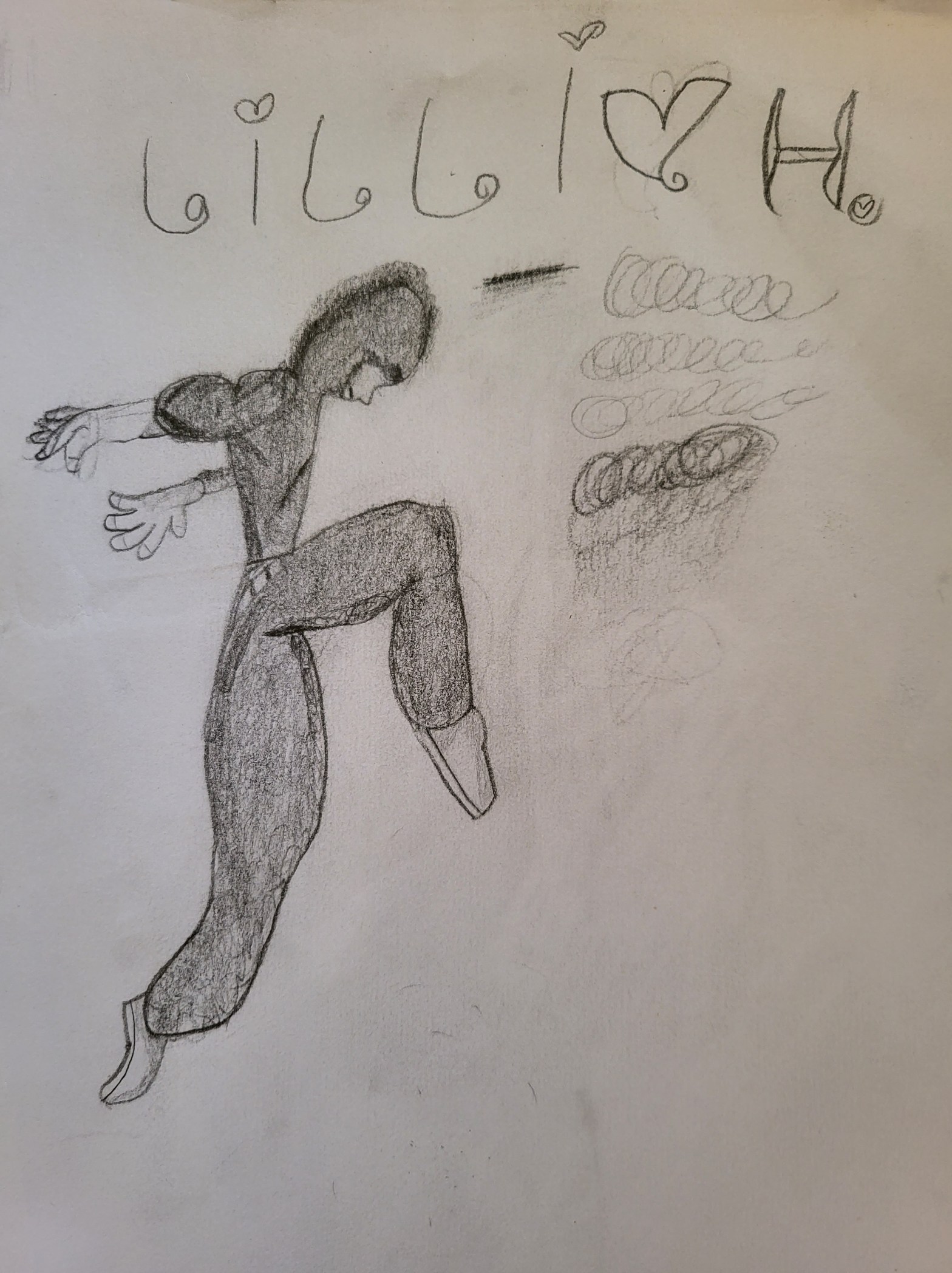
My daughter Lilli is very proud of this art she learned to create on Outschool, our tutoring service of choice

In recent years, the landscape of education has evolved dramatically, with an increasing number of families opting for homeschooling as an alternative to traditional schooling. This shift is driven by various factors, including the desire for greater parental involvement in a child’s education and the flexibility to tailor learning experiences to individual needs. As debates continue on the effectiveness of homeschooling, several studies highlight compelling reasons why empowering parents with more control over their children’s education can be beneficial.

**1. Personalized Learning**

One of the primary advantages of homeschooling is the ability to customize the educational experience to suit the unique learning style and pace of each child. Research by Dr. Brian Ray, founder of the National Home Education Research Institute (NHERI), suggests that personalized instruction leads to better academic outcomes and higher levels of student engagement. Parents can adapt curriculum materials, teaching methods, and schedules to match their child’s strengths, interests, and developmental stage, fostering a more effective learning environment.

**2. Stronger Family Bonds**

Homeschooling often strengthens familial relationships by providing more opportunities for meaningful interaction and shared learning experiences. A study published in the Journal of Research in Childhood Education found that homeschooling families reported closer parent-child relationships and increased communication compared to families with children in traditional schools. The collaborative nature of homeschooling encourages parents to actively participate in their child’s intellectual and emotional growth, creating a supportive and nurturing environment.

**3. Enhanced Academic Performance**

Contrary to misconceptions, research indicates that homeschooled students perform well academically and excel in standardized tests. According to a longitudinal study by Dr. Lawrence Rudner, homeschool students consistently scored above the national average on standardized achievement tests across all subjects and grade levels. This academic success is attributed to individualized attention, focused instruction, and the ability to explore subjects in greater depth based on the child’s interests and abilities.

**4. Flexible Learning Opportunities**

Homeschooling offers flexibility in terms of curriculum, scheduling, and learning environments. Parents can incorporate real-world experiences, field trips, and hands-on activities into daily lessons, enhancing practical skills and critical thinking abilities. This flexibility also accommodates diverse family lifestyles, such as travel, religious observances, or accommodating special needs, ensuring that education remains accessible and relevant to each child’s circumstances.

**5. Socialization and Community Engagement**

Concerns about socialization are often raised regarding homeschooling, but studies show that homeschooled children actively participate in community activities, sports, and social groups. Research published in the Peabody Journal of Education found that homeschool students develop strong interpersonal skills, exhibit higher levels of self-esteem, and engage positively with peers and adults in various settings. Additionally, digital platforms and homeschool co-ops provide opportunities for collaborative learning and social interaction, fostering a well-rounded educational experience.

**Conclusion**

As the landscape of education continues to evolve, homeschooling emerges as a viable option for families seeking greater autonomy and control over their children’s educational journey. Empowered by research and supported by educational resources, parents can effectively tailor learning experiences that promote academic excellence, foster strong family bonds, and nurture holistic development. While homeschooling requires commitment, dedication, and ongoing support, its potential to empower parents and enrich children’s lives remains a compelling argument in favor of parental control over education.

Do you have any interest in home education?

Eve

Homeschool Plan: Learning Latin to inspire my children to learn Spanish/ languages

Dear reader,

First of all, this is absolutely not 100 percent of my homeschooling log. Additionally, my babies have awesome tutors, and I supplement their learning.

Spanish is my first language. But I speak mostly English now. Dad speaks only English.

Our children were not interested in learning Spanish, so I didn’t force them.

Now, they’re more open since spending time with my mom and making friends who only speak Spanish that they could not understand.

My plan to practice amazing calligraphy to inspire my babies to do better (more legible and beautiful) handwriting worked, and I have pictures of their new improved handwriting to prove it. The progress happened within a week of my practice.

I decided to use the same exact tactic to inspire my kids to learn a language. Hopefully, they’ll learn Spanish, but I’m flexible and will let them choose their own language to learn.

I started learning Latin one month ago to show my studying and learning to my kids. My second daughter already practiced with me, though she thought it was boring.

I have had an interest in learning a third language for a long, long, long while, and my favorite sounding new language is Portuguese. Portuguese shares the root of Spanish, and that makes it easier for me to understand. I’m constantly trying to read Portuguese texts. (Note to self: follow Portuguese poets on Twitter)

I actually want to learn Hindi, though, because I love India, and this is a bit crazy but I want to retire in India, and I feel I have a deep connection to India and its culture. Hindi is extremely hard to learn: it has an entirely different script, so our Latin/ Greek influence will not help me there.

I did a tiny bit of Hindi and Sanskrit study just for the awareness. If I retire in India, I’ll need to know some Hindi, I’ll consider the study in the future, and I think it would be a lifelong study of that language. Their script is lovely, and my interest, of course, is to read their divine ancient texts before translation: it would be an insane amount of learning as I learned the original Sanskrit has an even older script! Learning two totally new scripts would be such a burden.

Either way. I downloaded the Duolingo app and went searching to start learning Hindi, but it wasn’t on the app, and I didn’t want to learn any of the languages available (because I’m interested in ancient texts)

But Latin was an option! I never had an interest in learning Latin. I know Spanish was developed from Latin and assumed it might be easier because of my fluent Spanish. However, I don’t like the Romans. And I don’t really care to read the Roman texts.

Latin was used to translate hieroglyphs, which I adore, and I understand there are uses. It might be the most used ancient language (that’s a total assumption). Anyway, I chose it because I’m doing this just for fun.

As soon as I chose Latin, I was happy it wasn’t Hindi! I might have abandoned Hindi studies by today because I like easy and fast progress and finding what I’m naturally good at.

I’m naturally good at learning Latin and by today, I know some vocabulary, history of the language, simple sentences, some grammar, I understand the Latin root of some English words, and got a bit comfortable in the learning process. I’m progressing fast, and I loved it. I’m really excited about it. I started learning yesterday!

My second daughter practiced a bit with me when she saw me! It was a huge success! I showed her and her older sister the Duolingo app and suggested they download it as it’s fun and perfect for children! My oldest daughter asked what vocabulary I’d learned, too.

I intend to watch Spanish videos with them and practice Spanish on Duolingo to impress them and pull them towards language learning.

Language learning is super fun, and I’m already looking for Latin poetry!

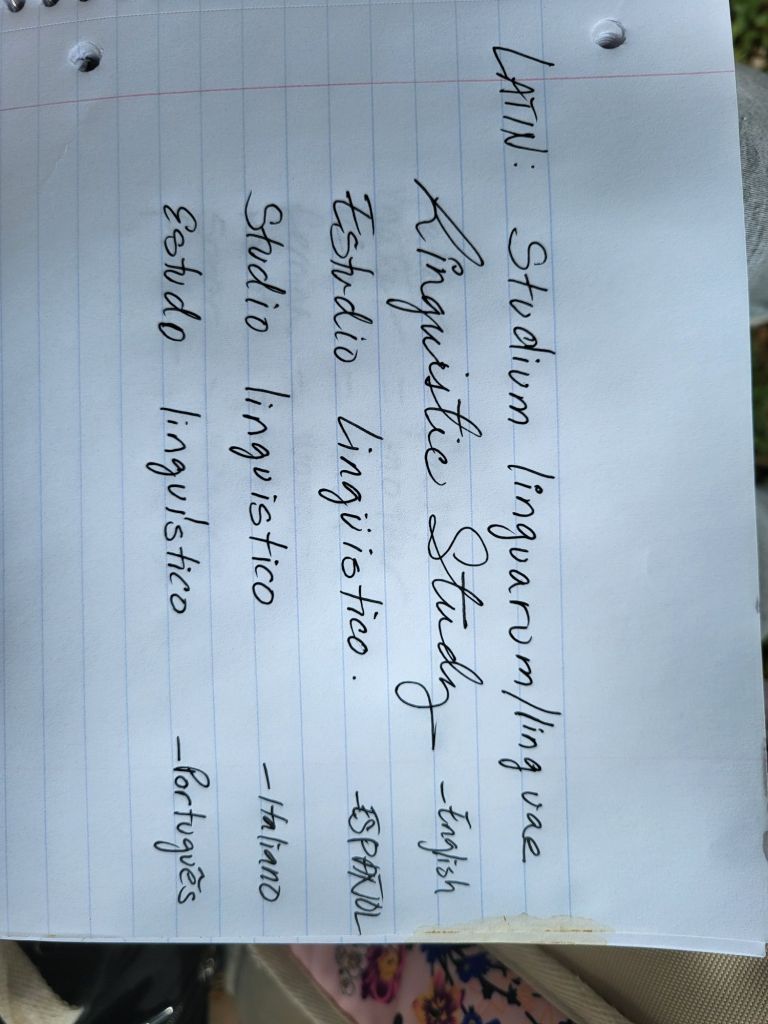
Linguistic study in Latin, English, Spanish, Portuguese, and Italian. Not about to study French any time soon.
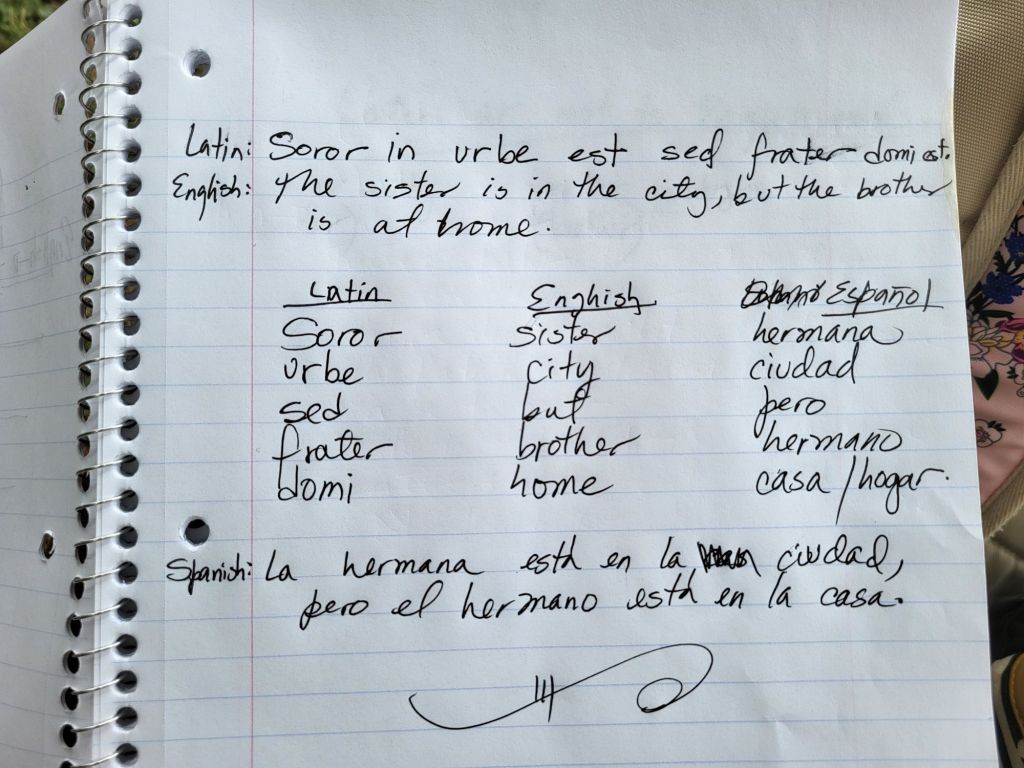
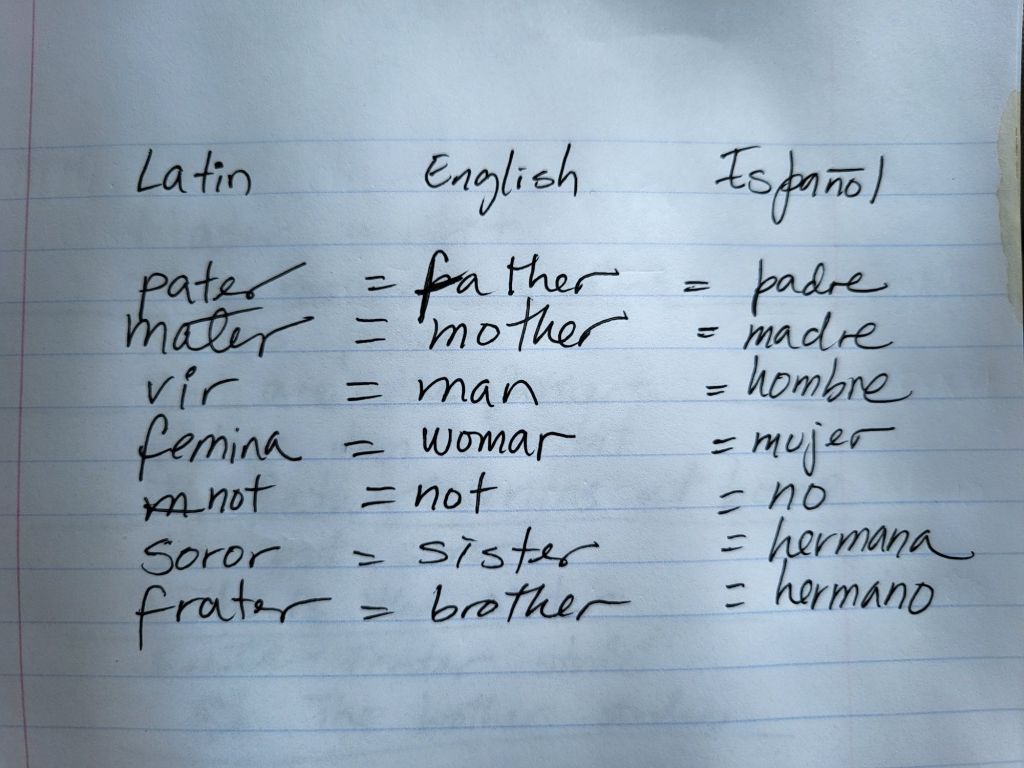
Latin to English/ Spanish sentence translation and vocabulary
Simple Latin sentences translated to Spanish and English
Latin – English – Spanish vocabulary

Eve