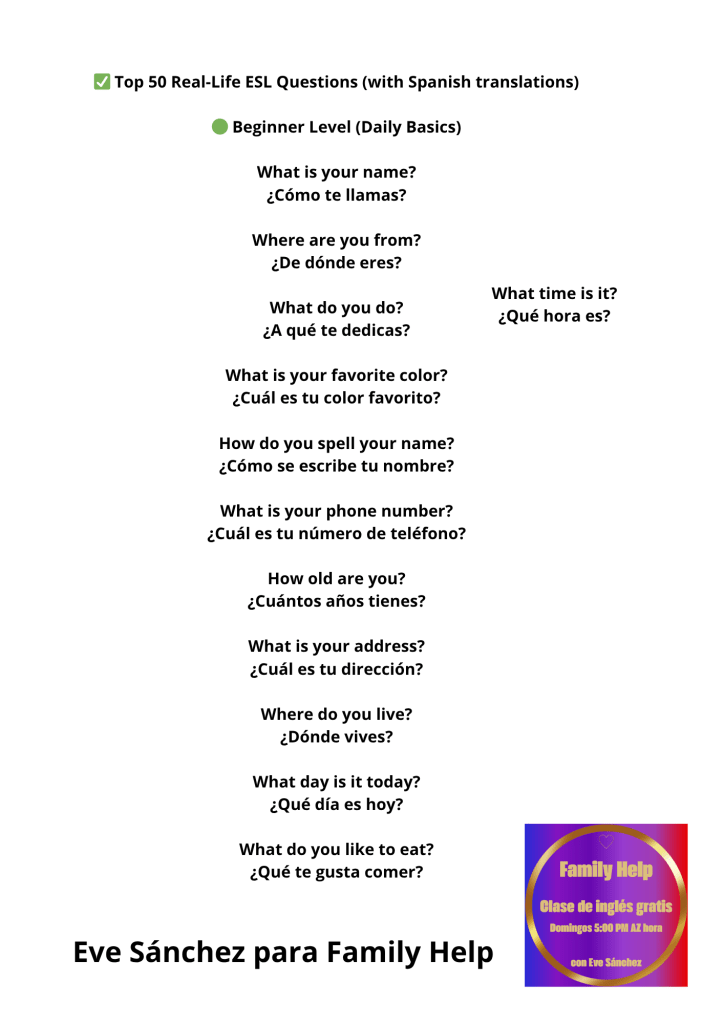
Family Help Free English Class – common questions – preguntas comunes

This material was designed to be useful to Spanish and English students.

Previous language translation materials

https://lovelightandlife.art.blog/2025/07/27/family-help-free-english-class-family-familia/

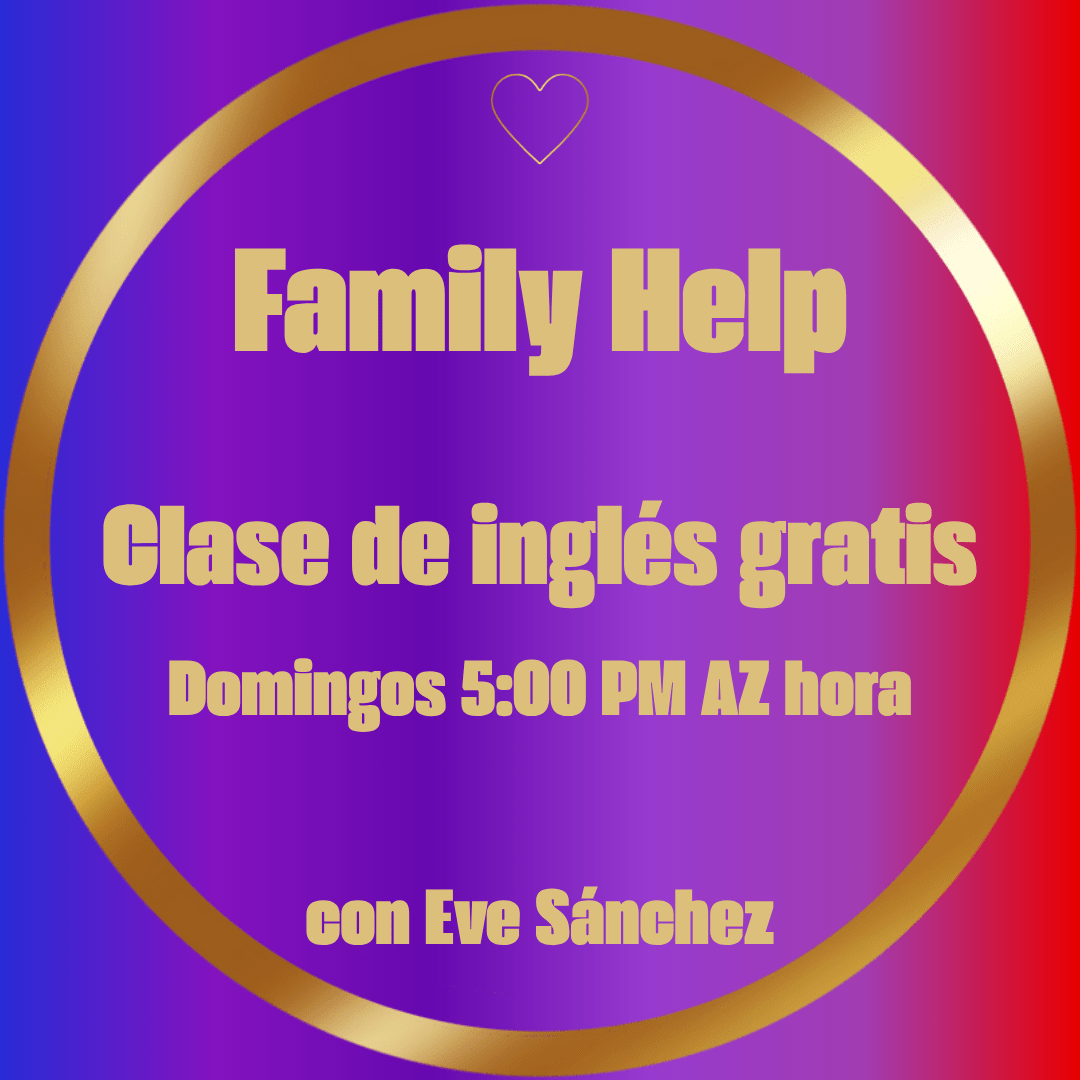
Clase de inglés gratis los domingos via Zoom:

https://us04web.zoom.us/j/78850803498?pwd=qGvbP0eNjZb2oBjoX1CrLQ9Januro3.1

Clase semanal interactiva | – Todos los niveles bienvenidos | – Siempre gratis

Únete a un espacio relajado y amigable para practicar inglés conversacional real de Estados Unidos, ¡el que se usa todos los días! Esta clase semanal está diseñada para ayudarte a:

– Entrenar el oído para entender el inglés natural

-️ Mejorar tu forma de hablar con conversaciones guiadas y divertidas

– Conectarte con otras personas en un ambiente cálido y acogedor

– Aprender expresiones y vocabulario útil que podrás usar en tu vida diaria

Hablaremos sobre la vida diaria, temas divertidos, emociones, cultura… como lo hacen los amigos. No es una clase de gramática: es una clase para ganar confianza, fluidez y comunicación real.

Eve

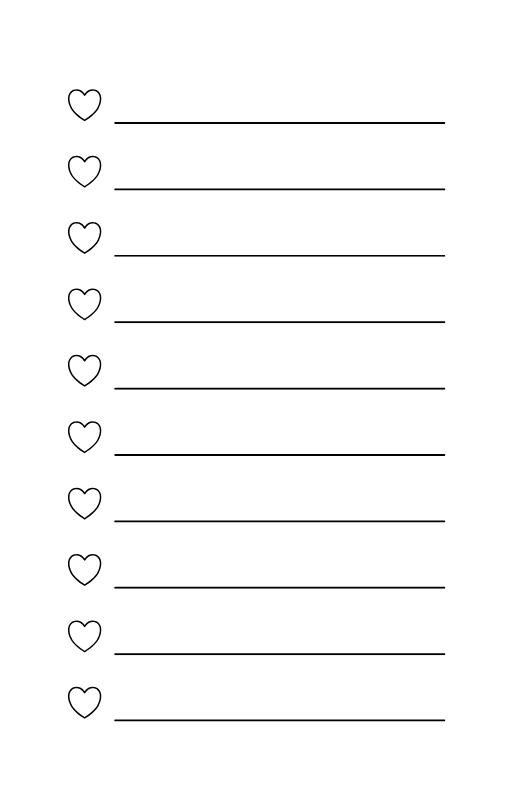
Heart List Printable for Children and Journaling Prompts – Homeschool

Dear reader,

Of course, you can print this list printable and write your list for your children, it would look better on my fridge that some lists I have posted.

But I am pitching this list printable as a homeschool journaling prompt. See the writing exercises below.

More learning offers on Etsy https://evelovestar.etsy.com

Here are 8 great journaling idea lists for kids, focusing on fun, creativity, and self-expression:

My Favorite Things

  • Write a list of your favorite books, movies, songs, or games.
  • Make a list of your favorite foods.
  • List your favorite animals and why you love them.
  • Write about your favorite place to visit and why it’s special.

2. Gratitude Lists

  • Write 5 things you are grateful for today.
  • List 3 people who make you happy and why.
  • Write 4 things about yourself that you like.
  • List 10 small things that make your day better (e.g., your favorite snack, a compliment, the sun shining).

3. Dream Big Lists

  • List 5 things you want to achieve when you grow up.
  • Write down 3 adventures you want to go on.
  • Make a list of skills you’d like to learn (e.g., playing an instrument, cooking, painting).
  • List 10 things that would make your dream home awesome.

4. Feelings and Emotions

  • Write a list of feelings you experienced today (happy, sad, excited, etc.).
  • Make a list of things that make you feel calm or peaceful.
  • Write about 5 things that make you laugh.
  • List 3 ways to cheer yourself up when you’re feeling down.

5. Things I Want to Learn

  • Make a list of new hobbies you want to try.
  • Write down 5 fun facts you’ve learned recently.
  • List things you are curious about and want to explore.
  • Write 3 questions you’d like to ask someone you admire.

6. Bucket Lists

  • List 10 things you want to do this year.
  • Write down a list of fun things you want to try with your family or friends.
  • List 5 places you’d love to visit one day.
  • Make a list of activities you’d like to do before the end of summer.

7. Nature and Outdoors

  • Write a list of your favorite outdoor activities.
  • Make a list of things you can find in the park (e.g., birds, flowers, bugs).
  • List 5 animals you’d like to see in the wild.
  • Write about your favorite seasons and what makes them special.

8. Creative Writing Prompts

  • List 5 characters you’d like to create for a story (e.g., a talking animal, a superhero).
  • Write about a magical world you’d love to visit.
  • List 3 events in your life that would make an interesting story.
  • Create a list of objects that might be in a treasure chest, and imagine the adventure to find it.

These prompts can be great for developing kids’ writing skills and encouraging them to think creatively and reflect on their emotions, interests, and dreams!

Previous Journaling Exercises

You can contact me on X @evelovestar

More learning offers such as Spanish classes, homeschooling aids, worksheets, and more on Etsy:

https://evelovestar.etsy.com

Eve

Lost in the Language Forest: How I Became Fluent in English & continue learning

Dear reader, I am preparing to “teach” an English class to my cousins and I am first preparing a language learning masterclass and I am finally ready to talk about my own language learning experience and tips I used learning my second language and how my language learning experience has evolved now that I study 2 languages (Latin & Italian for fun)..

I’ve been bilingual for about 17 years now. English is technically my second language, but at this point, it feels like my first. Still, for the longest time, I refused to say I was fluent. I could speak, yes — but to me, fluency meant ownership. It meant feeling the language in your bones, not just in your mouth. And until I knew I had it like that, I wouldn’t claim it. I’m picky that way. When I say I know something, I want to know it — not pretend or stretch the truth like so many do.

🌌 Language Learning Is Like Wandering a Dark Forest

Here’s a metaphor that lives in my bones: Learning a language is like getting lost in a forest at night. There’s no moon. No stars. You keep walking. You don’t understand anything, not even one thing, and you’re bumping into trees. But you keep going. You don’t judge the process. You trust the forest.

And eventually, you start to see shapes in the dark. You notice a path. You recognize a tree you’ve seen before. One day, you look up, and there’s light.

That’s what language learning has felt like for me over and over again. And I’ve learned that judgment kills curiosity, and curiosity is the magic fuel for all language acquisition.

🔄 Inputs and Outputs: The Secret Cycle

Language input is what you take in reading, listening, absorbing. Output is what you give speaking, writing, translating, teaching.

I’ve learned that when you teach, you learn twice. I’m learning Italian and Latin right now, but I’m also teaching English and, in the process, I’m learning how to learn. And that’s powerful. That’s what I want to pass on.

🧠 Can You Forget Your Native Language?

Yes. I did, a little. When I became completely immersed in English, my Spanish started to fade, not fully, but the recall slowed down. And I used to think that if you learned something well, you’d never forget it. But I’ve changed my mind.

You have to use what you’ve learned to keep it alive. That’s why I only listen to music in Spanish, read in Spanish, and finally, I started writing in Spanish daily, remembering started happening once again and I am once more able than most in my Spanish because as an adult I desire to know more Spanish, I have the tools, I have the outputs and then I read them over and over again and the learning doubles.

✨ Final Thought: Use Your Original Gifts

Whatever your strength is in your first language, use it to unlock your second. I was good at reading and writing in Spanish, so I used those same gifts in English. Don’t try to become someone else just to learn a language. Bring you with you.

You don’t need to be perfect. You need to be present. You need to love the process. You need to stop judging your progress. Because the language will meet you in the forest, and you will find your way out, fluent, radiant, transformed.

Love,
Eve Sánchez
Poetess | Language Student for Life
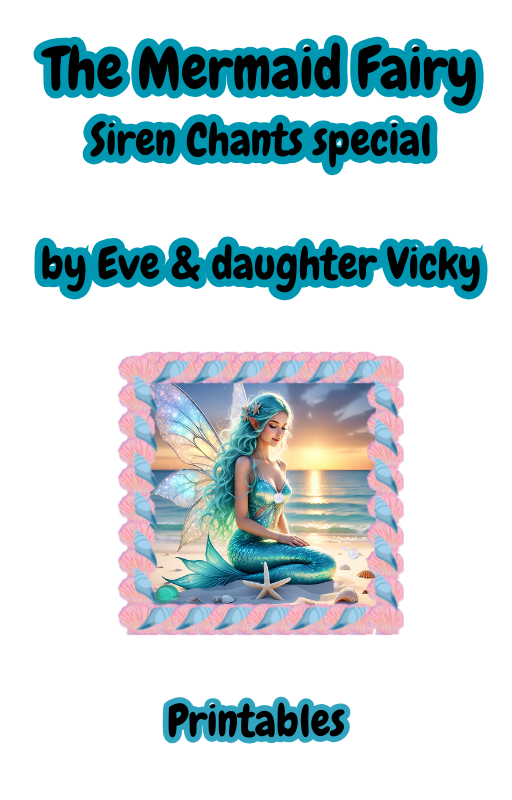
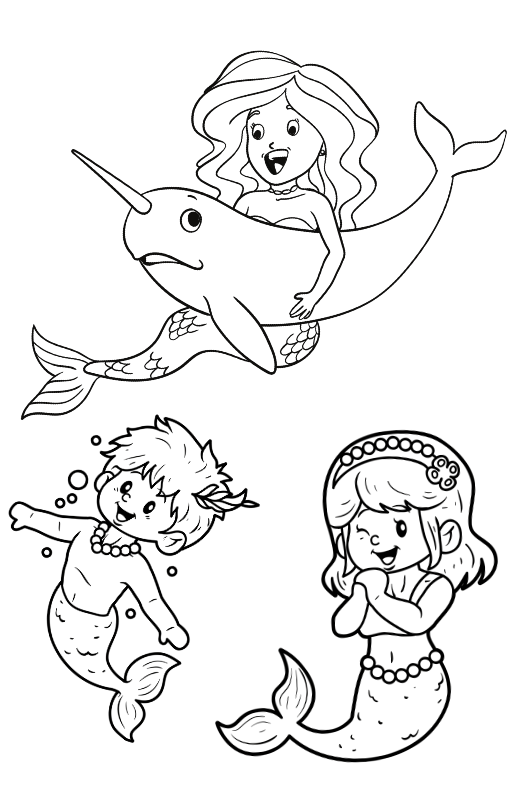
The Mermaid Fairy – children story

The Mermaid Fairy  

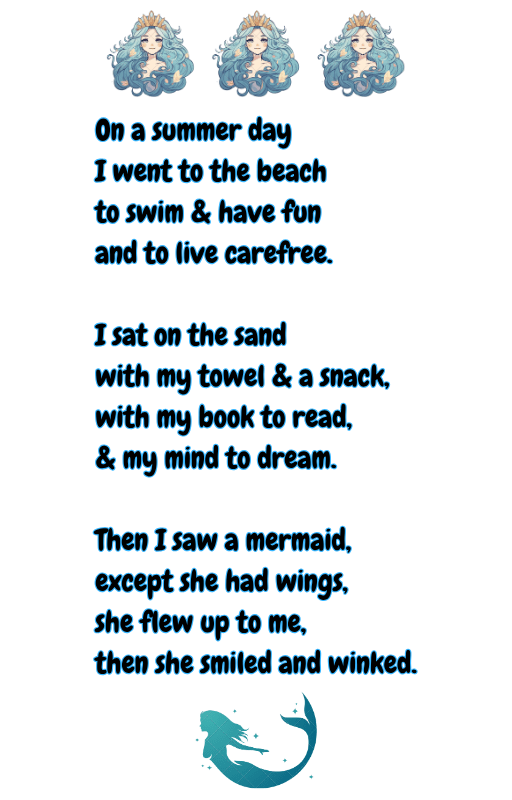
On a summer day
I went to the beach
to swim and have fun
and live carefree.

I sat on the sand
with towel and snack
with a book to read,
and my mind to dream.

Then I saw a mermaid,
except she had wings,
she flew up to me,
then she smiled and winked.

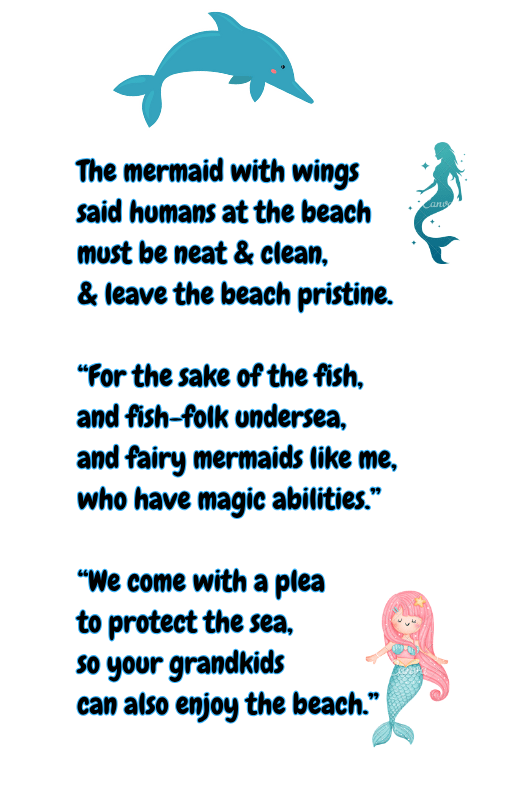
The mermaid with wings
said humans at the beach
must be clean & neat,
leave the beach pristine.

For the sake of fish,
and fish folk undersea,
and fairy mermaids like me,
who have the magic abilities.

We come with a plea
to protect the sea
so your grandkids
can go to the beach.

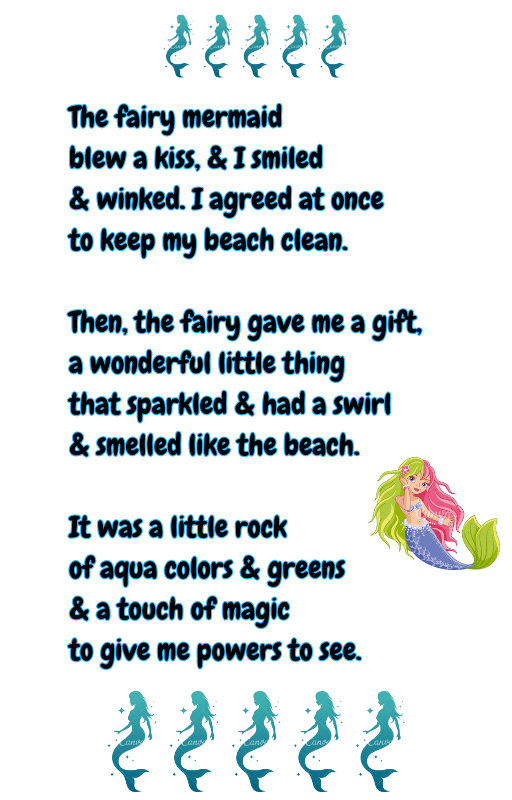
The fairy mermaid
blew a kiss & I smiled
& winked. I agreed
to keep the beach clean.

The fairy gave me a gift,
a wonderful little thing
that sparkled & had a swirl
& smelled like a beach.

It was a little rock
of aqua colors & greens
& a touch of magic
to give me powers to see.

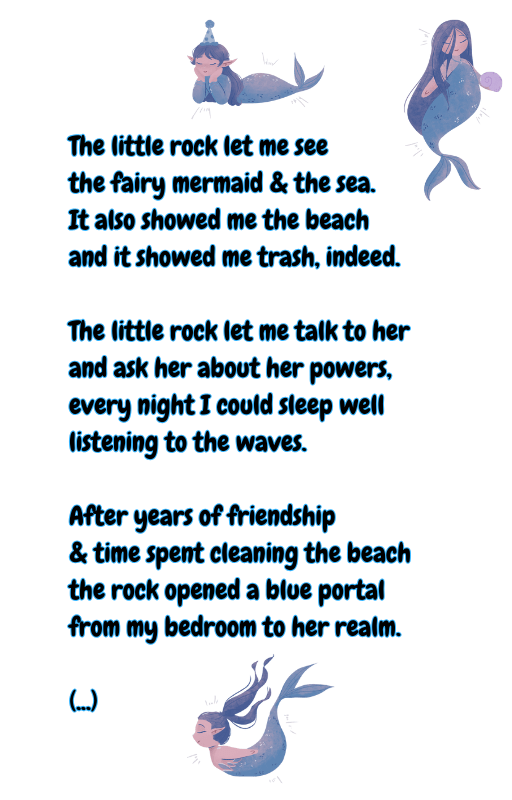
The little rock let me see
the fairy mermaid & the sea.
It also showed me the beach
and it showed me trash, indeed.

The little rock let me talk to her
and ask her about her powers
and at night I could sleep well
listening to the waves.

After years of friendship
& time spent cleaning the beach
the rock opened a blue portal
from my bedroom to her realm.

(...)

Adventure on the other side of this portal. I will ask my oldest daughters if they have any ideas on how to continue this sweet story.


Eve


Mandala Coloring Book Printable Worksheet (7) 10 – 12 yrs old7

Purchase the entire coloring book through this link:

https://www.etsy.com/your/shops/me/listing-editor/copy/1843753953

Otherwise, you are free to download and use all of the images I have shared. I shared two a month, see the last post through this link:

https://lovelightandlife.art.blog/2025/05/16/6/

Make sure to follow this blog for many more free worksheets and learning tools.

Eve

Journaling Pages: Lists for kids and journaling prompts

Dear reader,

We have entered the phase of the list creation on our journaling journey. As adults, we use and follow lists. At times, we create lists for our children to follow. Well, let us use this tool in our homeschooling efforts with this cute list printable.

LEARNING OFFERS ON ETSY: https://evelovestar.etsy.com

How can we make a list interesting for children?

To make lists interesting for children, incorporating a surprise element can spark their imagination and curiosity. Here are some ways to make journaling with lists more engaging and magical:

1. Incorporate Magical Themes

  • Fantasy Lists: For example, “Write a list of 5 magical creatures you’d like to meet.” You could add, “But one of them is invisible, and you have to describe how you’d find it!”
  • Wizards and Spells: “Create a list of 3 spells you would use if you were a wizard. What would each spell do? What would the spell sound like when you say it?”
  • Mystical Places: “Write a list of 4 enchanted places you could visit, but there’s a secret doorway in each one. What’s behind the door?”

2. Add a Surprising Twist

  • Unexpected Objects: “Make a list of 5 things you might find inside a treasure chest, but one of them can’t possibly exist—what would it be?”
  • Impossible Challenges: “Create a list of 3 things you would need to do to become a superhero, but one of the tasks is completely impossible—what is it?”
  • Dream Scenarios: “If you could visit a different planet, write a list of 4 things that might happen. One of them should be totally unexpected!”

3. Interactive Mysteries

  • Secret Codes: “Create a list of 5 secret messages you could send to a friend using codes. Can you figure out the secret code to one of them?”
  • Magical Artifacts: “Write a list of 3 items that belong to a famous wizard. They are magical, but each item has a mysterious power that you must discover.”

4. Unusual and Surreal Lists

  • Bizarre Combinations: “Write a list of 4 things that are totally different but somehow could work together—like a flying cat, a dancing elephant, and a singing tree.”
  • What If Lists: “Imagine you could shrink down to the size of an ant. What would you do? Make a list of 5 things that would be very different if you were tiny.”
  • Upside-Down World: “Create a list of 3 things that would happen in a world where gravity works backwards. How would people move, and what would they need to survive?”

5. Surprise Elements in Everyday Things

  • Unexpected Powers: “Write a list of 4 everyday objects (like a pencil, shoe, or book) that secretly have magical powers. What do they do when no one’s looking?”
  • Altered Animals: “Imagine an animal with a superpower. Make a list of 3 animals and what their superpowers would be. For example, a frog that can jump to the moon!”

6. Fantasy Adventures

  • Quest Lists: “If you were sent on an adventure to find a hidden treasure, write a list of 5 clues you would follow. But one clue must be impossible to figure out!”
  • Time Travel: “Write a list of 4 places in time you would visit if you had a time machine. But one of the places is a complete surprise—you can’t guess it!”

7. Interactive Creative Prompts

  • Secret Agents: “You are a secret agent! Write a list of 3 top-secret missions you must complete. One of them involves something completely magical or out of this world.”
  • Invisible Ink: “Write down a list of 5 wishes you would make if you had a magic pen. One wish will come true, but which one will it be? It’s a surprise!”

By weaving in magical elements, strange scenarios, and impossible situations, children are not just making lists—they’re creating whole worlds in their imagination. This type of journaling turns each list into a playful adventure, which encourages wonder, creativity, and excitement beyond the usual constraints of everyday life.

Previous Journaling Exercises

You can contact me on X @evelovestar

More learning offers such as Spanish classes, homeschooling aids, worksheets, and more on Etsy:

https://evelovestar.etsy.com

Eve

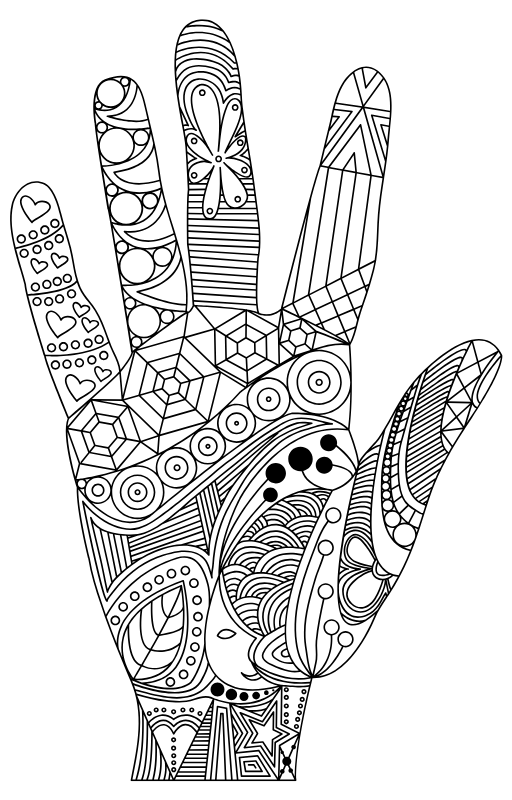
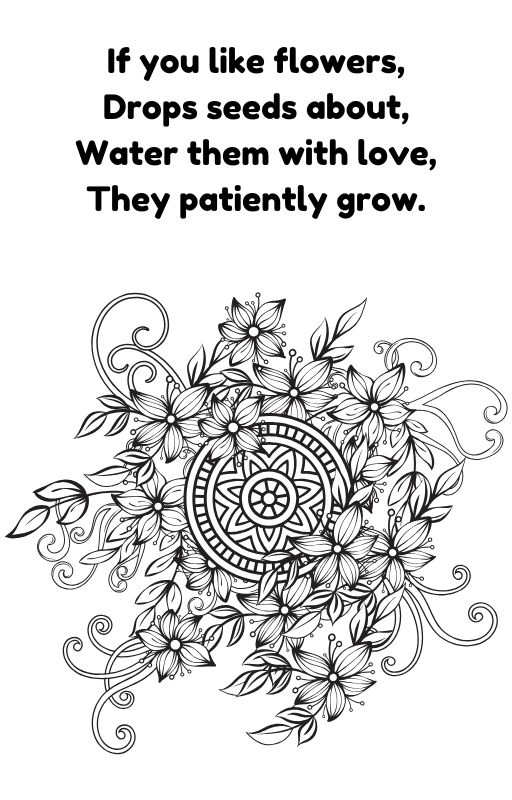
Mandala Coloring Book Printable Worksheet (6) 10 – 12 yrs old

Get the entire coloring book through this link to my Etsy shop. It promises hours of coloring and enjoyment.

https://www.etsy.com/your/shops/me/listing-editor/copy/1843441197

Otherwise, I will share more free images next month and make sure to find my previous coloring pages post, one of them available through this link:

https://lovelightandlife.art.blog/2025/04/14/5/

I added poetry to add learning to the fun.

Meant for 10 – 12 year olds.

Eve

Scroll Stationery – Background – Homeschool Aid

Here’s a list of creative ideas for homeschool parents to use vintage-looking scroll stationery in their lessons. The combination of history, ancient themes, and poetry will make learning engaging and immersive for kids:

More learning offers on our Etsy shop:

https://evelovestar.etsy.com

1. Ancient Letter Writing Practice

  • Historical Correspondence: Have students write letters from the perspective of famous historical figures like Julius Caesar, Cleopatra, or Socrates. Encourage them to use the vintage scroll stationery to reflect the era, using period-appropriate language and historical references.
  • Family Letters Through Time: Have students write a letter from the perspective of a family member living in ancient Greece or Rome. They can describe daily life, societal rules, and historical events of their time.

2. Poetry Composition

  • Write Classical Poetry: Encourage students to write their own poems inspired by ancient poets like Homer, Sappho, or Catullus. The vintage stationery gives them the perfect setting for composing poetic works about gods, myths, or nature.
  • Poetry Interpretation: After reading an ancient poem, ask students to write a modern interpretation of the poem, preserving its essence but in their own voice.

3. History-based Journaling

  • Historical Diaries: Ask children to keep a daily or weekly journal from the perspective of an ancient historian or archaeologist. They could document “discoveries” or describe ancient cities and cultures as if they were part of a historical excavation.
  • Time Travel Journals: Encourage kids to imagine they’ve traveled back in time to ancient Egypt, Greece, or Rome and write detailed journal entries about what they see, hear, and experience.

4. Mythological Storytelling

  • Write a Myth: Have students use the vintage scroll stationery to write their own versions of ancient myths or to create original myths inspired by ancient cultures. They can make up their own gods and mythical creatures and explore themes like love, war, or creation.
  • Illustrate a Myth: After reading an ancient myth, ask the children to write and illustrate a new part of the myth, imagining what might happen next. Use the scroll to make it feel like an ancient manuscript.

5. Letter from the Gods

  • Divine Correspondence: Assign students the task of writing a letter from the perspective of an ancient deity, like Zeus, Athena, or Apollo. The letter could be addressed to a mortal, explaining a divine command or giving guidance.
  • Mythical Messages: Kids can write a letter to an ancient god or goddess asking for advice on a problem they’re facing. This could be a fun way to explore the characteristics of these deities and how they are represented in myths.

6. Creative Ancient Maps and Geography

  • Draw Ancient Maps: Use the scroll stationery as a backdrop for drawing maps of ancient civilizations—Rome, Greece, Egypt, or Mesopotamia. The maps could detail the geography, landmarks, and famous cities of the time.
  • Travel Journals: Create a “travel journal” for an ancient explorer. Students can document their travels across the Mediterranean, describing different ancient cultures, landscapes, and encounters along the way.

7. Historical Poetry Analysis

  • Poetry Analysis from Ancient Texts: Select a passage from an ancient text (like the Iliad or the Aeneid) and ask students to write a poetic analysis on the themes and techniques used by the poet. They can copy the text onto the scroll and reflect on its deeper meaning.
  • Compare Ancient Poets: Have students write a comparative analysis between two ancient poets, such as Sappho and Ovid, using the scroll stationery to present their findings in a visually engaging way.

8. Philosophical Reflections

  • Socratic Journals: Inspired by Socratic questioning, have students write journal entries in response to deep philosophical questions on ethics, love, or virtue. Use the scrolls to mimic the formality and seriousness of the Socratic dialogues.
  • Ancient Wisdom: After learning about an ancient philosopher (like Plato or Aristotle), students can write letters or reflections on how that philosopher’s ideas apply to modern-day issues. These reflections can be written on the scroll for added historical flair.

9. Ancient-Inspired Vocabulary and Spelling

  • Latin or Greek Vocabulary Practice: Use the scroll for practicing Latin or Greek vocabulary. Have students write sentences using newly learned words or create their own glossary of ancient terms related to history or mythology.
  • Word Searches or Crosswords: Create word searches or crossword puzzles based on ancient vocabulary and have children complete them on the scroll paper, giving them an authentic and fun touch.

10. Creative Writing with Ancient Prompts

  • Time Traveler’s Tale: Give students a creative writing prompt where they travel back to ancient Rome or Greece. They can write a story about meeting a historical figure or participating in a key historical event.
  • Letters to the Future: Have children write a letter from an ancient civilization to the future, imagining what life might be like hundreds or thousands of years from their time. The scrolls will make the letters feel like they’re coming from the past.

11. Historical Reenactment Scripts

  • Write Historical Scenes: Ask students to write their own scripts for a scene in an ancient play or historical reenactment. This could be a scene from ancient Greek theater or a key event in Roman history. The scrolls can act as both the medium for writing and the script used in the reenactment.
  • Create Your Own Drama: Encourage children to write and perform a short play based on an ancient myth, like the Trojan War, or an event from ancient history. The scrolls can be the perfect “ancient” manuscript for the play’s script.

12. Art History and Calligraphy

  • Calligraphy Practice: Teach kids the art of calligraphy and ask them to practice ancient styles of writing. They can copy famous ancient inscriptions or write poems in their best calligraphy on the scroll.
  • Create Ancient Artworks: Ask students to draw their favorite scenes from ancient myths or historical events on the scroll, incorporating traditional art styles from the period.

13. Creating Ancient-Inspired Letters

  • Writing to Famous Figures: Have students write letters to famous figures like Alexander the Great, Julius Caesar, or Cleopatra. They can ask questions or offer advice based on what they’ve learned about these individuals in history.
  • Scribe’s Diary: Students could assume the role of an ancient scribe and write about their daily duties, describing the challenges and rewards of preserving history through written word.

These ideas turn the vintage scroll stationery into more than just a beautiful backdrop; it becomes a tool for immersive learning, history exploration, creative expression, and even philosophy. By incorporating this tactile and artistic medium into homeschooling, you can ignite a child’s imagination and curiosity about the ancient world while also honing their writing and analytical skills.

Other scroll stationery

Purchase our premium worksheets, lesson plans, Spanish lessons, and more on our Etsy shop:

https://evelovestar.etsy.com

Eve