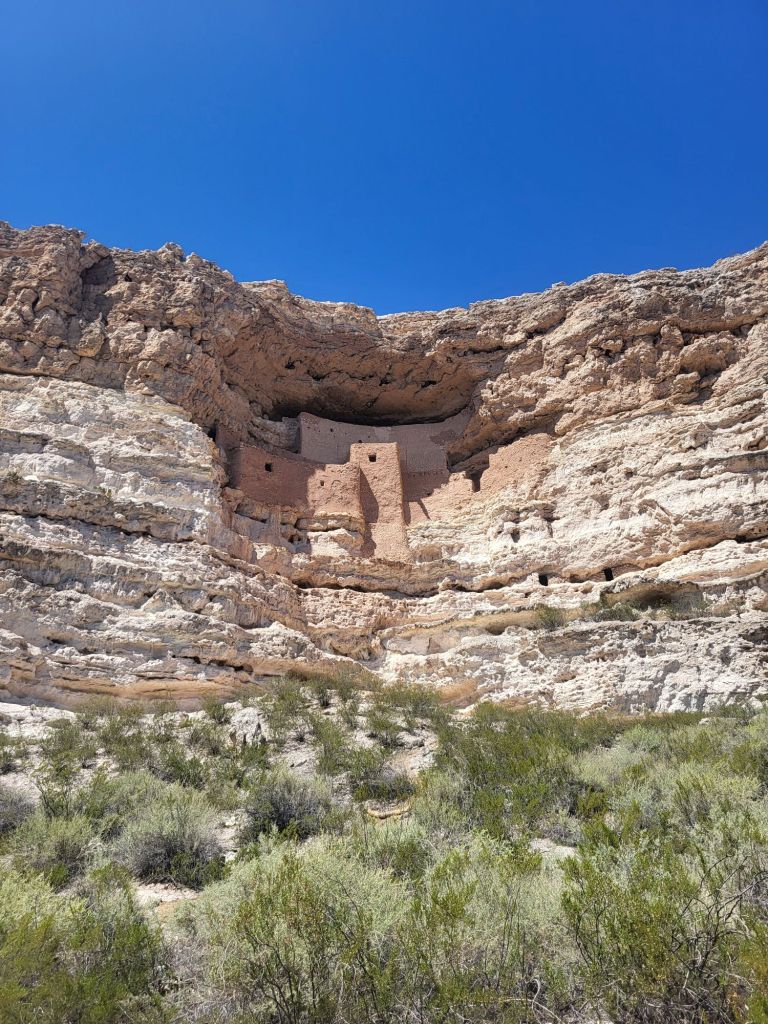
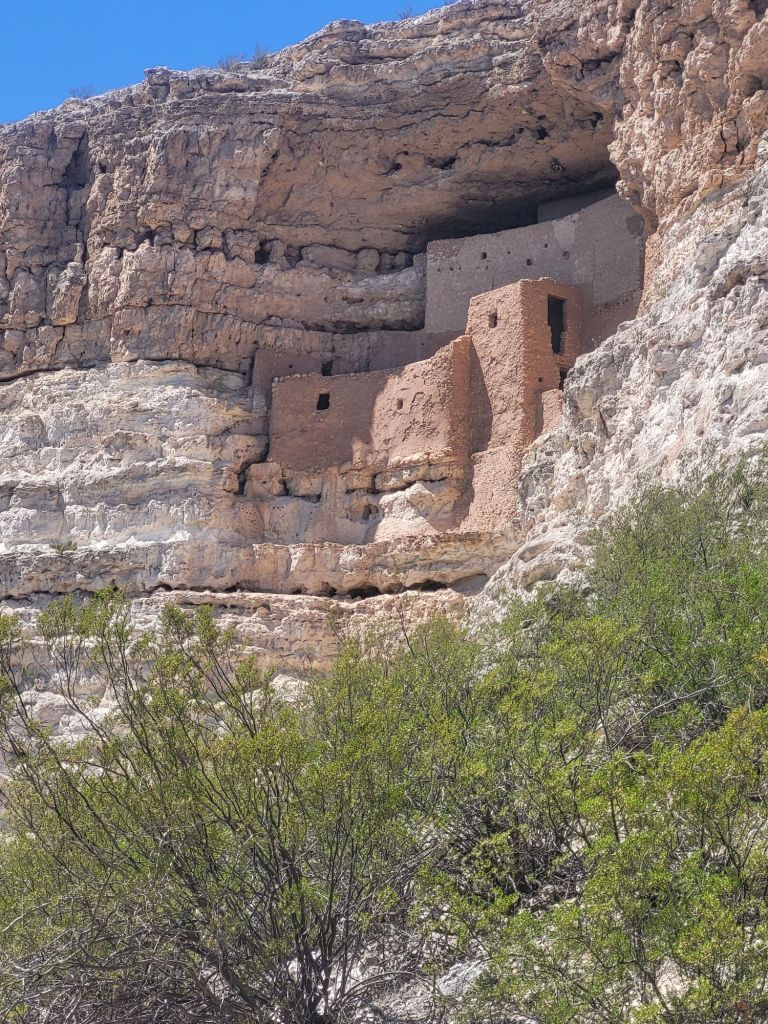
Here’s a stunning view of Montezuma Castle National Monument, a remarkable cliff dwelling in Arizona.
What’s So Special About Montezuma Castle?
1. What and Who Built It
- Montezuma Castle is not really a castle but a prehistoric five-story, approximately 20-room “apartment complex” built by the Sinagua people, a pre-Columbian culture related to the Hohokam, between around AD 1100 and 1425, possibly over three centuries .
- The name is a misnomer: early European-American settlers wrongly believed it was tied to the Aztec emperor Montezuma, though it was abandoned over 40 years before his birth .
2. Location and Structure
- Carved into a limestone cliff about 90 feet (roughly 80 ft / 24 m) above Beaver Creek, it’s situated just northeast of Camp Verde in the Verde River Valley .
- The cliff’s natural alcove shielded the structure, greatly aiding its remarkable preservation .
3. Architectural Innovation
- Built using limestone chunks and mud-based mortar, with wooden beams (from local trees like sycamore) and thatch ceilings—walls were ~2 ft thick at the base, narrowing to ~1 ft at the top; doorways were about 5 ft tall, ceilings around 6 ft high .
- Located high above the flood-prone valley, it offered safety from Beaver Creek’s seasonal flooding, a clever environmental adaptation .
4. Historical Importance & Protection
- Declared one of the first U.S. National Monuments by President Theodore Roosevelt on December 8, 1906, under the Antiquities Act .
- Listed on the National Register of Historic Places in 1966 .
- Early visitors once climbed ladders to enter the ruins, but access was halted in 1951 to prevent further damage .
- Restoration efforts have taken place since the late 19th century, including in 1897 and the 1930s; more recently, mid-1990s efforts addressed carpenter bee damage. Preservation uses traditional Sinagua-style techniques when possible .
5. Visitor Experience
- The monument spans about 860 acres .
- A 0.3-mile paved loop trail from the visitor center leads to views of the castle; over 95% of the visible structure is original .
- Features include a museum displaying tools, grindstones (metates), bone needles, ornaments, pottery, and artifacts reflecting their craftsmanship and trade networks .
- Castle A, another nearby cliff dwelling, is visible from the trail but closed to protect it; it suffered fire damage between 1375–1395 from conflict .
6. Natural and Cultural Legacy
- The surrounding area hosts a rich ecosystem, where a survey recorded around 784 species, only 11% non-native including bats, birds, reptiles, mammals, and more .
- At least 14 bat species, including endangered ones like the Western Red Bat and Townsend’s Big-eared Bat, inhabit the site. Hummingbird studies are also ongoing .
Montezuma Well: The Water Source Connection
- Montezuma Well is a detached unit of the National Monument, located about 11 miles northeast, near Rimrock, Arizona .
- It’s a large limestone sinkhole approximately 386 ft across and continuously fed by ~1.5 million gallons of spring water daily, even during droughts; water is highly carbonated and contains arsenic .
- The Well supported early irrigation systems used for agriculture from as early as the 8th century, with parts still in use today .
- Hosts endemic species, including unique snails, leeches, amphipods, and others, a biodiversity hotspot .
Amazing experience for $10 adult pass. Children enter free.
The children loved it and it was very educational.
Eve

You must be logged in to post a comment.