Family Help: Free English class (Clase de inglés) – Vocabulary: questions – preguntas

I have designed these materials so they can also be used by English speakers learning Spanish. Let me know if these are of help or what materials are needed in your case. These are from my new class as a ESL tutor and I will continue to share them.
🎉 Clase de inglés: Conversando con amigos 🎉

🗓 Todos los domingos | 🕔 5:00 PM hora de Arizona
📍 En vivo por zoom | 💬 ¡Siempre gratis!

¿Te gustaría hablar inglés como lo hacen los amigos en la vida real?
Esta clase es para ti. 🧡

En un ambiente relajado y divertido, vamos a practicar inglés conversacional real, el que se usa todos los días en Estados Unidos. Aquí no se trata de memorizar reglas gramaticales, sino de conectar, comunicar y ganar confianza al hablar.

🔹 ¿Qué haremos en clase?
✅ Escucharás y entenderás inglés natural
✅ Hablarás en conversaciones guiadas y espontáneas
✅ Aprenderás expresiones útiles y vocabulario real
✅ Compartiremos historias, cultura, emociones y risas
✅ Conocerás personas de todo el mundo que también quieren mejorar su inglés

✨ La clase es impartida por una poeta y amante de los idiomas que convierte el aprendizaje en una experiencia creativa y con corazón.

👥 Todos los niveles son bienvenidos. No importa si sabes poco o mucho inglés — aquí todos aprendemos juntos.

¡Únete y comienza a hablar como un verdadero amigo! 💬🌟

Eve
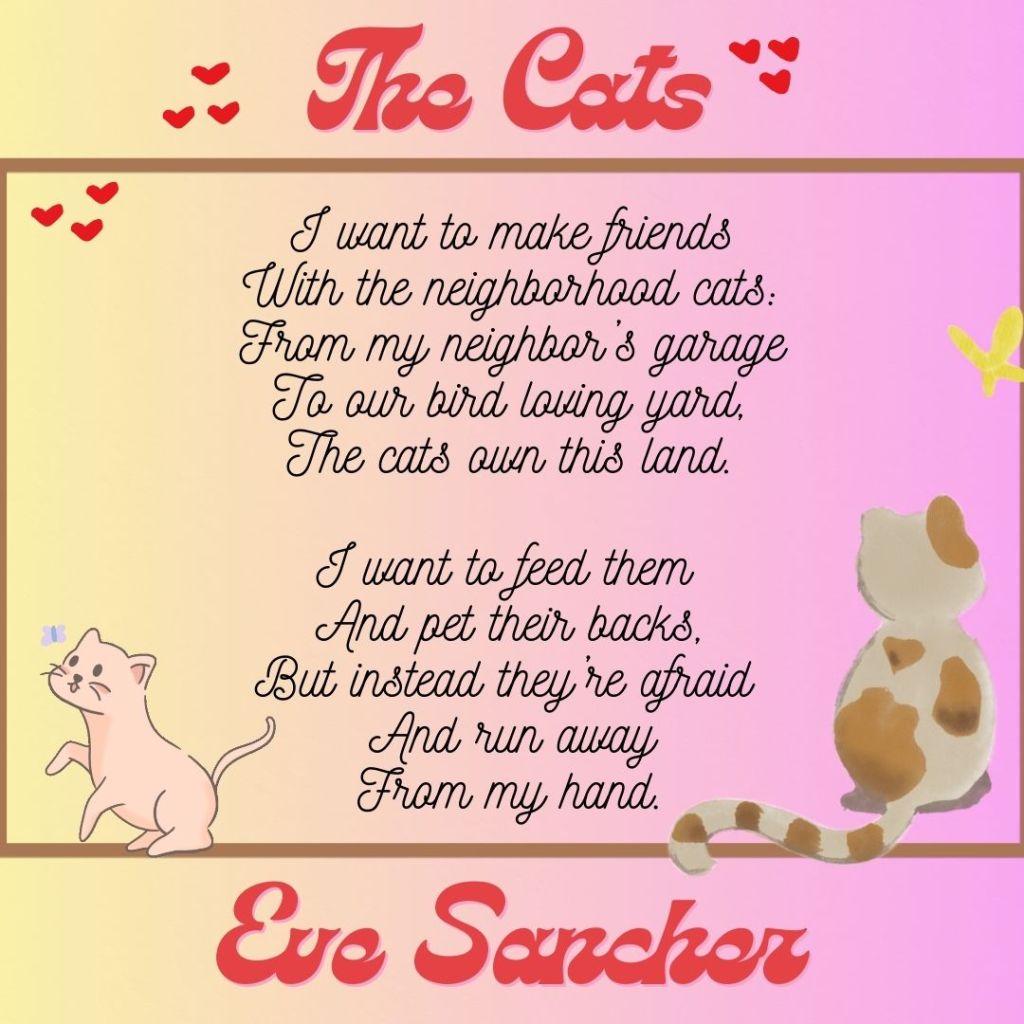
The Cats poem and creative writing activity

We were inspired by the cats in our neighborhood.

Activity:

Create your own cat poem or creative writing piece using our free background.

Created using Canva.

Free use for homeschooling

Tip: If you do not know how to rhyme, use the rhyming dictionary.

Share your poem with Eve on X @evelovestar

Eve

Words: Advice vs. advise

Dear reader,

English is my second language. learned it as an adult. Since I love to learn properly, grammar has been my best friend.

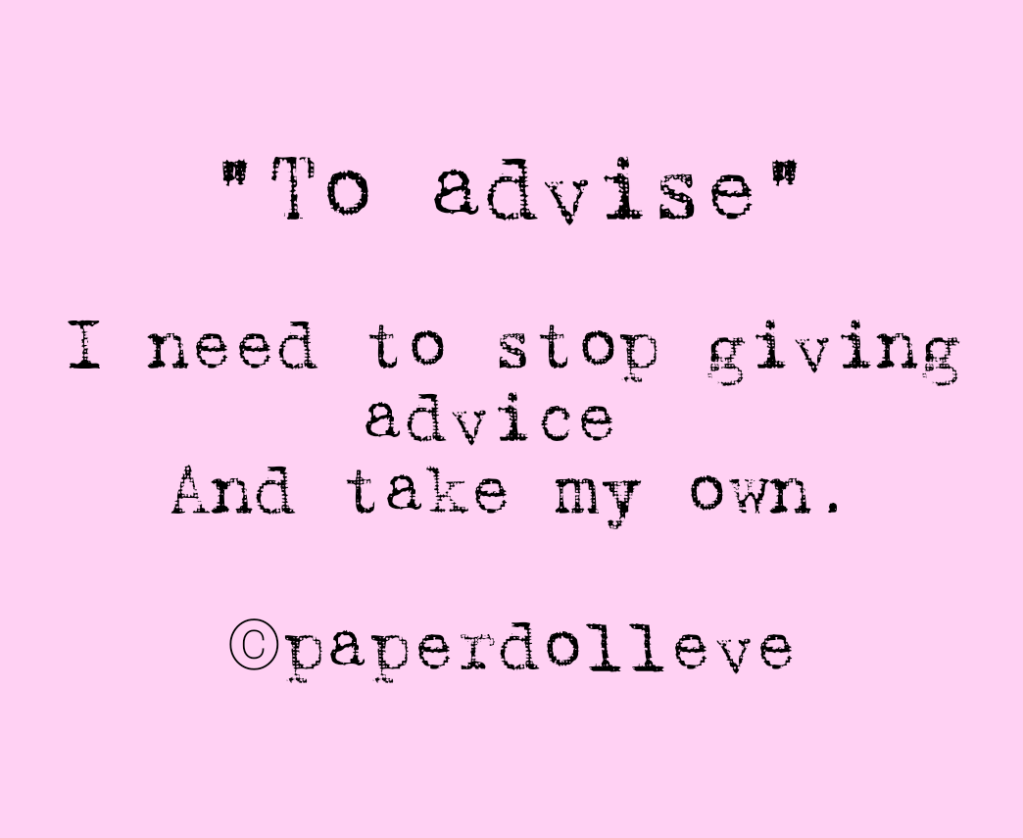
With this short poem, I was trying to make the distinction between advice and advise after I realized I had used the improper spelling of the word. Actually, I thought it was only one word long ago.

When you write, you learn. My advise if you are trying to make a distinction between the two words is to use them in writing. I know now, before, while I was confused and knew I could make a mistake, I would search the difference and find help from a blog post like this one or an article.

Difference between advice and advise

The difference between advise and advice is simple:

  • Advice is a noun, meaning a suggestion or recommendation. Example: “She gave me great advice.”
  • Advise is a verb, meaning to offer a suggestion. Example: “I advise you to listen carefully.”

Tip: Use “advice” when you’re talking about the suggestion itself, and use “advise” when you’re talking about giving or offering that suggestion.

To advice is a verb or a word that refers to action. The action is advising. The word is spelled with an s whenever you say TO ADVISE or ADVISING because these refer to the verb or the action of advising another.

A noun is a thing, wether a physical thing like a table or a non physical thing such as advice

Sentences and examples

When someone is giving a suggestion or recommendation, the action is called advising. So, “advising” is the act of offering advice.

Advice is the thing: the words or suggestions and to advise is the action of saying the advice.

For example:

  • Verb: “The teacher is advising the students to study.”
  • Noun: “The advice she gave was helpful.”

Just remember: the action of giving advice = advising!

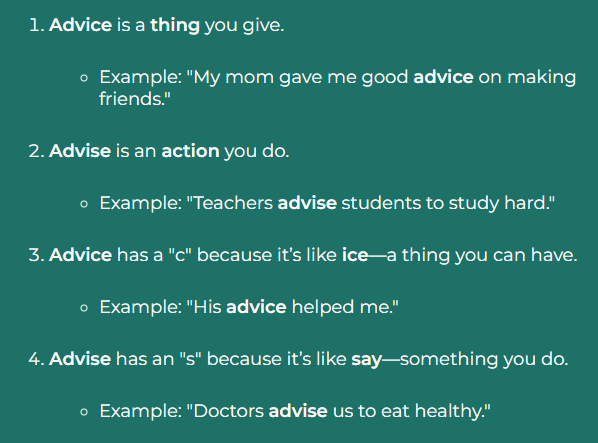
Here are a few simple sentences for children to help them remember the difference between advise and advice:

  1. Advice is a thing you give.
    • Example: “My mom gave me good advice on making friends.”
  2. Advise is an action you do.
    • Example: “Teachers advise students to study hard.”
  3. Advice has a “c” because it’s like ice—a thing you can have.
    • Example: “His advice helped me.”
  4. Advise has an “s” because it’s like say—something you do.
    • Example: “Doctors advise us to eat healthy.”

These can make it fun and easier for children to remember the difference!

Was this helpful?

Feel free to use my poem in your lesson or class or as a reminder.

Please tell me if you would like to see more like this,

With love,

Eve

Learning Italian with Music: Phrases I understood

Dear reader,

(If you are learning/ teaching Spanish, scroll all the way to the end of this post for my Spanish lesson)

Learning a foreign language by listening to music is both enjoyable and effective. By regularly exposing your ears to the sounds and rhythms of the language, you train yourself to recognize its unique patterns. Start by focusing on familiar words and phrases—this helps you connect the lyrics to meanings you already know. As you listen, you’ll naturally pick up new vocabulary, and recognizing recurring phrases can build your fluency. Music also helps with pronunciation and intonation, as you hear native speakers or singers using the language in a fluid, natural way. Repeating this process deepens your understanding and brings the language to life in a fun and engaging way.

17268870436756450260713478198

Note: I already knew a little, tiny bit of Italian when I started this, also Spanish is my first language:

Continue reading “Learning Italian with Music: Phrases I understood”

Shall I compare thee to a summer day? Solstice poetry by Shakespeare with modernization of the poem

Dear Lovestar, Happy Solstice! I didn’t write a summer poem yet, so I decided to let Shakespeare do the speaking today. Read and enjoy one of the most popular and beloved poems ever by the most famous English poet.

Shakespeare sonnet 18

Shall I compare thee to a summer’s day?Thou art more lovely and more […]

Shall I compare thee to a summer day? Solstice poetry by Shakespeare