Journaling Pages: Lists for kids and journaling prompts

Dear reader,

We have entered the phase of the list creation on our journaling journey. As adults, we use and follow lists. At times, we create lists for our children to follow. Well, let us use this tool in our homeschooling efforts with this cute list printable.

LEARNING OFFERS ON ETSY: https://evelovestar.etsy.com

How can we make a list interesting for children?

To make lists interesting for children, incorporating a surprise element can spark their imagination and curiosity. Here are some ways to make journaling with lists more engaging and magical:

1. Incorporate Magical Themes

  • Fantasy Lists: For example, “Write a list of 5 magical creatures you’d like to meet.” You could add, “But one of them is invisible, and you have to describe how you’d find it!”
  • Wizards and Spells: “Create a list of 3 spells you would use if you were a wizard. What would each spell do? What would the spell sound like when you say it?”
  • Mystical Places: “Write a list of 4 enchanted places you could visit, but there’s a secret doorway in each one. What’s behind the door?”

2. Add a Surprising Twist

  • Unexpected Objects: “Make a list of 5 things you might find inside a treasure chest, but one of them can’t possibly exist—what would it be?”
  • Impossible Challenges: “Create a list of 3 things you would need to do to become a superhero, but one of the tasks is completely impossible—what is it?”
  • Dream Scenarios: “If you could visit a different planet, write a list of 4 things that might happen. One of them should be totally unexpected!”

3. Interactive Mysteries

  • Secret Codes: “Create a list of 5 secret messages you could send to a friend using codes. Can you figure out the secret code to one of them?”
  • Magical Artifacts: “Write a list of 3 items that belong to a famous wizard. They are magical, but each item has a mysterious power that you must discover.”

4. Unusual and Surreal Lists

  • Bizarre Combinations: “Write a list of 4 things that are totally different but somehow could work together—like a flying cat, a dancing elephant, and a singing tree.”
  • What If Lists: “Imagine you could shrink down to the size of an ant. What would you do? Make a list of 5 things that would be very different if you were tiny.”
  • Upside-Down World: “Create a list of 3 things that would happen in a world where gravity works backwards. How would people move, and what would they need to survive?”

5. Surprise Elements in Everyday Things

  • Unexpected Powers: “Write a list of 4 everyday objects (like a pencil, shoe, or book) that secretly have magical powers. What do they do when no one’s looking?”
  • Altered Animals: “Imagine an animal with a superpower. Make a list of 3 animals and what their superpowers would be. For example, a frog that can jump to the moon!”

6. Fantasy Adventures

  • Quest Lists: “If you were sent on an adventure to find a hidden treasure, write a list of 5 clues you would follow. But one clue must be impossible to figure out!”
  • Time Travel: “Write a list of 4 places in time you would visit if you had a time machine. But one of the places is a complete surprise—you can’t guess it!”

7. Interactive Creative Prompts

  • Secret Agents: “You are a secret agent! Write a list of 3 top-secret missions you must complete. One of them involves something completely magical or out of this world.”
  • Invisible Ink: “Write down a list of 5 wishes you would make if you had a magic pen. One wish will come true, but which one will it be? It’s a surprise!”

By weaving in magical elements, strange scenarios, and impossible situations, children are not just making lists—they’re creating whole worlds in their imagination. This type of journaling turns each list into a playful adventure, which encourages wonder, creativity, and excitement beyond the usual constraints of everyday life.

Previous Journaling Exercises

You can contact me on X @evelovestar

More learning offers such as Spanish classes, homeschooling aids, worksheets, and more on Etsy:

https://evelovestar.etsy.com

Eve

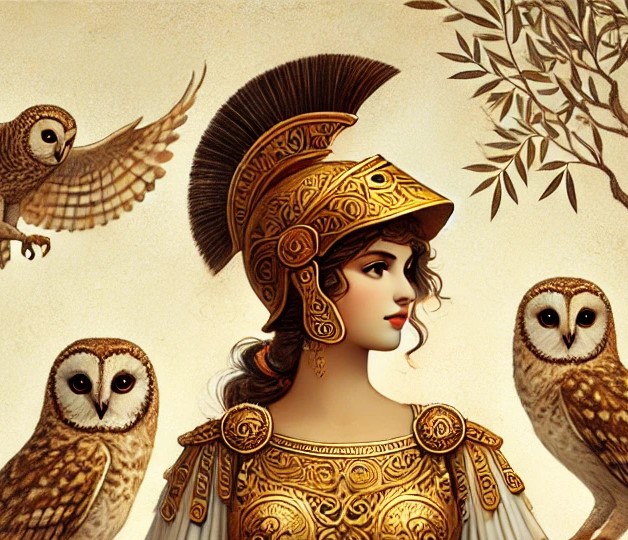
Lesson Plan (7-9): Athena, Ancient Greek Goddess: Fun and Creative Introduction to Greek Mythology.

Collaboration with Lilli (9), who helped me create the lesson, game, graphics, and learned alongside me.

I saved many Athena photos, illustrations, and more to this Pinterest board. For inspiration click and see the different Athena goodies with links to more Athena content.

Pinterest

Learn About Athena

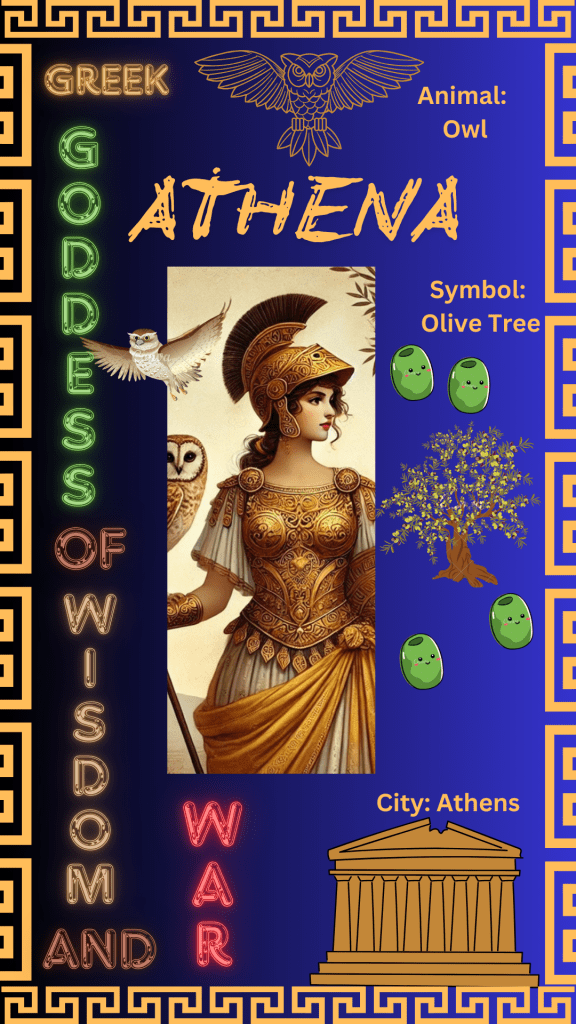
Lilli created this Athena infographic on Canva.

FUN FACTS

Athena was the Ancient Greek goddess of war and wisdom

Athena Symbols: Olive tree and owls

Athena was born fully grown in armor

20241020_1113101761417033601254705
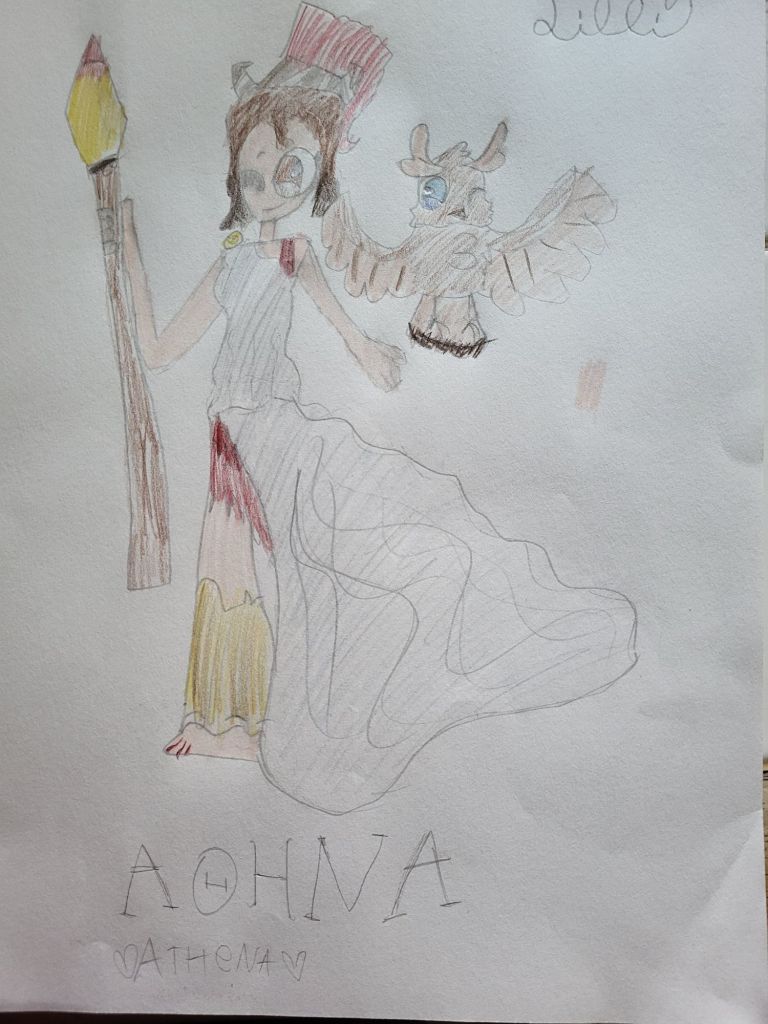
Lilli’s Athena art with her ancient Greek name in capital letters.

Lesson Plan (7 to 9 year olds) Introduction to Athena in Greek Mythology

Here’s an Introduction Lesson Plan about Athena for children ages 7 to 9. It’s designed to be fun and creative, involving hands-on activities like making a paper doll, storytelling, and a coloring project to keep kids engaged while learning about Greek mythology.


Lesson Plan: Athena, the Greek Goddess of Wisdom and War

Age Group: 7-9 years old
Duration: 60-90 minutes
Objective: Students will learn about Athena, her role in Greek mythology, and express creativity through art, storytelling, and crafts.


Materials Needed:

  • Printable Athena paper doll template (with Greek dress, armor, and owl accessories)
  • Markers, crayons, colored pencils
  • Scissors, glue
  • Construction paper for comic book creation
  • Copies of Athena myth stories (simplified versions)
  • Athena coloring pages
  • Whiteboard/Chalkboard (for brainstorming)

Lesson Breakdown:

1. Introduction to Athena (10-15 minutes)

  • Discussion: Start the lesson by introducing Athena. Use simple language to explain that Athena is the goddess of wisdom, war, and crafts in Greek mythology. Mention that she is famous for her intelligence, bravery, and protection of the city of Athens.
  • Ask Questions:
    • What do you think a goddess of wisdom and war would do?
    • Why do you think people respected her so much?
  • Fun Fact: Share that her favorite animal is the owl because it symbolizes wisdom.

2. Create a Paper Doll (15-20 minutes)

  • Activity: Hand out a printable paper doll template of Athena. This template should include:
    • A basic doll figure (Athena)
    • Traditional Greek clothing (a flowing dress, armor)
    • Accessories like an owl, helmet, spear, and shield
20241020_1406095278872489353558465
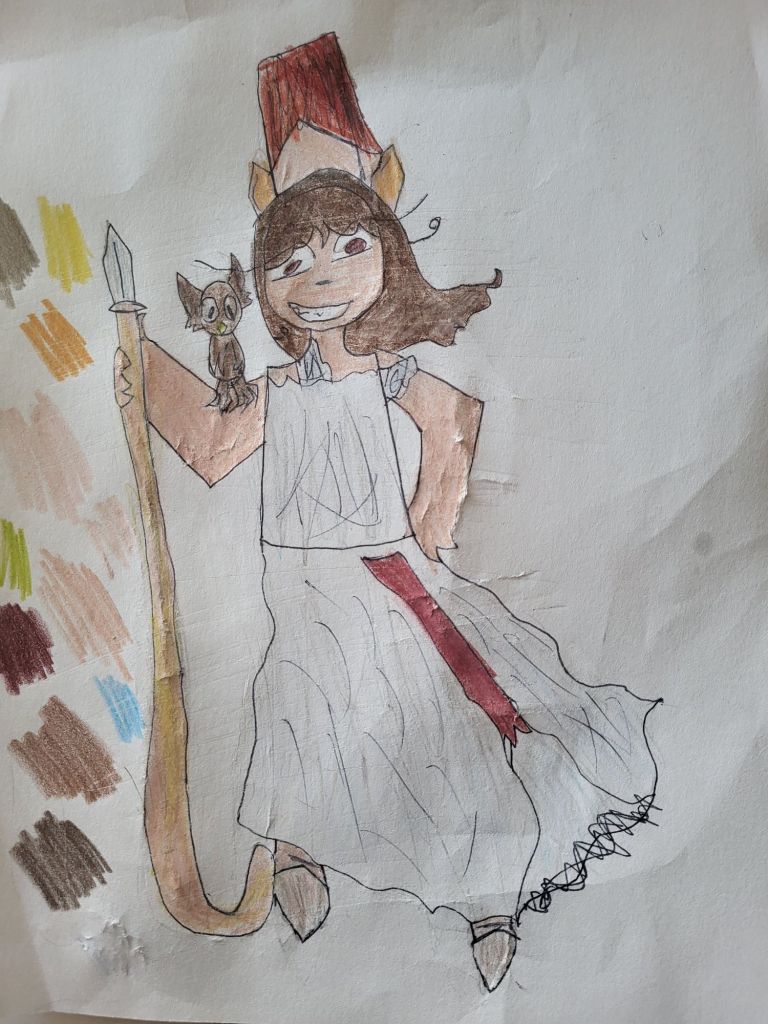
Lizzie’s Athena
  • Instructions:
    • Have students color the doll and clothing, then cut out the pieces.
    • Glue or attach the clothing onto the doll to create their own mini Athena.
  • Discussion While Working:
    • Talk about why Athena wore armor even though she was peaceful and loved wisdom.

3. Read a Short Myth about Athena (10-15 minutes)

  • Storytelling: Read aloud a simplified myth about Athena. You could choose:
    • Athena’s Birth: How she was born from Zeus’ head.
    • Athena and the City of Athens: How she gave the olive tree to Athens.
  • Interactive Discussion:
    • Ask them: What was your favorite part of the story?
    • How do you think Athena felt when she helped the city of Athens?

4. Create a Story or Comic Book (15-20 minutes)

  • Activity: Provide each child with construction paper to create a simple 3-4 panel comic strip or short story. The prompt could be:
    • “Athena Goes on an Adventure”: Have the children imagine a fun adventure for Athena, like her helping a hero or solving a tricky problem using her wisdom.
  • Steps:
    • Draw pictures of Athena and her adventure.
    • Add speech bubbles or a few sentences to describe what’s happening.
  • Encourage Creativity: Allow the kids to come up with their own ideas, such as Athena talking to animals or meeting other gods.

5. Coloring Time (10-15 minutes)

  • Activity: Hand out Athena coloring pages that depict her with owls, a spear, or in her flowing gown.
  • Optional Discussion: While they color, discuss how Greek gods and goddesses were often drawn or sculpted in ancient times.

6. Class Sharing (10 minutes)

  • Share Creations: Let each student show their paper doll and comic strip or story to the class.
  • Encouragement: Praise their creativity and highlight fun details in their stories or drawings.

Wrap-Up:

  • Review: Ask them to name one thing they learned about Athena today.
  • Closing: End with a question to spark curiosity for next time: “If you could meet Athena, what would you ask her?”

Follow-Up Activity for Home:

  • Encourage students to research more about Greek mythology with their parents or continue coloring and creating new stories about Athena.

This lesson plan balances learning with creative play, making it a fun and memorable introduction to Athena and Greek mythology for younger children!

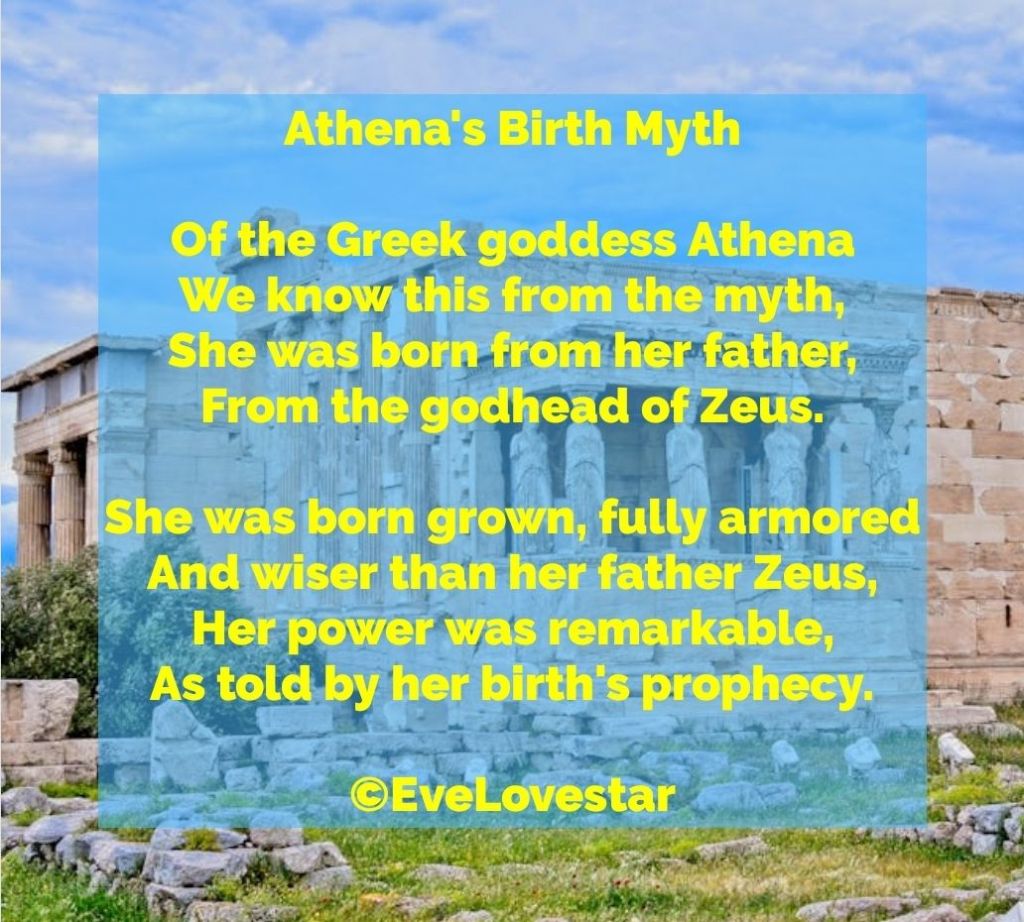
Athena Creation Myth

Creative Athena Activity Ideas

  • Color Athena coloring pages
  • Create an Athena paper doll and learn about the Ancient Greek costumes
  • Create a story with Athena as a character
  • Write an Athena song or poem
  • Dress up as Athena

Athena Trivia Game: Simple

Here’s a fun and easy Athena Trivia Game for children, designed to teach them about the Greek goddess in a playful way! Each question includes simple multiple-choice options to keep it engaging and interactive.

Scroll down to review your answers.

Athena Trivia Game

Question 1:
Who is Athena the goddess of?

  • A) The Sea
  • B) Wisdom and War
  • C) Music

Question 2:
What is Athena’s favorite animal, which represents wisdom?

  • A) Owl
  • B) Lion
  • C) Snake

Question 3:
Which city in Greece is named after Athena?

  • A) Sparta
  • B) Athens
  • C) Crete

Question 4:
What weapon does Athena usually carry in battles?

  • A) Bow and Arrow
  • B) Sword
  • C) Spear

Question 5:
Athena was born fully grown from the head of which god?

  • A) Zeus
  • B) Hades
  • C) Poseidon

Question 6:
What is Athena’s special tree, often associated with peace?

  • A) Apple Tree
  • B) Oak Tree
  • C) Olive Tree

Question 7:
Which hero did Athena help in his journey to slay Medusa?

  • A) Perseus
  • B) Hercules
  • C) Theseus

Question 8:
Athena is known for her wisdom. What does she often wear on her head as a symbol of this?

  • A) A crown
  • B) A helmet
  • C) A laurel wreath

Question 9:
Athena never married and stayed focused on her duties. What is she often called because of this?

  • A) The Brave Warrior
  • B) The Wise Queen
  • C) The Virgin Goddess

Question 10:
In one myth, Athena competed with Poseidon to become the patron of Athens. What gift did she give to win?

  • A) A magical horse
  • B) An olive tree
  • C) A golden shield

Bonus Activity:

After the quiz, encourage kids to draw their version of Athena or make up a new adventure where Athena helps a hero. This keeps them creatively engaged!


This game is simple, fun, and educational, perfect for children learning about Greek mythology!

Answers

Athena

  1. Answer: B) Wisdom and War
  2. Answer: A) Owl
  3. Answer: B) Athens
  4. Answer: C) Spear
  5. Answer: A) Zeus
  6. Answer: C) Olive Tree
  7. Answer: A) Perseus
  8. Answer: B) A helmet
  9. Answer: C) The Virgin Goddess
  10. Answer: B) An olive tree

Sources

Here’s a list of sources where you can learn about Athena for free, perfect for children or general mythology enthusiasts:

1. Theoi Greek Mythology – Athena

  • Comprehensive resource on Greek gods and goddesses, including detailed descriptions of Athena’s myths, symbols, and representations.
ATHENA (Athene) – Greek Goddess of Wisdom, War & Crafts (Roman Minerva) (theoi.com): Lesson Plan (7-9): Athena, Ancient Greek Goddess: Fun and Creative Introduction to Greek Mythology.

2. Greek Mythology: Athena on Ducksters

  • A child-friendly website that provides easy-to-understand information about Athena’s role in mythology, her symbols, and famous stories.

https://www.ducksters.com/history/ancient_greece/athena.php

3. Encyclopedia Britannica: Athena

  • A trusted and detailed article on Athena, covering her origins, myths, and importance in ancient Greek culture.

https://www.britannica.com/topic/Athena-Greek-mythology

4. National Geographic Kids: Gods and Goddesses of Ancient Greece

  • A kid-friendly introduction to Greek mythology with a section dedicated to Athena and other important gods.

5. World History Encyclopedia: Athena

  • A more in-depth look at Athena’s role in ancient history, including her influence in art, literature, and historical accounts.

https://www.worldhistory.org/athena/

6. Perseus Digital Library: Athena

  • A digital library offering primary source texts and ancient writings that mention Athena, great for older students or deeper research.

https://www.perseus.tufts.edu/Herakles/athena.html

7. Mythopedia: Athena

  • A clear and modern look at Athena’s mythology, detailing her most famous myths, relationships, and legacy.

https://mythopedia.com/library/homeric-hymns-evelyn-white-1914/28-to-athena

8. Greek Gods and Goddesses: Athena

  • A simple website with brief facts and stories about Athena, designed for a quick overview and younger readers.

These sources offer a mix of simplified content for children and in-depth articles for older students or adults who want to explore Athena’s mythology further.


Thank you for learning with us today,

Let us be besties,

Eve and Lilli

Socrates, Ancient Athenian Philosophy and Wisdom. Philosophy Classes for Children.

Dear reader,

I bring you more Socrates materials for our learning as parents and, soon, tools (including a free Lesson Plan) to introduce this master of questioning to our children.

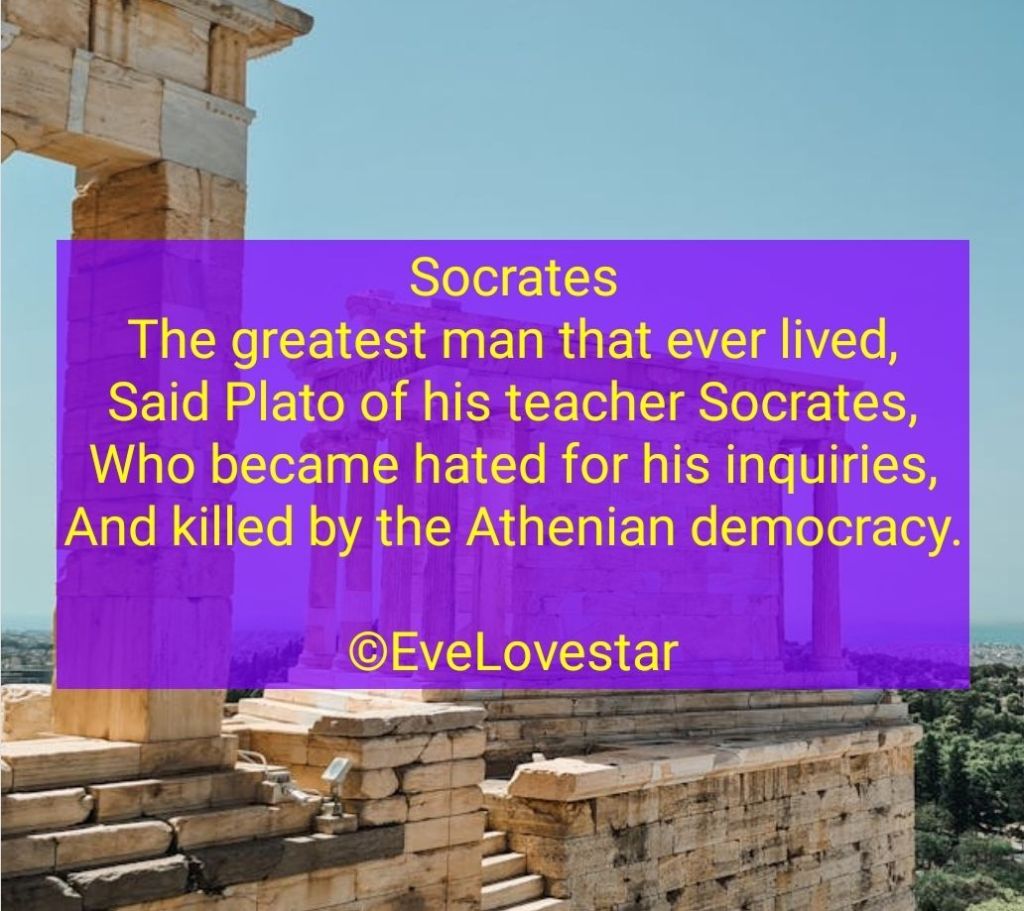
Below, you will find 2 of my poems about Socrates, which can be used as materials for reading and comprehension, links to philosophy classes, a free class link (using it will be though because they have too many good choices, take your time to find your favorite class), and links for Socrates study.

Poetry is great for the Socratic Method, actually.

Plato: student of Socrates, teacher of Aristotle, who was the teacher of Alexander the Great: some of the most famous names in history and wisdom.

To be able to home educate or homeschool, we must educate ourselves first. Also, by learning, we inspire our children to do the same.

Related Outschool Classes and Tutors. Scroll to get your free class!!!

Outschool is my preferred tutor program, and my three oldest daughters have had many Outschool classes. We enjoy the program so much that I became an ambassador for them. This means I share the classes and teachers I love, and they pay me in free class credits at no cost to you.

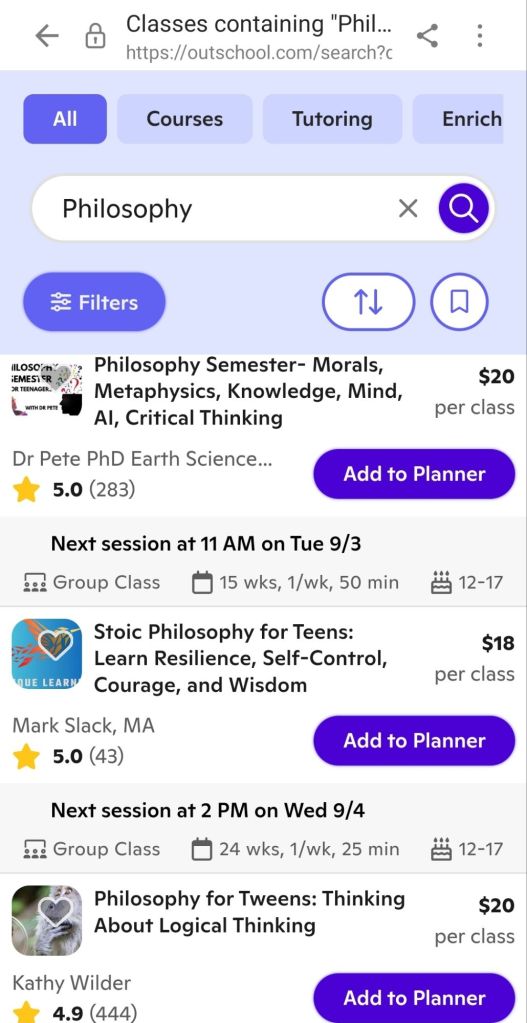
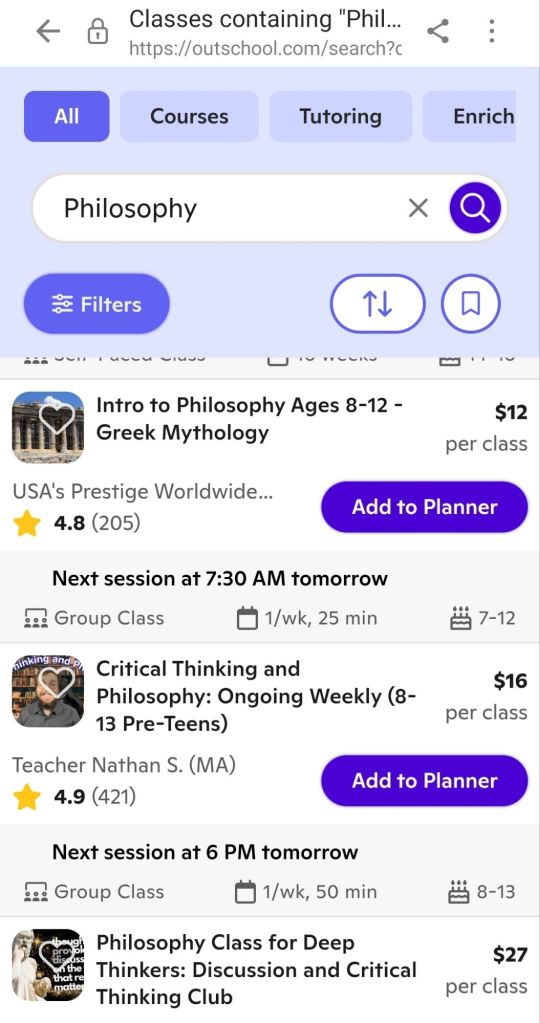
Outschool has a bunch of classes for everything. They do not have a class on Socrates, but they have loads of ancient history classes, and I just found too many philosophy classes to share. Outschool is international and likely in your country as well.


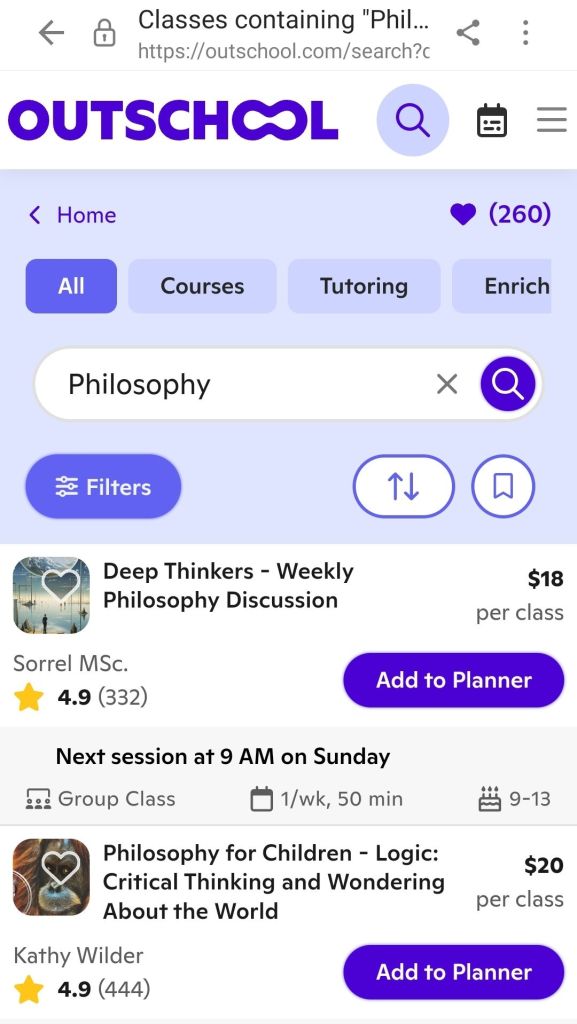
Philosophy classes for children on Outschool
Philosophy classes on Outschool

Deep Thinkers – Weekly Philosophy Discussion


US Grade 4 – 7
Explore the world of ideas and challenge your perceptions in ‘Deep Thinkers,’ a unique online philosophy class designed specifically for young minds.

This isn’t your typical classroom experience; here, we delve into life’s biggest questions and the mysteries of existence in a fun, interactive, and engaging manner.

Through engaging discussions and thought-provoking exercises, students will journey through a diverse range of philosophical concepts, from understanding the abstract concept of time to discussing human nature and even delving into fascinating ideas like simulation theory. But don’t be intimidated by these ‘big’ topics. Each idea is broken down and presented in a way that’s both accessible and relevant to our students’ experiences.

https://outschool.com/classes/deep-thinkers-weekly-philosophy-discussion-iWfptOAP?refuid=XqYUyJwg


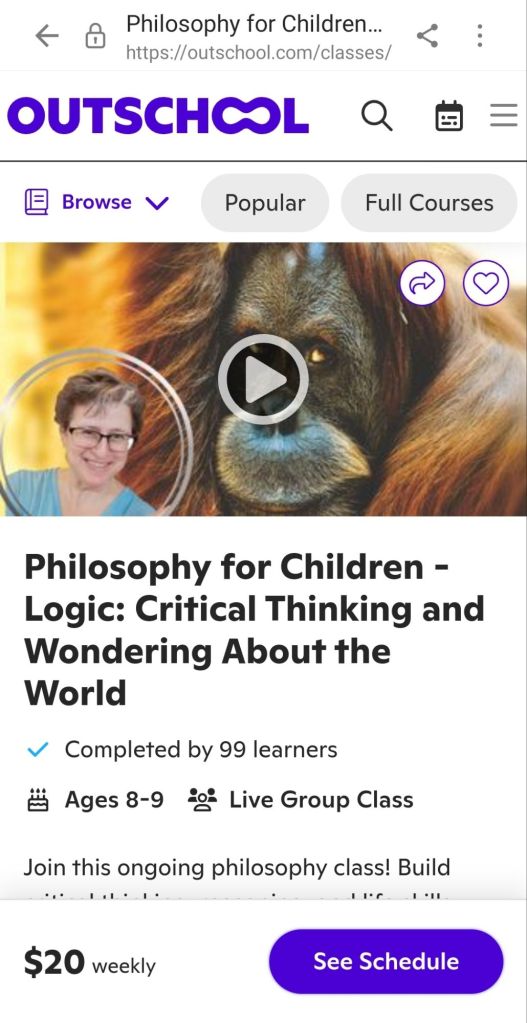
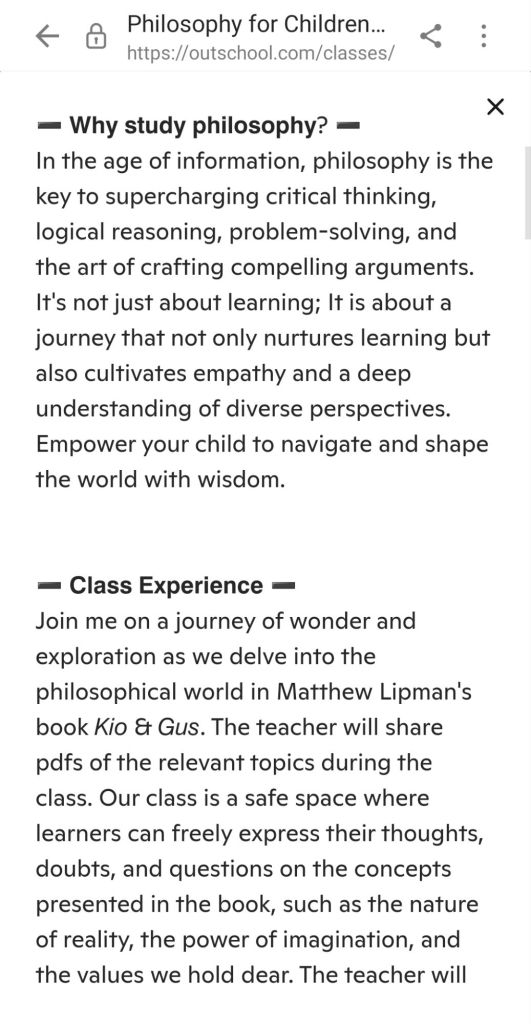
Another philosophy class for children
This teacher uses the Socratic Method (Socrates philosophy of questioning)

https://outschool.com/classes/philosophy-for-children-logic-critical-thinking-and-wondering-about-the-world-Z7lr88r4?refuid=XqYUyJwg


Get your first Outschool Class for free:

Outschool lets your kids’ curiosity run wild with classes on any topic you can imagine. If you’re new to Outschool, you’ll get $20 USD referral credit with this link:

https://outschool.com/parents/4619c2ca-b8bf-41ca-8022-360fb68c720b/e973a1f4-a2d0-463d-87c4-95d8a90c8352?signup=false&usid=XqYUyJwg&utm_campaign=share_invite_web_share_api

If you sign up for an Outschool class, tell them I sent you by adding my code at check out

STAR2024

AZ’s ESA covers the cost of these classes if you have one. I believe ESAs from other states such as Florida cover the costs as well.


Socrates, a poem.

Socrates in the Shadows

In the quiet halls where shadows lie,
A thinker walks ‘neath a boundless sky,
His breath a whisper in ancient wind,
A voice of reason, fierce and thin.

He stands where darkness cloaks the land,
A world enslaved by iron hand,
The political woes, a heavy yoke,
Yet in his heart, no fear awoke.

“Do you not see?” he calls with grace,
“The chains that bind, the darkened space,
Are but illusions, thin and frail,
For wisdom’s light shall never pale.”

With valor bold, he questions all,
The gods above, the shadows’ call,
He seeks the truth where others flee,
In courage fierce, his mind roams free.

He strides through doubts and silent fears,
His voice a beacon through the years,
He asks of us: “What makes us wise?
Is it in gold or in the skies?”

“No,” he says, “it’s in the soul,
In questioning the tyrant’s role,
In seeking truth where shadows play,
In daring to defy the fray.”

For in the face of cruel despair,
When tyrants’ lies fill up the air,
It’s in the quest for wisdom’s grace,
That we reclaim our rightful place.

“Rise above the darkened gloom,”
He whispers in the dim-lit room,
“Embrace the light, the questions bold,
And let your wisdom break the mold.”

In every mind, his spirit sows,
A seed of courage, wisdom grows,
In questioning, we find the key,
To break the chains and set us free.

So heed the call of Socrates,
In every shadow, find the peace,
For in the search for truths untold,
We find the courage to be bold.

Sources for further study: free, online: I’ll offer additional sources soon.

https://en.m.wikipedia.org/wiki/Socrates

https://www.britannica.com/biography/Socrates

https://www.history.com/topics/ancient-greece/socrates

Stay tuned for more coming on this topic, including the free Lesson Plan for our children.

If this helped or inspired you, let me know so I can do more like this. I loved it, but I’ll share more if you like it, too.

If you have questions about Outschool tutoring, let me know in the comments

Note: This was a quick poem that I will most definitely edit when I complete the final Lesson Plan on this subject (the whole package I’m preparing which will take me some time, because I don’t want to rush it.

With the intention to inspire learning, thinking, and questioning,

Eve

Socrates: Ancient Greek Philosopher. The Wisest Man Ever Born?

Dear reader,

Let us talk about Socrates, the ancient Athenian philosopher.

First, I’ll include an essay for adults, and coming soon, I’m going to share a free lesson plan for home education parents, just in case you’re looking for educational materials. If you’re a homeschooling parent, and this was helpful, let me know, I’ll be sure to create more like this.

The soon to come lesson plan will be completely free, as my gift to parents. I will continue to develop this lesson plan for use with my kids. I’ll then go about creating materials for my future lesson plan, one that will be complete. This will take a lot of time, but I’ll share a lot of sources for your studies if you’re interested in introducing your children to Ancient Philosophy. Stay tuned.

The free Lesson will include

  • A lesson plan to introduce kids to Ancient Philosophy and Socrates
  • The lesson will be tailored for children 8 -12 ( my oldest learners)
  • Several simple poems for reading and  comprehension materials

Socrates. Valor and Fearlessness

Socrates said in his famous trial (the result of which was the Athenians killing him) that the god Apollo had prophesied that there was no wiser man than him.

Socrates went on to inspire wisdom in a level that has not been matched. His student Plato would go on to be the father of philosophy, and Plato’s student, Aristotle (Alexander the Great’s famous teacher), was the father of universities, per this course I listed below.

Source:

Listen to Famous Greeks by J. Rufus Fears, The Great Courses on Audible.

https://www.audible.com/pd/B00D8G01VG?source_code=ASSOR150021921000R

Socrates

  • Ancient Athenian
  • Known for questioning everyone
  • “No honest man can survive in your democracy. It is so corrupt!” Were hos words to his Athenian oppressors proving his valor and fearlessness
  • Murdered by the Athenians for inpiety

Socrates: The Paragon of Virtue and Philosophy


Socrates, one of the most influential figures in Western philosophy, lived in ancient Athens during the 5th century BCE. His contributions to philosophy, characterized by his commitment to virtue and his fearless stance against the political establishment, have left a lasting legacy.

Legacy and Ideas

Socrates is renowned for his contributions to ethics and epistemology. Unlike his predecessors, who often engaged in speculative and metaphysical inquiry, Socrates focused on practical ethics and the nature of human virtue. His philosophy was grounded in the belief that understanding the nature of virtue was essential for leading a good life. This approach is most famously encapsulated in his assertion that “the unexamined life is not worth living.”

Central to Socratic thought is the Socratic Method, a form of dialectical questioning that aims to stimulate critical thinking and expose contradictions. Through this method, Socrates sought to challenge assumptions and encourage deeper understanding. This approach involves asking a series of questions to help individuals arrive at their own conclusions, rather than providing them with answers. The goal is to foster clarity of thought and promote self-awareness.

Socrates also introduced the concept of “Socratic irony,” where he professed ignorance to draw out the knowledge of others. This tactic allowed him to reveal the ignorance of those who claimed to possess knowledge, thus promoting a deeper exploration of truth.

Valor and Fearlessness

Socrates’ valor and fearlessness are perhaps most evident in his interactions with Athenian politicians and his eventual trial. Socrates lived during a time of significant political turmoil in Athens. His commitment to questioning the status quo and challenging the moral and intellectual complacency of the time often put him at odds with powerful figures.

One of Socrates’ most notable acts of courage was his refusal to abandon his principles, even in the face of severe consequences. During the Peloponnesian War, Athens was under the influence of a series of politically charged events and shifts in power. Socrates remained steadfast in his commitment to questioning the moral and ethical conduct of the politicians and leaders, despite growing hostility.

Socrates’ fearlessness culminated in his trial and subsequent execution. In 399 BCE, Socrates was charged with impiety and corrupting the youth of Athens. He was sentenced to death by drinking poison hemlock. Despite the gravity of his situation, Socrates faced his fate with remarkable composure, continuing to question and discuss philosophical issues up until his final moments. His willingness to accept death rather than compromise his beliefs is seen as a testament to his commitment to truth and virtue.

Conclusion

Socrates’ legacy endures through his profound impact on philosophy and his embodiment of intellectual courage. His method of questioning, dedication to virtue, and resistance to political pressure have inspired countless individuals to seek truth and live a life of moral integrity. Socrates’ life and teachings continue to be a beacon for those who value wisdom, ethical rigor, and the courage to stand up for one’s beliefs. His unwavering pursuit of truth in the face of adversity exemplifies the highest ideals of philosophical inquiry and personal virtue.

If this was inspiring or helpful, let me know, I would love to do more like this.

Stay tuned for an upcoming free lesson plan to introduce children to Socrates and Athenian philosophy,

Eve