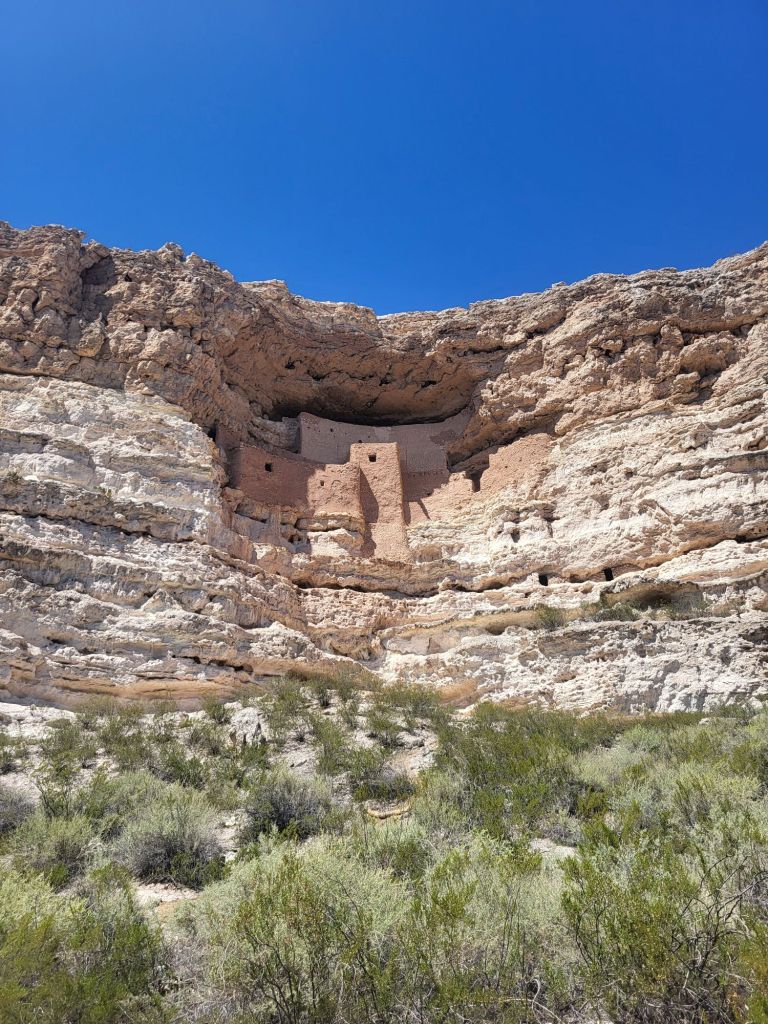
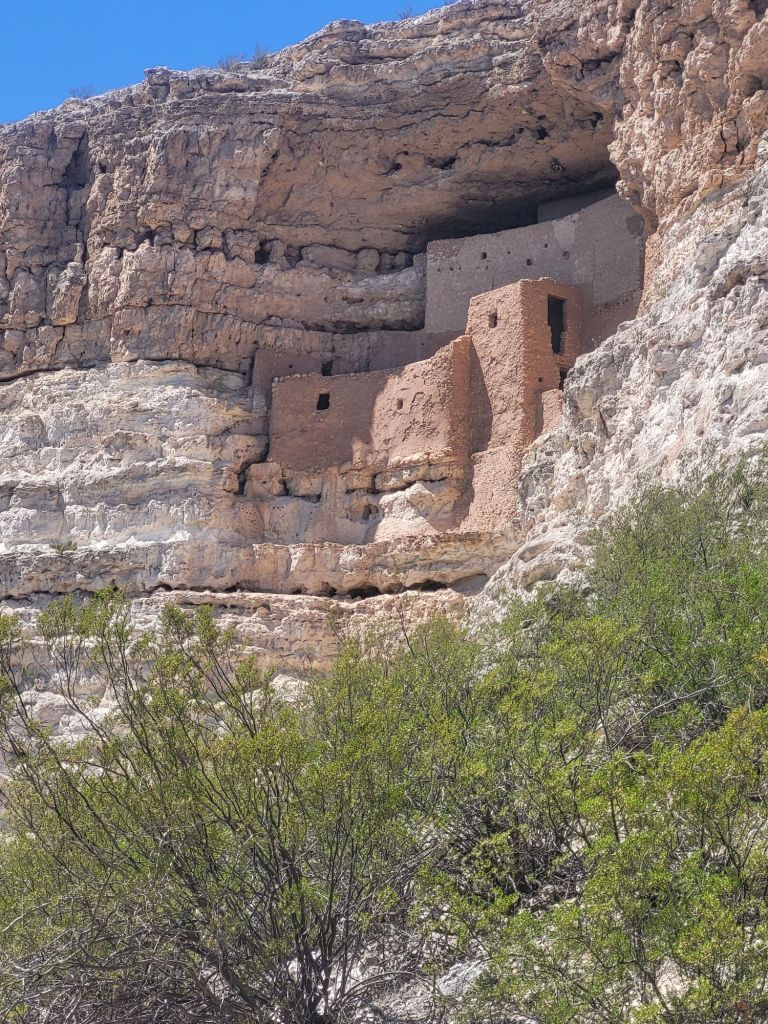
Here’s a stunning view of Montezuma Castle National Monument, a remarkable cliff dwelling in Arizona.
What’s So Special About Montezuma Castle?
1. What and Who Built It
Montezuma Castle is not really a castle but a prehistoric five-story, approximately 20-room “apartment complex” built by the Sinagua people, a pre-Columbian culture related to the Hohokam, between around AD 1100 and 1425, possibly over three centuries .
The name is a misnomer: early European-American settlers wrongly believed it was tied to the Aztec emperor Montezuma, though it was abandoned over 40 years before his birth .
2. Location and Structure
Carved into a limestone cliff about 90 feet (roughly 80 ft / 24 m) above Beaver Creek, it’s situated just northeast of Camp Verde in the Verde River Valley .
The cliff’s natural alcove shielded the structure, greatly aiding its remarkable preservation .
3. Architectural Innovation
Built using limestone chunks and mud-based mortar, with wooden beams (from local trees like sycamore) and thatch ceilings—walls were ~2 ft thick at the base, narrowing to ~1 ft at the top; doorways were about 5 ft tall, ceilings around 6 ft high .
Located high above the flood-prone valley, it offered safety from Beaver Creek’s seasonal flooding, a clever environmental adaptation .
4. Historical Importance & Protection
Declared one of the first U.S. National Monuments by President Theodore Roosevelt on December 8, 1906, under the Antiquities Act .
Listed on the National Register of Historic Places in 1966 .
Early visitors once climbed ladders to enter the ruins, but access was halted in 1951 to prevent further damage .
Restoration efforts have taken place since the late 19th century, including in 1897 and the 1930s; more recently, mid-1990s efforts addressed carpenter bee damage. Preservation uses traditional Sinagua-style techniques when possible .
5. Visitor Experience
The monument spans about 860 acres .
A 0.3-mile paved loop trail from the visitor center leads to views of the castle; over 95% of the visible structure is original .
Features include a museum displaying tools, grindstones (metates), bone needles, ornaments, pottery, and artifacts reflecting their craftsmanship and trade networks .
Castle A, another nearby cliff dwelling, is visible from the trail but closed to protect it; it suffered fire damage between 1375–1395 from conflict .
6. Natural and Cultural Legacy
The surrounding area hosts a rich ecosystem, where a survey recorded around 784 species, only 11% non-native including bats, birds, reptiles, mammals, and more .
At least 14 bat species, including endangered ones like the Western Red Bat and Townsend’s Big-eared Bat, inhabit the site. Hummingbird studies are also ongoing .
Montezuma Well: The Water Source Connection
Montezuma Well is a detached unit of the National Monument, located about 11 miles northeast, near Rimrock, Arizona .
It’s a large limestone sinkhole approximately 386 ft across and continuously fed by ~1.5 million gallons of spring water daily, even during droughts; water is highly carbonated and contains arsenic .
The Well supported early irrigation systems used for agriculture from as early as the 8th century, with parts still in use today .
Hosts endemic species, including unique snails, leeches, amphipods, and others, a biodiversity hotspot .
Amazing experience for $10 adult pass. Children enter free.
The children loved it and it was very educational.
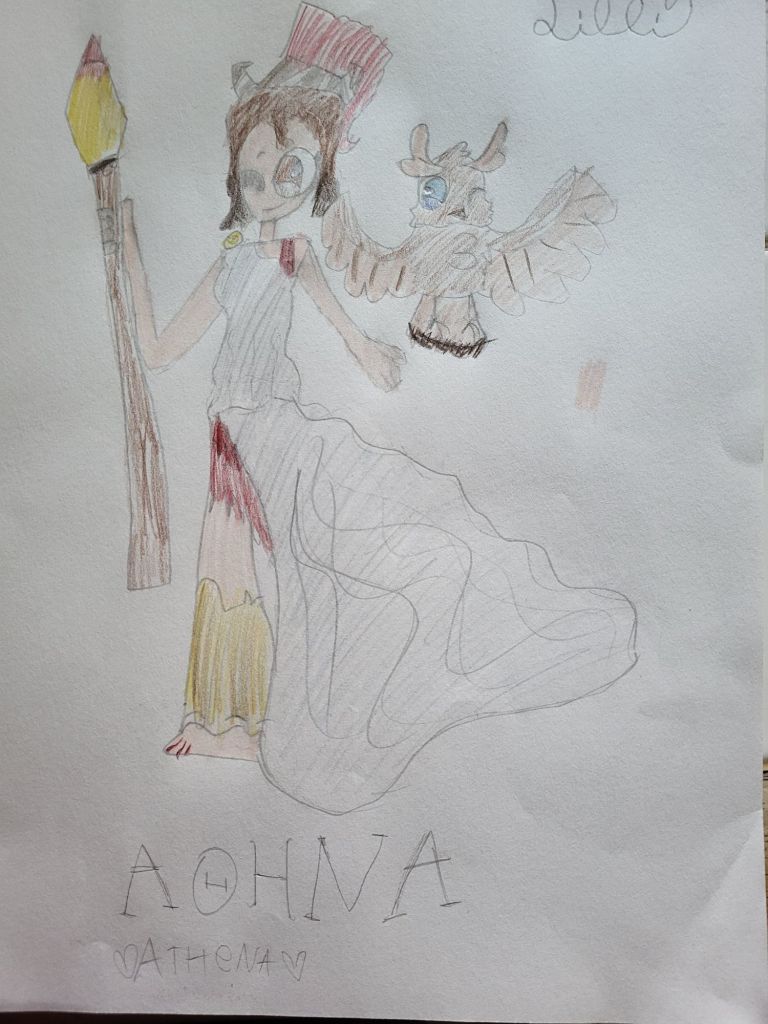
Collaboration with Lilli (9), who helped me create the lesson, game, graphics, and learned alongside me.
I saved many Athena photos, illustrations, and more to this Pinterest board. For inspiration click and see the different Athena goodies with links to more Athena content.
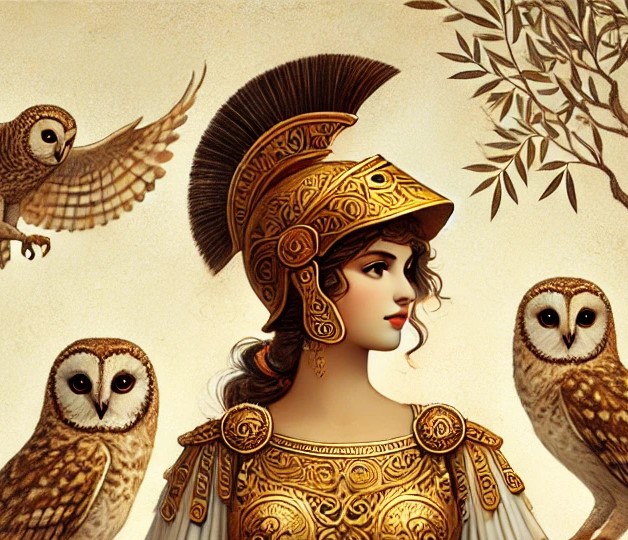
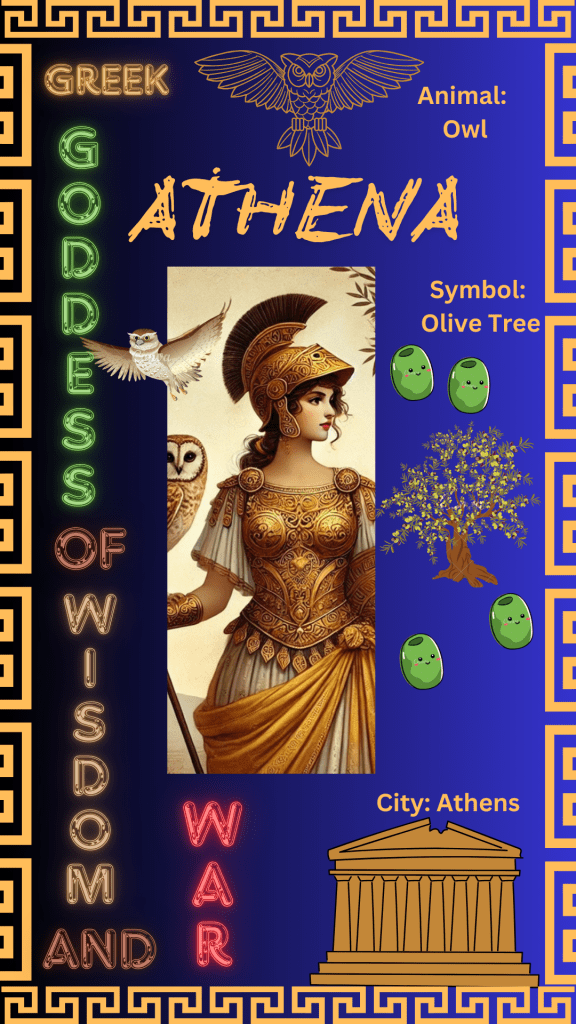
Athena was the Ancient Greek goddess of war and wisdom
Athena Symbols: Olive tree and owls
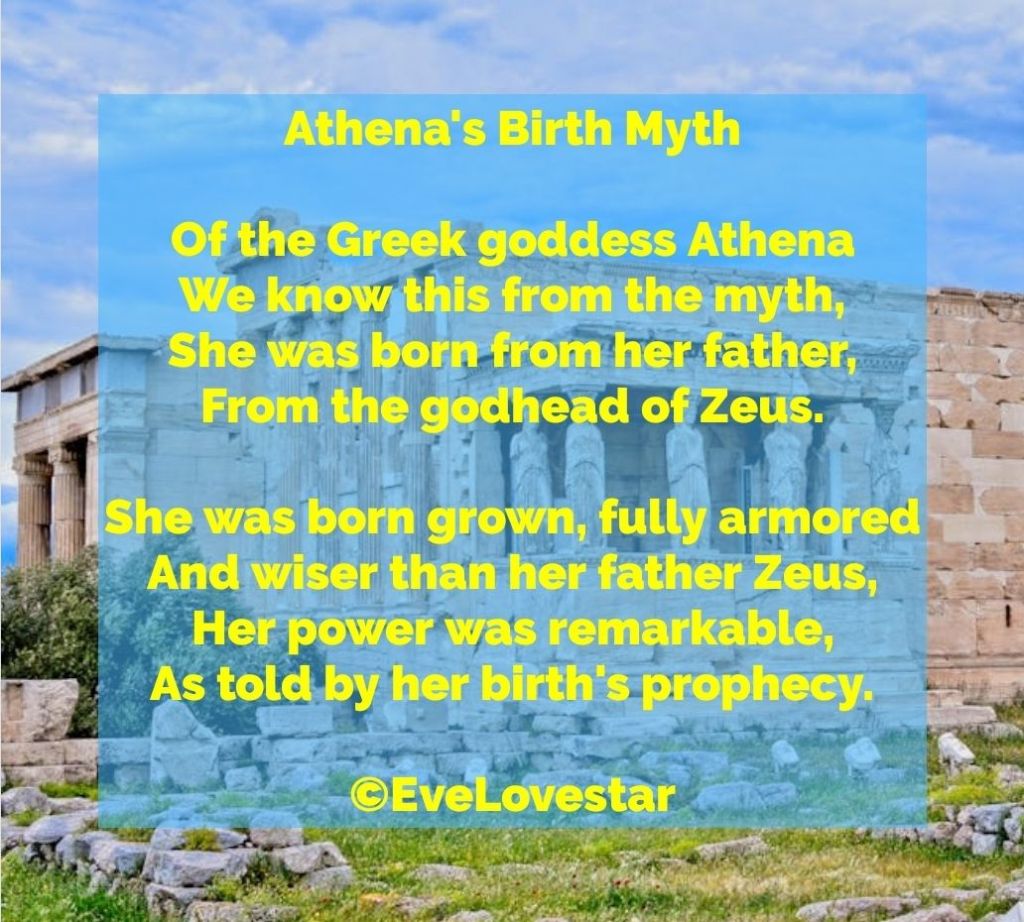
Athena was born fully grown in armor
Lilli’s Athena art with her ancient Greek name in capital letters.
Lesson Plan (7 to 9 year olds) Introduction to Athena in Greek Mythology
Here’s an Introduction Lesson Plan about Athena for children ages 7 to 9. It’s designed to be fun and creative, involving hands-on activities like making a paper doll, storytelling, and a coloring project to keep kids engaged while learning about Greek mythology.
Lesson Plan: Athena, the Greek Goddess of Wisdom and War
Age Group: 7-9 years old Duration: 60-90 minutes Objective: Students will learn about Athena, her role in Greek mythology, and express creativity through art, storytelling, and crafts.
Materials Needed:
Printable Athena paper doll template (with Greek dress, armor, and owl accessories)
Markers, crayons, colored pencils
Scissors, glue
Construction paper for comic book creation
Copies of Athena myth stories (simplified versions)
Athena coloring pages
Whiteboard/Chalkboard (for brainstorming)
Lesson Breakdown:
1. Introduction to Athena (10-15 minutes)
Discussion: Start the lesson by introducing Athena. Use simple language to explain that Athena is the goddess of wisdom, war, and crafts in Greek mythology. Mention that she is famous for her intelligence, bravery, and protection of the city of Athens.
Ask Questions:
What do you think a goddess of wisdom and war would do?
Why do you think people respected her so much?
Fun Fact: Share that her favorite animal is the owl because it symbolizes wisdom.
2. Create a Paper Doll (15-20 minutes)
Activity: Hand out a printable paper doll template of Athena. This template should include:
A basic doll figure (Athena)
Traditional Greek clothing (a flowing dress, armor)
Accessories like an owl, helmet, spear, and shield
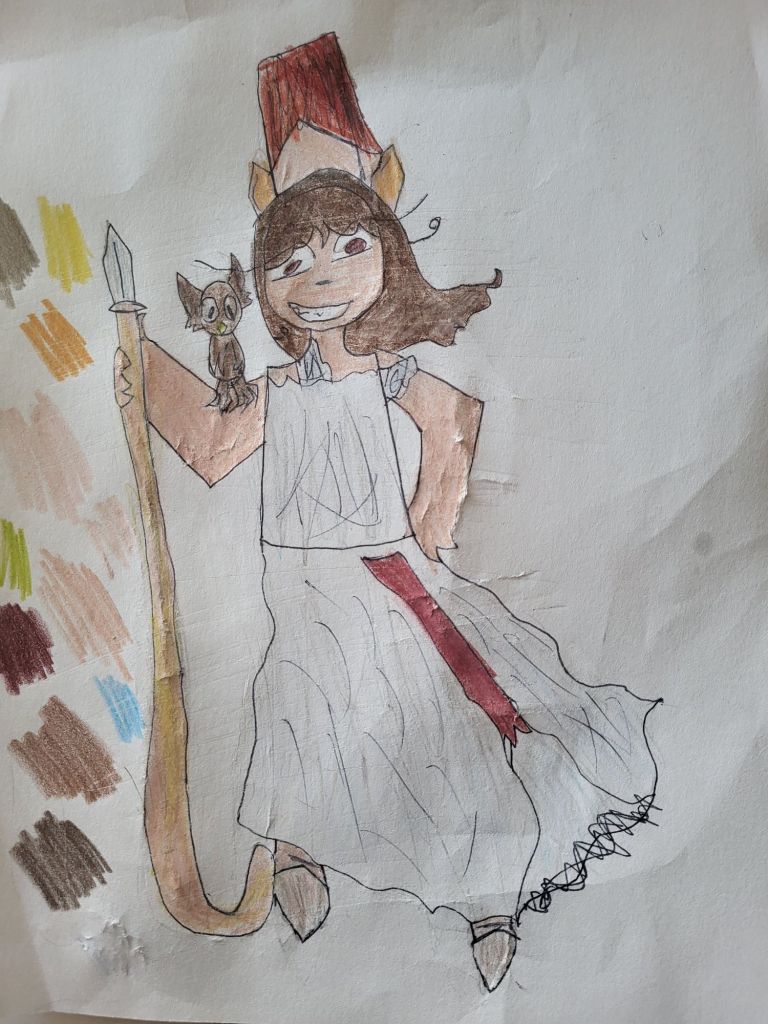
Lizzie’s Athena
Instructions:
Have students color the doll and clothing, then cut out the pieces.
Glue or attach the clothing onto the doll to create their own mini Athena.
Discussion While Working:
Talk about why Athena wore armor even though she was peaceful and loved wisdom.
3. Read a Short Myth about Athena (10-15 minutes)
Storytelling: Read aloud a simplified myth about Athena. You could choose:
Athena’s Birth: How she was born from Zeus’ head.
Athena and the City of Athens: How she gave the olive tree to Athens.
Interactive Discussion:
Ask them: What was your favorite part of the story?
How do you think Athena felt when she helped the city of Athens?
4. Create a Story or Comic Book (15-20 minutes)
Activity: Provide each child with construction paper to create a simple 3-4 panel comic strip or short story. The prompt could be:
“Athena Goes on an Adventure”: Have the children imagine a fun adventure for Athena, like her helping a hero or solving a tricky problem using her wisdom.
Steps:
Draw pictures of Athena and her adventure.
Add speech bubbles or a few sentences to describe what’s happening.
Encourage Creativity: Allow the kids to come up with their own ideas, such as Athena talking to animals or meeting other gods.
5. Coloring Time (10-15 minutes)
Activity: Hand out Athena coloring pages that depict her with owls, a spear, or in her flowing gown.
Optional Discussion: While they color, discuss how Greek gods and goddesses were often drawn or sculpted in ancient times.
6. Class Sharing (10 minutes)
Share Creations: Let each student show their paper doll and comic strip or story to the class.
Encouragement: Praise their creativity and highlight fun details in their stories or drawings.
Wrap-Up:
Review: Ask them to name one thing they learned about Athena today.
Closing: End with a question to spark curiosity for next time: “If you could meet Athena, what would you ask her?”
Follow-Up Activity for Home:
Encourage students to research more about Greek mythology with their parents or continue coloring and creating new stories about Athena.
This lesson plan balances learning with creative play, making it a fun and memorable introduction to Athena and Greek mythology for younger children!
Athena Creation Myth
Creative Athena Activity Ideas
Color Athena coloring pages
Create an Athena paper doll and learn about the Ancient Greek costumes
Create a story with Athena as a character
Write an Athena song or poem
Dress up as Athena
Athena Trivia Game: Simple
Here’s a fun and easy Athena Trivia Game for children, designed to teach them about the Greek goddess in a playful way! Each question includes simple multiple-choice options to keep it engaging and interactive.
Scroll down to review your answers.
Athena Trivia Game
Question 1: Who is Athena the goddess of?
A) The Sea
B) Wisdom and War
C) Music
Question 2: What is Athena’s favorite animal, which represents wisdom?
A) Owl
B) Lion
C) Snake
Question 3: Which city in Greece is named after Athena?
A) Sparta
B) Athens
C) Crete
Question 4: What weapon does Athena usually carry in battles?
A) Bow and Arrow
B) Sword
C) Spear
Question 5: Athena was born fully grown from the head of which god?
A) Zeus
B) Hades
C) Poseidon
Question 6: What is Athena’s special tree, often associated with peace?
A) Apple Tree
B) Oak Tree
C) Olive Tree
Question 7: Which hero did Athena help in his journey to slay Medusa?
A) Perseus
B) Hercules
C) Theseus
Question 8: Athena is known for her wisdom. What does she often wear on her head as a symbol of this?
A) A crown
B) A helmet
C) A laurel wreath
Question 9: Athena never married and stayed focused on her duties. What is she often called because of this?
A) The Brave Warrior
B) The Wise Queen
C) The Virgin Goddess
Question 10: In one myth, Athena competed with Poseidon to become the patron of Athens. What gift did she give to win?
A) A magical horse
B) An olive tree
C) A golden shield
Bonus Activity:
After the quiz, encourage kids to draw their version of Athena or make up a new adventure where Athena helps a hero. This keeps them creatively engaged!
This game is simple, fun, and educational, perfect for children learning about Greek mythology!
Answers
Athena
Answer: B) Wisdom and War
Answer: A) Owl
Answer: B) Athens
Answer: C) Spear
Answer: A) Zeus
Answer: C) Olive Tree
Answer: A) Perseus
Answer: B) A helmet
Answer: C) The Virgin Goddess
Answer: B) An olive tree
Sources
Here’s a list of sources where you can learn about Athena for free, perfect for children or general mythology enthusiasts:
These sources offer a mix of simplified content for children and in-depth articles for older students or adults who want to explore Athena’s mythology further.
Are you a poetry lover or an educator who uses poetry?
I am studying the history of poetry. Thank you for embarking on this journey with me.
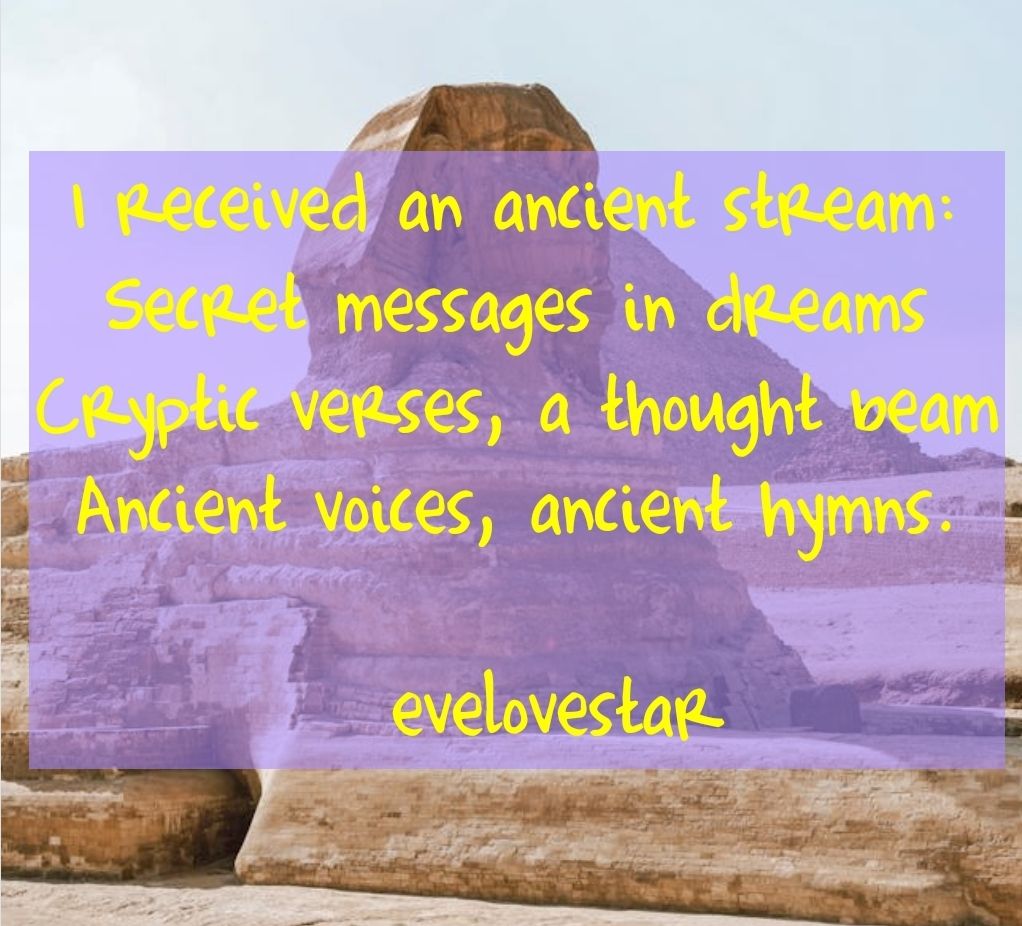
“The Ancient Stream” the beginning of the poetry collaboration on Twitter/ X.
In my home education journey, I am still working to get my children more involved with poetry. My oldest agreed to take a class about poetry. She also studied Shakespeare.
Previously, when we tried online school, I helped my two oldest kids write poems for classes. My oldest kid won second place in a poetry competition. They have created their own poems after watching me write many poems of my own.
Previous to attempting to teach my kids the history of poetry, I have to learn more about it myself.
As I researched this topic to create something solid, I learned so much that I didn’t know about the power of poetry, and I’m excited to share.
Eventually, I’ll collect all this information together into an ebook – presentation for my kids to study when they’re ready.
This material is advanced, not for kids. This could be useful to teenagers, young adults, poets, writers, and teachers/ homeschool parents.
Why I study poetry
I see poetry as the king of language.
I study poetry more than for its beauty. I can’t even express why. All I can say is that poetry is in my DNA. I feel certain word combinations deeply. Poetry that resonates with me has the potential to be more than inspirational. It can be life changing.
Studying poetry and its rich history and tradition offers numerous gifts, including:
1. **Cultural Insight**: Poetry provides a window into the values, beliefs, and societal norms of different cultures throughout history.
2. **Language Mastery**: Analyzing poetry enhances language skills, including vocabulary, syntax, and figurative language comprehension.
3. **Emotional Expression**: Poetry explores complex human emotions and experiences in ways that prose often cannot, fostering empathy and emotional intelligence.
4. **Historical Context**: Poems reflect historical events, movements, and perspectives, offering unique insights into the past.
5. **Aesthetic Appreciation**: Studying poetry develops an appreciation for the beauty of language, imagery, rhythm, and sound.
6. **Critical Thinking**: Analyzing poetry sharpens critical thinking skills by requiring interpretation, evaluation of themes, and exploration of multiple meanings.
7. **Creativity and Imagination**: Writing and studying poetry encourage creative expression and imaginative thinking.
8. **Personal Growth**: Engaging with poetry promotes self-reflection, mindfulness, and personal growth through introspection and exploration of universal themes.
9. **Literary Tradition**: Understanding the history of poetry connects us to a rich literary tradition spanning millennia, influencing modern literature and culture.
10. **Cross-Cultural Connections**: Poetry transcends borders and languages, facilitating cross-cultural understanding and appreciation.
11. **Psychological Insight**: Poetic expression often delves into the depths of human psychology, offering insights into the human condition and psyche.
12. **Spiritual and Philosophical Exploration**: Many poems explore existential questions, spiritual beliefs, and philosophical inquiries, inviting contemplation and dialogue.
Studying poetry thus enriches our understanding of language, culture, history, and ourselves, making it a valuable pursuit across educational, personal, and professional realms.
**Introduction:Unraveling the Mysteries of Poetry**
Poetry, as an art form, transcends time and culture, serving as a medium of expression, storytelling, and cultural preservation. Delving into its origins leads us into the realms of ancient oral traditions and mythology.
**Section 1: Origins in Oral Tradition**
Poetry emerges from the dawn of human language, intertwining with oral traditions passed down through generations. Before the advent of written language, early societies relied on oral poetry to convey history, myths, rituals, and moral lessons. These poetic narratives were crafted with rhythmic patterns and mnemonic devices, aiding in their memorization and transmission across cultures.
Scholars believe that the origins of poetry are deeply entwined with the development of language itself, evolving from primitive chants and incantations into structured forms that encapsulated the essence of human experience. While the exact beginnings remain obscured by the mists of prehistory, archaeological evidence and comparative linguistic studies offer glimpses into the ancient roots of poetic expression.
**Section 2: Poetry and Mythology**
In the era of early civilizations, poetry and mythology were intricately woven together. Mythological narratives often found their voice in poetic forms, serving as a means to explain natural phenomena, celebrate heroes, and uphold societal values. Examples abound across ancient cultures, from the epic hymns of Sumerian mythology to the lyrical odes of Greek legends.
These mythopoetic traditions not only preserved cultural identity but also provided a medium for exploring existential questions and the mysteries of the human condition. Through poetry, ancient peoples forged connections with their ancestors, gods, and the cosmos, creating narratives that resonated through time and space.
**Conclusion: Poetry as a Gateway to Human History**
The origins of poetry, rooted in oral tradition and mythology, underscore its fundamental role in shaping human consciousness and cultural evolution. While the precise moment of its inception eludes us, poetry’s enduring legacy as a conduit of expression and cultural memory remains indisputable.
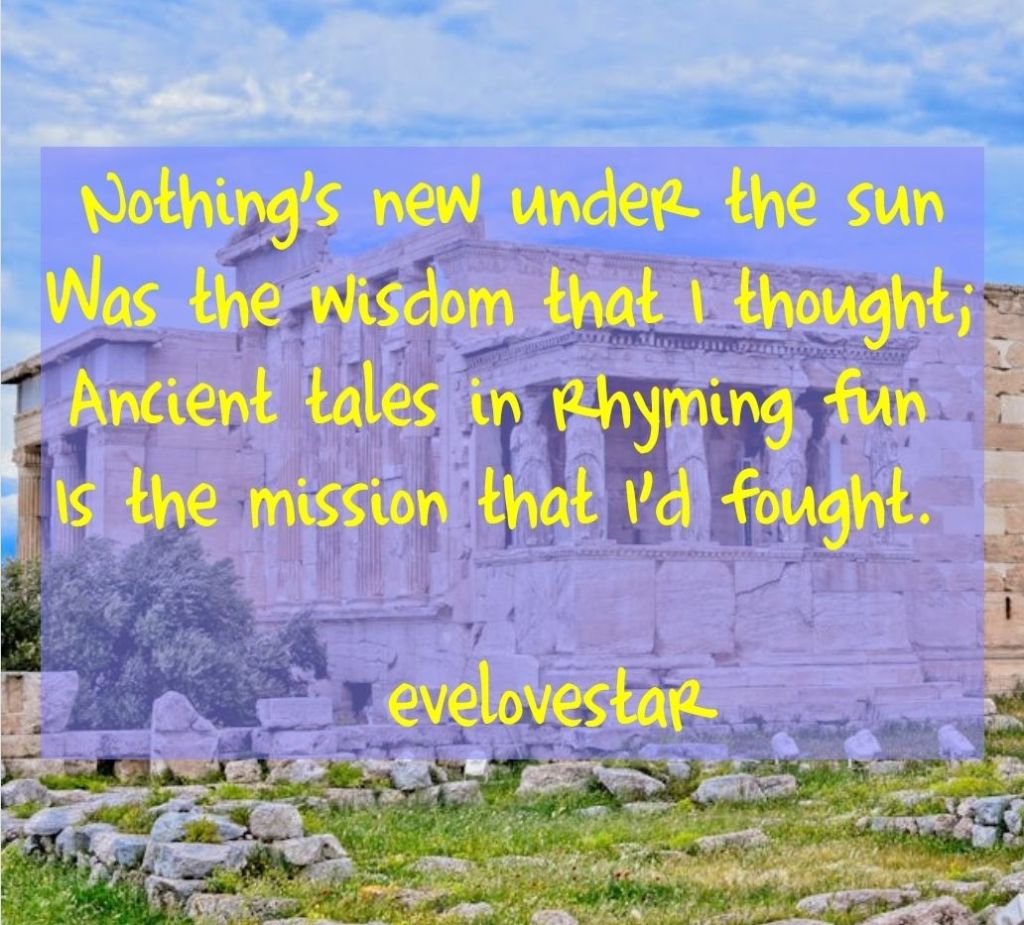
As we embark on a journey through the annals of poetic history, we unravel not only the mysteries of our past but also rediscover the timeless power of language and creativity. Poetry, in its myriad forms and voices, continues to inspire, provoke, and illuminate the human experience, inviting us to explore the depths of our collective heritage.
Excerpt from “The Ancient Stream” an ongoing poetry collaboration on Twitter/ X.
Homer. The Illiad and the Odyssey
Homer, believed to be the author of the epic poems “The Iliad” and “The Odyssey,” composed these works during a time when writing was not yet prevalent in ancient Greece. Instead, these monumental epics were passed down orally, generation after generation, through skilled storytellers. Historians don’t know much about Homer.
This oral tradition not only preserved the narratives of heroic deeds and mythological tales but probably also added layers of improvisation and embellishment with each retelling.
There was potential for alterations and adaptations over time, as oral transmission is inherently susceptible to changes influenced by cultural shifts and the storyteller’s interpretative lens. Despite these challenges, Homer’s epics endure as masterpieces of ancient literature, showcasing the power of oral tradition in preserving and transmitting cultural heritage.
I wonder what these epics were like when they were transmitted orally.
In modern times, we know all about The Illiad and The Odyssey. We have read translations, watched movies, and documentaries about it. What we can appreciate is the language it was written in, the ancient Greek form of poetry, which largely differed from modern poetry. I don’t think it’s possible to recreate that kind of poetry in English.
Sources for our continued study
Here are some sources and references that we can use for further study on the origins of poetry and its connections to mythology:
1. **Books:** – *The Power of Myth* by Joseph Campbell and Bill Moyers – Explores the role of mythology in human culture and storytelling. – *The Poetics* by Aristotle – Classical work on the principles of poetry and drama. – *The Epic of Gilgamesh* – An ancient Mesopotamian epic poem, one of the earliest known literary works. – *The Odyssey* and *The Iliad* by Homer – Classic examples of epic poetry from ancient Greece.
2. **Articles and Academic Papers:** – JSTOR is a database that provides access to various scholarly articles on ancient poetry and mythology.
3. **Websites and Online Resources:** – Ancient History Encyclopedia – Provides articles and resources on ancient civilizations and their literary traditions.
– Theoi Greek Mythology (https://www.theoi.com/) – A comprehensive resource on Greek mythology, including myths often conveyed through poetry. – Internet Sacred Text Archive (https://www.sacred-texts.com/) – Offers a collection of texts from ancient and modern religions, including poetic works and mythological narratives.
These sources provide a solid starting point for readers interested in exploring the origins of poetry and its connections to mythology in greater depth. They cover a range of perspectives from academic studies to literary classics, ensuring a well-rounded approach to understanding this foundational aspect of human culture.

You must be logged in to post a comment.