Exploring Poetry as a Tool for Language Learning

Dear reader,

I am currently reading poetry in Latin for my humble Latin learning practice. Let’s discuss why poetry is a fun and effective way to acquire a new language.

This applies to students who already have some knowledge of the new language. If you are starting to read in your target language, this tip applies to you.

Medium Level Spanish poem: The poet feels deeply where others refuse to feel. The poet is not afraid of love, even though he/ she is conscious that it might one day turn off.

Poetry, with its intricate use of language, offers a unique avenue for learners to delve deeper into a new language. Far from the straightforward prose typically encountered in language textbooks, poetry presents learners with a challenge that extends beyond mere grammar and vocabulary. It demands an understanding of cultural nuances, literary devices, and a keen ear for rhythm and cadence.

Yet poetry, with its whimsical beauty, can be the catalyst for a deeper understanding of a new language. I read the same poem for over a week hundreds of times in Latin, and I then translated it. Yes, it took a week, but that’s nothing compared to never understanding that gorgeous piece of literature.

Complexity of Poetry

At its core, poetry is a linguistic art form that pushes the boundaries of language. Its condensed and often metaphorical nature forces readers to interpret meaning beyond literal words. This complexity serves as both a hurdle and an opportunity for language learners. By grappling with poetic verses, learners are exposed to varied sentence structures, idiomatic expressions, and figurative language that are essential for fluency.

Stepping Out of the Comfort Zone

Engaging with poetry requires readers to step out of their linguistic comfort zones even if the poetry we’re reading is in our first language. Unlike everyday language, poetry uses heightened language, symbolism, and imagery, challenging learners to think critically and creatively. This exposure not only enriches vocabulary but also enhances comprehension skills by encouraging deeper analysis of context and subtext.

Linguistic and Literary Growth

Studying poetry aids language learning by fostering a deeper appreciation for the nuances of grammar and syntax. Poetic forms such as sonnets, haikus, and ballads adhere to specific structures, exposing learners to formal conventions while encouraging experimentation with language. Moreover, the rhythmic patterns inherent in poetry improve pronunciation and cadence, aiding in the development of natural speech patterns in the target language.

And dare I say that the repetition in poetry could assist I memory because like that ancient Roman smart guy said

Repetition is the mother of learning.

Another cool thing about poetry is that you can read a poem 5000 times if you love it.

Cultural Insight and Empathy

Poetry serves as a window into the cultural and historical contexts of a language. By exploring poems from different periods and regions, learners gain insight into societal norms, values, and perspectives. This cultural immersion not only enhances language proficiency but also cultivates empathy and cross-cultural understanding.

Practice Makes Proficient

Practicing poetry reading or, better yet, writing in a new language further solidifies linguistic skills. Crafting poems forces learners to apply grammar rules, expand vocabulary, and experiment with stylistic devices. This active engagement promotes language retention and fluency by reinforcing learned concepts in a creative and memorable manner.

Conclusion

In conclusion, while poetry may initially seem daunting to language learners, its inherent challenges and rewards make it a powerful tool for linguistic and literary growth. By embracing the complexity of poetic expression, learners not only enhance their language proficiency but also deepen their understanding of cultural contexts and human experience. Thus, integrating poetry into language learning curriculum enriches the educational experience, fostering a lifelong appreciation for language and literature.

Are you learning a language?

Are you already reading poetry in your target language?

If you’re learning Spanish, I have a multitude of poems for your reading pleasure and language peactice.

Please let me know if you’re searching for Spanish reading texts.

With love,

Eve

Tips for learning a second language

Dear reader,

I speak two languages, and I’m learning 3 new languages right now. My study of these three new languages will be for life.

I’m going to offer tips that helped me learn English, which is my second language, and I will be using these tips to learn my three new languages (Latin, Ancient Greek, and Italian).

Tips for learning a second language

Here’s a list of effective tips for learning a second language:

1. **Immerse Yourself**: Surround yourself with the language as much as possible through media, conversations, and cultural activities.

2. **Practice Regularly**: Consistency is key. Practice speaking, listening, reading, and writing every day.

3. **Start with the Basics**: Master the fundamentals of grammar, vocabulary, and pronunciation early on.

4. **Set Realistic Goals**: Break down your learning into achievable milestones to stay motivated.

5. **Use Language Learning Apps**: Apps like Duolingo can provide structured lessons and practice.

6. **Find a Language Partner**: Practice speaking with native speakers or fellow learners to improve fluency and confidence. Or follow native speakers on YouTube, Twitter, etc.

7. **Listen and Repeat**: Mimic native speakers to improve your accent and intonation.

8. **Learn from Context**: Understand phrases and expressions within their cultural and situational context.

9. **Keep a Vocabulary Notebook**: Write down new words and review them regularly.

10. **Watch Movies and TV Shows, listen to music**: Listen to dialogue and immerse yourself in the language.

11. **Read Books and Articles**: Start with simpler texts and gradually move to more complex ones.

12. **Join Language Classes or Groups**: Formal classes or online communities can provide structure and support.

13. **Travel to a Country Where the Language Is Spoken**: Immerse yourself in the culture and practice speaking with locals.

14. **Don’t Be Afraid to Make Mistakes**: Learning from errors is an essential part of the language acquisition process.

15. **Stay Motivated**: Remind yourself why you want to learn the language and celebrate your progress along the way.

By incorporating these tips into your language learning routine, you can enhance your skills and proficiency more effectively.

Which ones have you used?

Which ones are most helpful?


Which languages do you speak or are learning?

Eve

Homeschool Plan: Learning Latin to inspire my children to learn Spanish/ languages

Dear reader,

First of all, this is absolutely not 100 percent of my homeschooling log. Additionally, my babies have awesome tutors, and I supplement their learning.

Spanish is my first language. But I speak mostly English now. Dad speaks only English.

Our children were not interested in learning Spanish, so I didn’t force them.

Now, they’re more open since spending time with my mom and making friends who only speak Spanish that they could not understand.

My plan to practice amazing calligraphy to inspire my babies to do better (more legible and beautiful) handwriting worked, and I have pictures of their new improved handwriting to prove it. The progress happened within a week of my practice.

I decided to use the same exact tactic to inspire my kids to learn a language. Hopefully, they’ll learn Spanish, but I’m flexible and will let them choose their own language to learn.

I started learning Latin one month ago to show my studying and learning to my kids. My second daughter already practiced with me, though she thought it was boring.

I have had an interest in learning a third language for a long, long, long while, and my favorite sounding new language is Portuguese. Portuguese shares the root of Spanish, and that makes it easier for me to understand. I’m constantly trying to read Portuguese texts. (Note to self: follow Portuguese poets on Twitter)

I actually want to learn Hindi, though, because I love India, and this is a bit crazy but I want to retire in India, and I feel I have a deep connection to India and its culture. Hindi is extremely hard to learn: it has an entirely different script, so our Latin/ Greek influence will not help me there.

I did a tiny bit of Hindi and Sanskrit study just for the awareness. If I retire in India, I’ll need to know some Hindi, I’ll consider the study in the future, and I think it would be a lifelong study of that language. Their script is lovely, and my interest, of course, is to read their divine ancient texts before translation: it would be an insane amount of learning as I learned the original Sanskrit has an even older script! Learning two totally new scripts would be such a burden.

Either way. I downloaded the Duolingo app and went searching to start learning Hindi, but it wasn’t on the app, and I didn’t want to learn any of the languages available (because I’m interested in ancient texts)

But Latin was an option! I never had an interest in learning Latin. I know Spanish was developed from Latin and assumed it might be easier because of my fluent Spanish. However, I don’t like the Romans. And I don’t really care to read the Roman texts.

Latin was used to translate hieroglyphs, which I adore, and I understand there are uses. It might be the most used ancient language (that’s a total assumption). Anyway, I chose it because I’m doing this just for fun.

As soon as I chose Latin, I was happy it wasn’t Hindi! I might have abandoned Hindi studies by today because I like easy and fast progress and finding what I’m naturally good at.

I’m naturally good at learning Latin and by today, I know some vocabulary, history of the language, simple sentences, some grammar, I understand the Latin root of some English words, and got a bit comfortable in the learning process. I’m progressing fast, and I loved it. I’m really excited about it. I started learning yesterday!

My second daughter practiced a bit with me when she saw me! It was a huge success! I showed her and her older sister the Duolingo app and suggested they download it as it’s fun and perfect for children! My oldest daughter asked what vocabulary I’d learned, too.

I intend to watch Spanish videos with them and practice Spanish on Duolingo to impress them and pull them towards language learning.

Language learning is super fun, and I’m already looking for Latin poetry!

Linguistic study in Latin, English, Spanish, Portuguese, and Italian. Not about to study French any time soon.
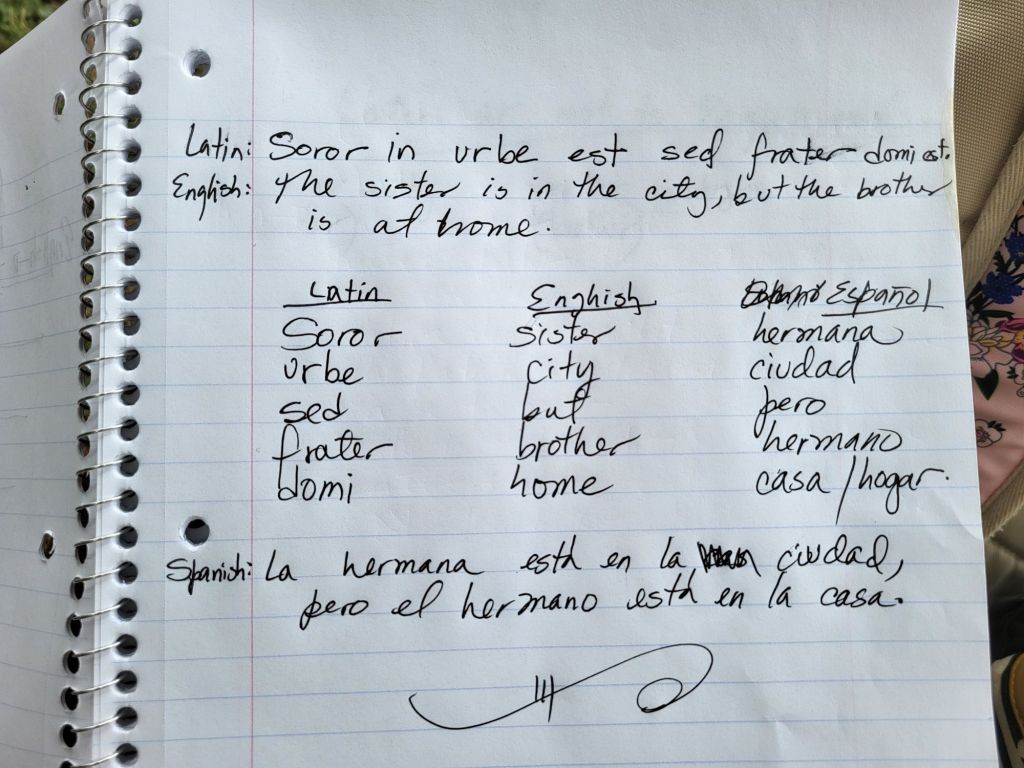
Latin to English/ Spanish sentence translation and vocabulary
Simple Latin sentences translated to Spanish and English
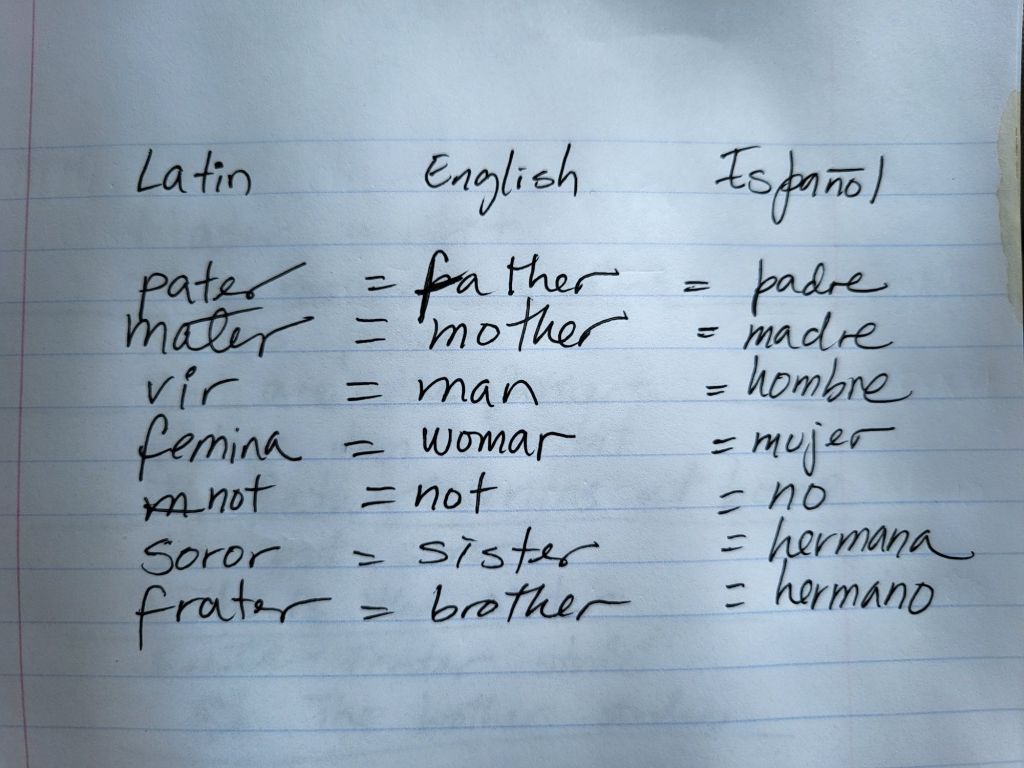
Latin – English – Spanish vocabulary

Eve