Duolingo Language Learning: I use it for easy home education

Dear reader,

(Spanish learning/ teaching? Scrool to the end for my fun lesson)

It is true that I love language study and learning and I love Duolingo, even though I am not happy they do not have a level two once you finish you language course. I finished my Latin course and got bored, picked up 2 more languages…

This is my Duolingo report this week:
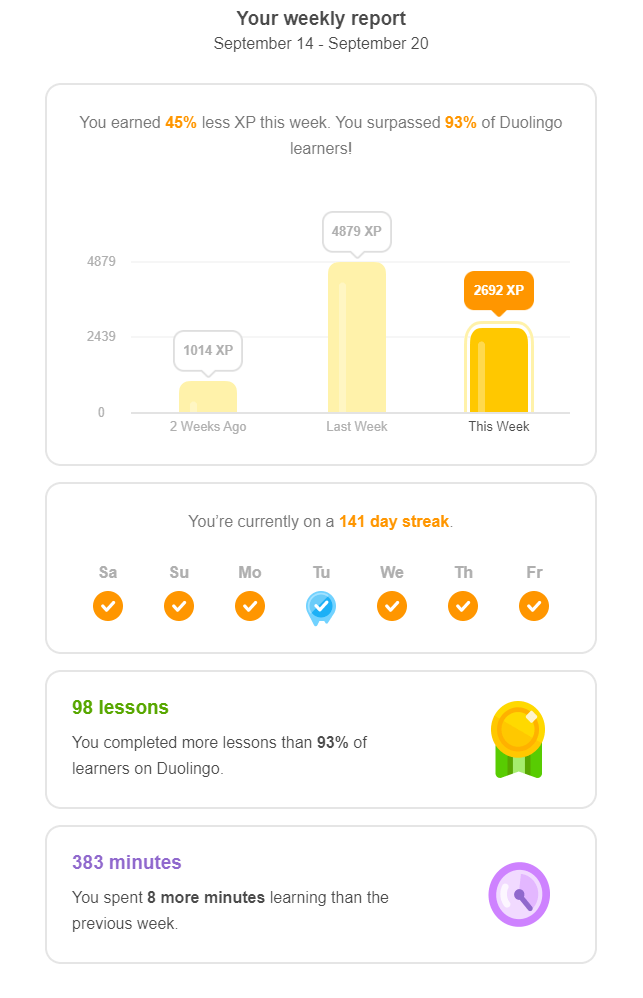
I guess I have a need to prove I am a real person. Why?

With the modern trend of everything we find being AI, I do have a need to prove that I am a real person who really studies language and teaches her children.

Just today we did Halloween arts and crafts…

Anyway, let us connect on Duolingo if you use it, find me as Eve Sanchez.

Why Duolingo
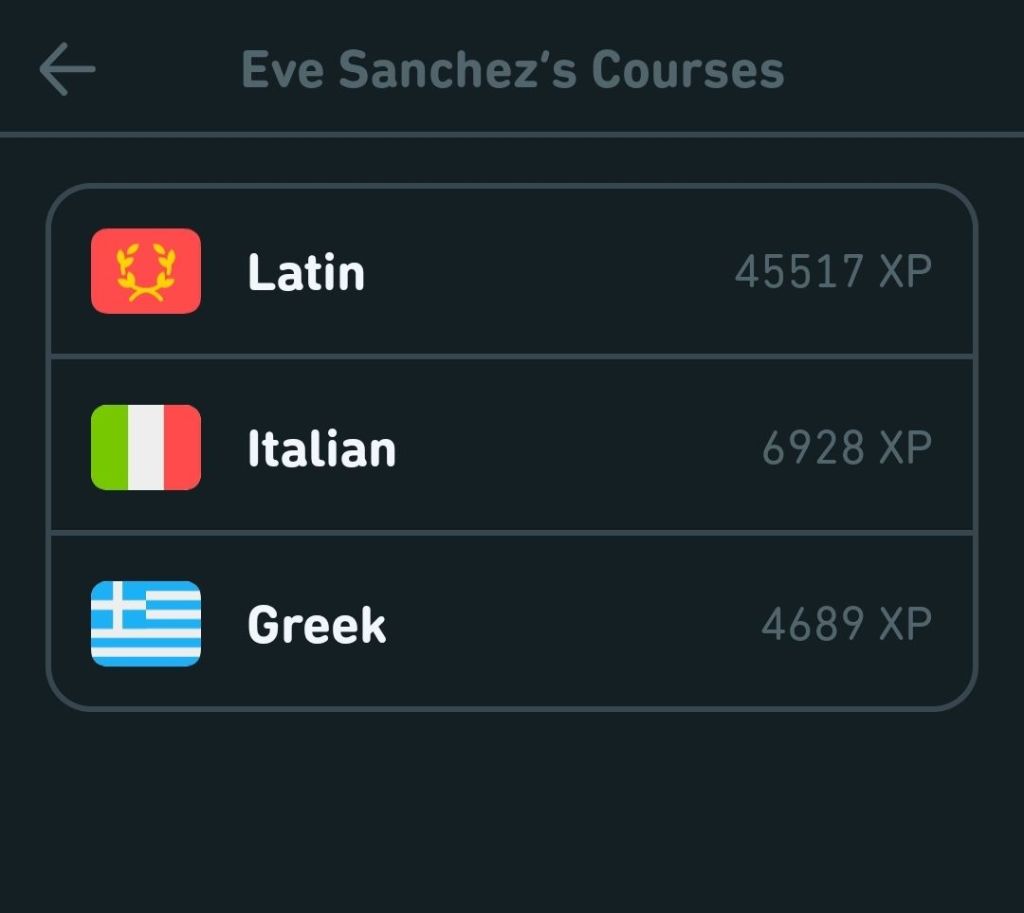
screenshot_20240920_193751_duolingo1642364965774451837
I am currently trying to have more XP on Greek, also struggling with my Greek.

I do not need to learn a language, but I attempted to get my kids interested in Spanish, my first language, and they do not want to be told what to learn, they have their own opinions and ideas, which is really cute…

I joined Duolingo to inspire my kids to learn languages because they imitate anything I do: no pressure.

It worked because they started learning languages too. They are not organized and quit their own Duolingo, yet, Lilli does my Latin lessons at times, Vivi is learning the Greek alphabet with me, they have a Dinolingo Spanish course, Lilli took a Latin class, Lilli and I have Latin jokes, Alex does the Greek lessons with me and repeats the Greek words, Lilli and Vivi took Spanish classes: it worked, but my inspiration effort is ongoing.

Part of my effort is to have them observe my own learning, as well as to experience my learning methods which are varied and colorful, on top of that to expose them to different languages: music in Spanish and Italian; Italian, Latin, Greek words, phrases, and entire videos or podcasts being broadcasted in our house; and more.

And you,

Are you learning or teaching a language? Which? Do you have tips?

Do you listen to music in your target language?

Learning Spanish?

Check out my cool Spanish with poetry clas:
Purchase the class through this link which includes a children’s printable workbook, a test, and more:

https://payhip.com/b/NLMdU

But first, take the free lesson on this blog:

With love,

Eve
Spanish lesson 1. Rima y Ritmo: Poetry with a native poet (1)

Dear reader,

Edit: My children loved the class and printable worksheet and requested more classes like this. Follow for the next classes coming up in the same fun but in-depth manner.

I have been pitching the idea everywhere that poetry is an excellent tool for language learning as reading materials. And now I will prove by creating the most creative Spanish lesson ever.

The full lesson, including a printable worksheet and test for children is available if you need additional help with this material:

Here’s why poetry is amazing for language learning:

Culture

Deep learning through complexity of poetry

Fun content that is memorable

Rhyming and rhythm helps with memorization

Spanish: 1st level. Lesson 1

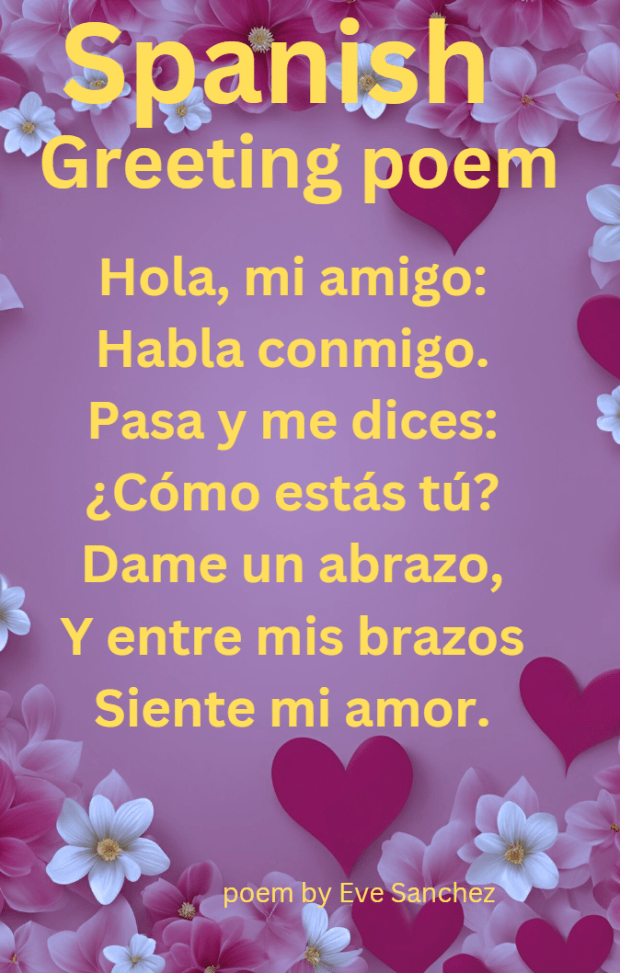
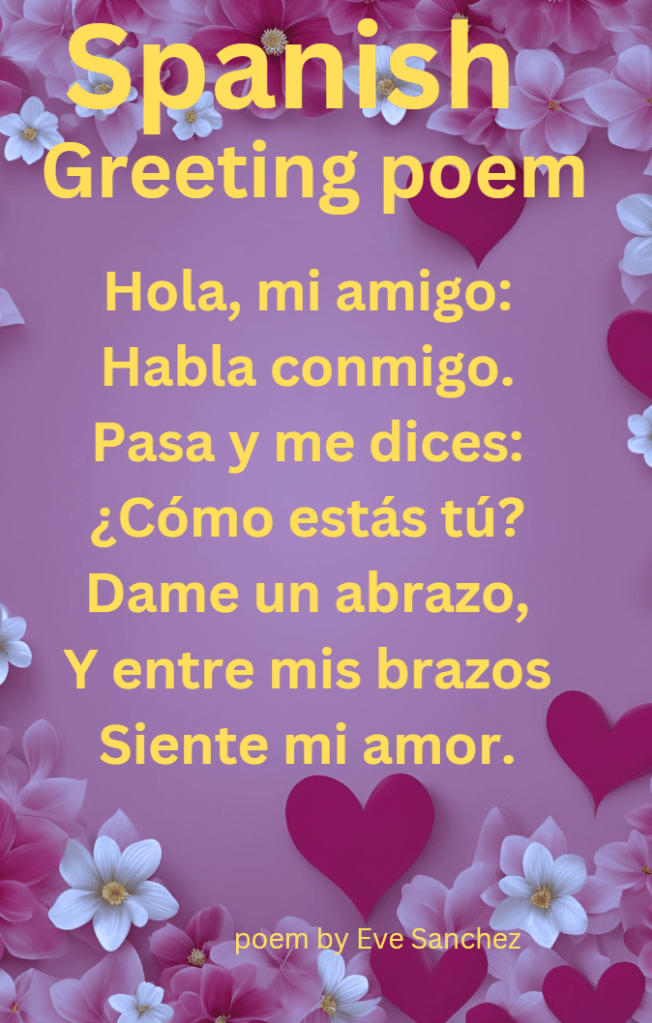
Hola mi amigo (Hello my friend) poem by Eve. Read further, and I’ll explain every word and phrase.

This poem is appropriate for a level 1 learning. It uses simple language and common phrases, making it accessible for beginners. This is a little more intense than the usual level 1 dialog, but it is also much more memorable, and I bet you can engage with this content more than with the usual language class dialog.

The main points for teaching are:

  • Basic Vocabulary: The words and expressions are straightforward and familiar, suitable for early learners.
  • Simple Sentence Structure: The poem’s structure is uncomplicated, which helps learners grasp basic sentence formation and concepts.
  • Easy to memorize: I do not attempt to memorize vocabulary anymore. That is the “boring” learning style that many of us reject. I like to engage with the reading content. However, poetry is naturally easier to memorize than prose or conversations. You will find yourself remembering without trying, especially if you do it with fun in mind and without judging your learning speed.

Lesson Plan. Feel free to use this for personal use/ homeschooling

(For more learning, I’m collecting all this into an ebook, return, and you will see additional lesson posts totally free)

If you’re a teacher and wish to use this material, let me know.

Welcome to my unique language lesson, where we explore the beauty of poetry as a tool for learning. Poetry is more than just a form of artistic expression; it’s a gateway to deep emotional understanding and linguistic mastery. By delving into poetry, you’ll not only enhance your language skills but also gain insight into the cultural and emotional nuances of Spanish.

Why poetry? It offers a fun and engaging way to learn, transforming the study of vocabulary and grammar into a creative and immersive experience. Poetry often includes complex structures and rich imagery, which challenges learners to think critically and understand the language on a deeper level. Many native speakers might not fully grasp the subtleties of poetry, but by engaging with it, you’ll achieve a profound and sophisticated understanding of the language.

In this class, we’ll use carefully selected poems to guide our learning journey. You’ll explore themes, emotions, and linguistic intricacies that will elevate your understanding of the language. Let’s embark on this poetic adventure together and discover the power of language through the art of verse.

Poem translation

Hello my friend,
Talk to me,
Come in, and tell me,
How are you?
Give me a hug
And between my arms
Feel my love.

Continue reading “Spanish lesson 1. Rima y Ritmo: Poetry with a native poet (1)”